


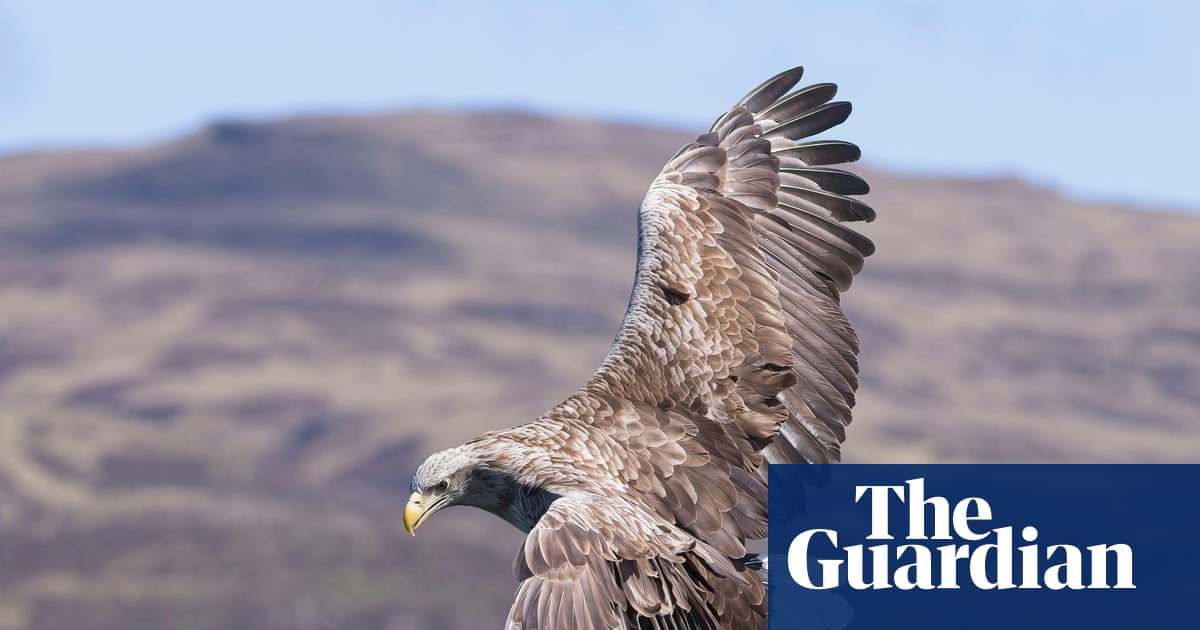
White-tailed eagles reintroduced into England and Wales imperil endangered seabird populations and risk wiping out some colonies, ecologists and conservationists are warning. Puffins, guillemots, razorbills, fulmars and kittiwakes are among the birds for which breeding populations could collapse if large numbers of white-tailed eagles are released, according to some academics and conservationists.
Amidst all the excitement and enthusiasm for reintroducing white-tailed eagles, the fact that these birds will probably destroy our seabird colonies seems to have been completely overlooked, said Tim Birkhead, an emeritus professor of ecology and evolution at the University of Sheffield. The return of white-tailed eagles to Britain after they were driven to extinction in 1918 has been a great conservation success story in recent decades. But proposals to release up to 60 eagles in Gwent, south Wales, on top of 20 young birds already being released over the next three years on Exmoor, is dividing nature lovers.
The Gwent Wildlife Trust is supporting the proposed Gwent reintroduction while the Wildlife Trust of South & West Wales is opposed. Last month an eagle from the Exmoor release was sighted over the south Wales island of Skomer, a renowned seabird sanctuary where David Attenborough was filmed encountering puffins and shearwaters for his Wild Isles series. British seabirds have suffered the worst declines of any group of birds over the last five years, with populations falling by a fifth, but the seabird populations in south Wales are relatively healthy.
Sarah Kessell, the chief executive of the Welsh wildlife trust, expressed alarm over the growing evidence of white-tailed eagle impacts on cliff-nesting seabirds. She emphasized that islands like Skomer and Skokholm are sanctuaries for globally important populations that are already under threat, noting that the added pressure of disturbance and displacement from the raptors could severely affect breeding success.
White-tailed eagle chicks brought over from Norway to reintroduce them into Scotland in 1975 have led to a wild population now of 200 breeding pairs, alongside 45 birds successfully reintroduced to the Isle of Wight since 2019. Although there has been repeated illegal killing of the huge avian predator, the first English-born wild bird fledged from a nest in East Sussex in 2023. Wales has not yet restored the species to its skies.
Prof Geoff Hilton, the head of wetland evidence at the Wildfowl and Wetlands Trust, which is leading the Gwent reintroduction, argued that conservation action always carries an element of risk that must be carefully evaluated and balanced against potential opportunities. Hilton emphasized that white-tailed eagles are generalist feeders with a varied diet including carrion, fish and small mammals, noting that research published in 2020 found birds of particular conservation concern accounted for approximately 1% of identified prey in long-term Baltic studies.
With careful phasing, the project aims to establish seven to nine breeding pairs over the next 10 years, according to Hilton, who added that the initiative is not expected to significantly reduce any single species population but rather foster healthier, more balanced ecosystems. However, in evidence submitted against the Gwent proposals, Stephen Votier, a professor of seabird conservation and ecology at Heriot-Watt University, warned that white-tailed eagles can indirectly affect the social aspects of breeding by inducing fear that causes adult seabirds to temporarily desert nesting sites.
Researchers note that such disruption exposes vulnerable chicks to predation by other birds including gulls and corvids. Birkhead pointed to scientific evidence from Scandinavia showing that predators can hasten the extinction of seabird colonies, citing a 2023 study which found that an increasing abundance of white-tailed eagles accelerated the loss of a kittiwake colony in northern Norway.
While authors of the Norwegian study acknowledged that they cannot automatically assume the exact situation will repeat in south Wales, they stated it is impossible to rule out a similar outcome over time. As debate continues, authors and researchers are urging caution to ensure that ambitious reintroduction efforts do not come at the permanent expense of Britain's most vulnerable coastal wildlife.