


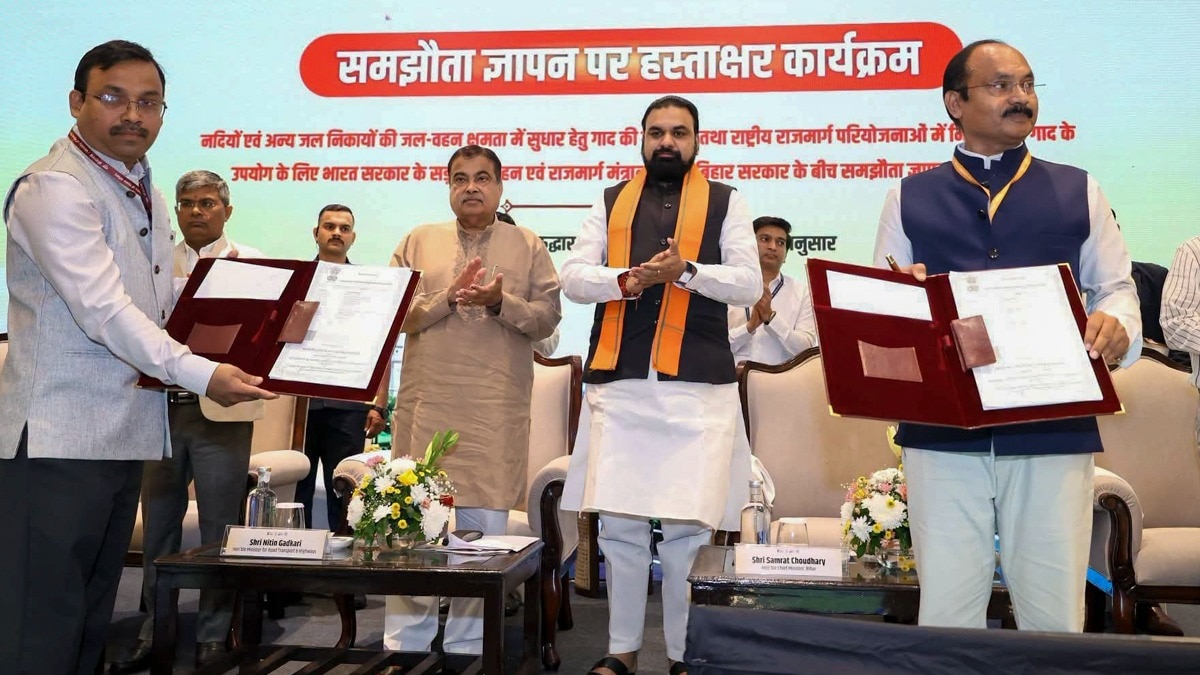
The Bihar government has launched the Bihar Water Resources Restoration and Silt Management Policy 2026 to address the long-standing problem of silt accumulation in rivers and reduce flood risks across the state, a statement said.As part of the initiative, silt will be scientifically removed from rivers, barrages and reservoirs and utilised for infrastructure development, including National Highway construction.The National Highways Authority of India (NHAI) and the Bihar government have signed a memorandum of understanding (MoU) to facilitate the desilting of water bodies and use suitable extracted material in highway projects.The agreement was signed in New Delhi in the presence of Bihar Chief Minister Samrat Choudhary and Union Road Transport and Highways Minister Nitin Gadkari. The initiative aims to address two key requirements simultaneously: restoring the water-carrying and water-retention capacity of water bodies affected by silt accumulation and ensuring the availability of suitable earth and fill material for highway construction.According to an NHAI statement, the authority has identified a requirement for approximately 243 lakh cubic metres of silt for its ongoing and proposed National Highway projects in Bihar.
The state currently has 39 ongoing highway projects covering around 1,561 km, with an estimated cost of Rs 58,340 crore.Additionally, 11 proposed projects covering approximately 1,982 km are expected to involve an investment of Rs 1,85,200 crore.Under the agreement, desilting operations will be undertaken following detailed technical assessments of identified water bodies.The extracted material, subject to quality testing and suitability, will be utilised in National Highway projects in accordance with the applicable Ministry of Road Transport and Highways (MoRTH) specifications and Indian Roads Congress (IRC) codes.The MoU also establishes an institutional framework for coordination between NHAI and the Bihar government.The state's Road Construction Department (RCD) will serve as the nodal agency, while a state-level coordination committee will oversee project proposals, approvals, implementation progress and compliance.The agreement includes safeguards to prevent desilting activities from disturbing ecological balance or damaging riverbanks, embankments, bridges and other structures.Extraction will be allowed only at approved locations and within technically prescribed limits.Regular monitoring, joint measurements, digital record-keeping and periodic reconciliation of extracted, transported and utilised quantities will also be undertaken to ensure transparency.A key objective of the policy is to treat river silt as a usable resource rather than construction waste.Its utilisation in highway and embankment projects is expected to reduce dependence on agricultural soil for infrastructure development, while also helping conserve cultivable land.The initiative could additionally reduce the cost of construction material procurement and support faster execution of infrastructure projects.Flooding has remained a recurring challenge for Bihar, particularly in the northern districts, where seasonal floods frequently damage homes, agricultural land and public infrastructure.Silt accumulation is among the factors affecting the capacity of rivers and other water bodies to carry and retain water.The government expects scientific desilting to improve water flow and strengthen flood management efforts.Meanwhile, Bihar's National Highway network has expanded from 4,615 km in 2014 to approximately 6,500 km at present.Since 2014, work has also been undertaken on around 29 new bridges over major rivers in the state.The implementation of the new policy and the NHAI agreement will now be crucial in determining the initiative's impact.Regular desilting, effective monitoring and environmentally responsible utilisation of extracted material will be essential to achieving the twin objectives of reducing flood risks and strengthening Bihar's road infrastructure.- EndsWith PTI inputs