


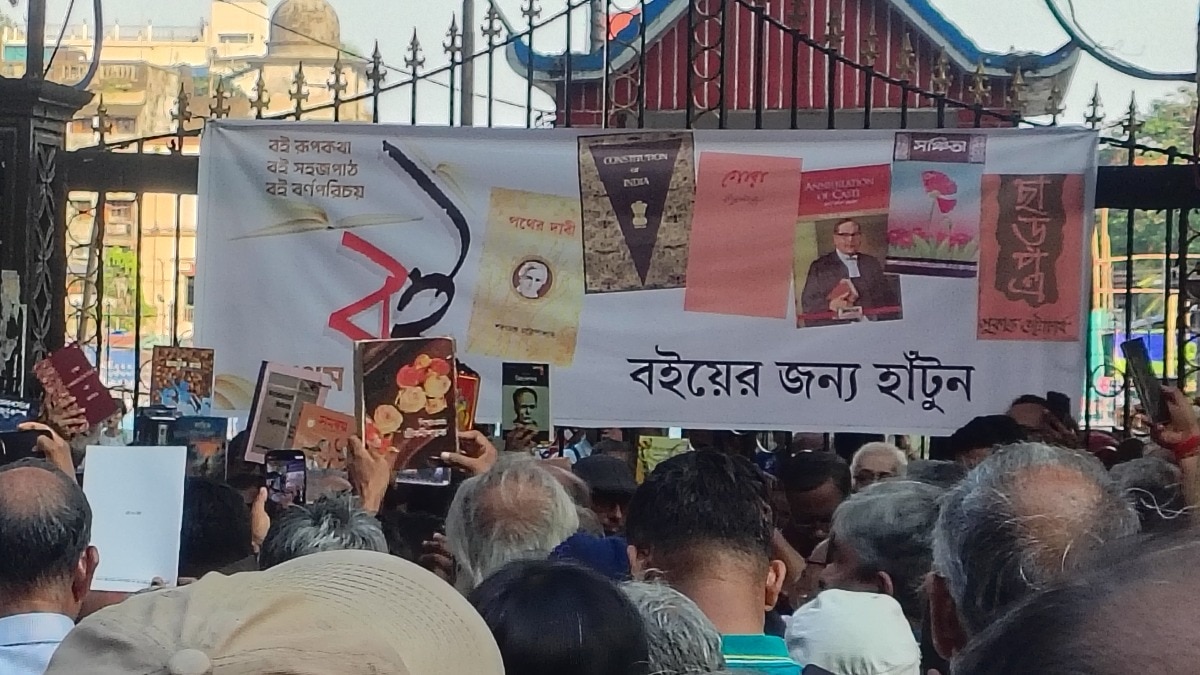
The recent vandalism of political bookstalls during the Durga Puja festival in West Bengal has triggered an extraordinary wave of public solidarity, culminating in protest marches across Kolkata and beyond. The incidents went far beyond typical political friction, striking a sensitive nerve in a state where books, intellectual discourse, and publishing have long formed the bedrock of cultural identity.
During the autumn festival, several bookstalls operated by Left parties across the state were targeted, with books torn and scattered, and stall workers allegedly assaulted. In the Jadavpur neighborhood, a bulldozer was deployed to clear a CPI(M) stall under legal pretexts, while a right-wing student leader in Dum Dum tore up books and reportedly attacked an elderly man. The actions drew condemnation from across the political spectrum, with a ruling Trinamool Congress MLA visiting a Left bookstall to buy books in protest, and prominent BJP figures publicly distancing themselves from the destruction.
The backlash brought together diverse social groups, including younger generations holding up books as symbols of resistance during a rally at Kolkata's College Square. Observers noted that the deep reaction stems from a cultural tradition where books are viewed not merely as bound paper, but as vessels of knowledge. In many Bengali households, accidentally touching a book with one's foot is treated as a severe transgression, reflecting an ingrained muscle memory of reverence toward learning.
Historians and former officials point out that this deep-seated respect for literature dates back to the 19th century, when the Bengali middle class embraced modern education and global philosophy, establishing institutions like the Calcutta Textbook Society in the 1820s. This historical openness allowed generations to engage with diverse international thinkers alongside local spiritual and literary icons. Scholars argue that attacking bookstalls represents an assault on the region's long tradition of polyvocality and liberal intellectual freedom, transcending mere partisan politics to target the cultural soul of Bengal.