


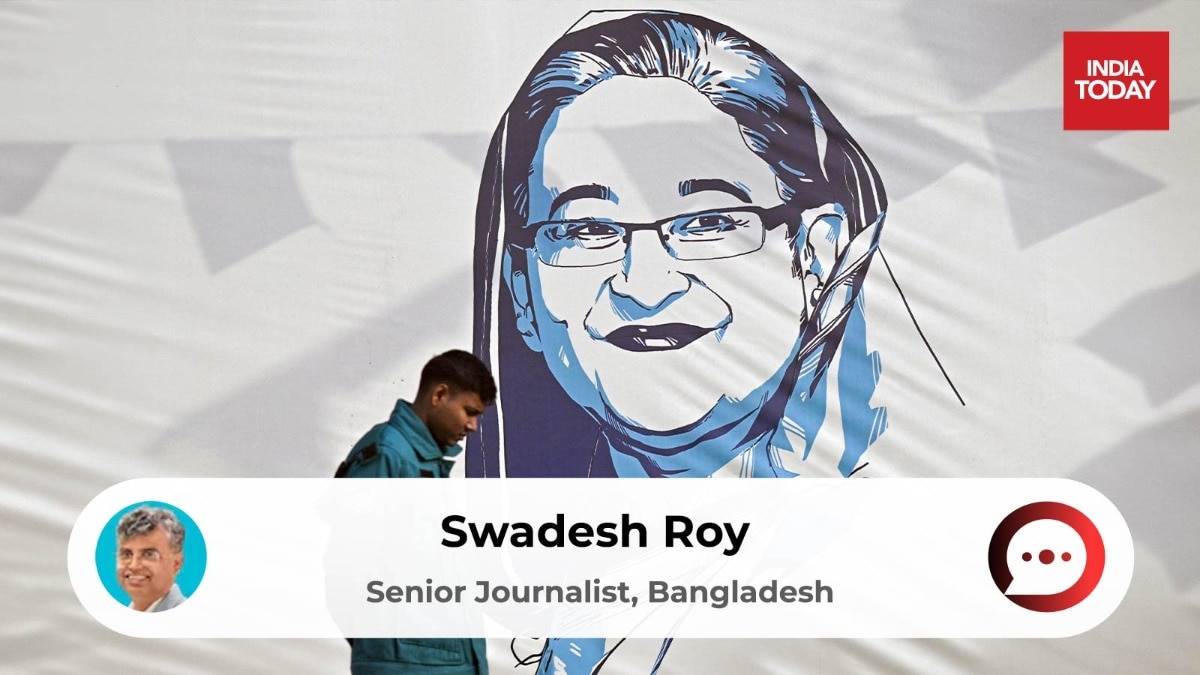
On November 9, the British law firm Matrix, engaged by Sheikh Hasina, submitted an application to the Bangladesh High Commission in Delhi seeking a new passport and national identity card for her. Reuters reported the development that same day, almost immediately after it occurred.The appropriate authority in Bangladesh for issuing a new passport and national identity card is the Ministry of Home Affairs.
At the time of writing, the minister's remarks on behalf of the ministry had been notably measured. Responding to journalists' questions, the minister said that, like them, he had learnt of the matter through the media.
He would respond after examining its legal aspects.Those who follow developments in Bangladesh, even to some extent, know how Sheikh Hasina came to be in India. Nevertheless, India's envoy to Bangladesh, Dinesh Trivedi, recently stated that, amid the circumstances that arose on August 5, 2024, the Bangladesh Army took Prime Minister Sheikh Hasina to India for her safety.The Bangladesh Army took her to India in her capacity as prime minister, and when the Bangladesh Air Force aircraft arrived at a military base there, India's national security adviser, who holds full Cabinet minister rank, received her at the airbase.
Much water, however, has flowed under the bridge in Bangladesh since that incident. After Sheikh Hasina was taken to India for her safety, a government was formed here under the "doctrine of necessity", with Muhammad Yunus as chief adviser.
Eighteen months later, that government held an election. The Bangladesh Nationalist Party (BNP) and its natural political ally, Jamaat-e-Islami, participated in that election, and the BNP formed the government.
Jamaat-e-Islami is now the opposition in Parliament.An important aspect of this election, and a central issue in Bangladesh's politics, is that, before the election, the Yunus government banned the activities of Sheikh Hasina's party, the Bangladesh Awami League, through an executive order. Subsequently, a special court in Bangladesh concluded her trial in her absence, with a state-appointed lawyer representing her, and sentenced her to death.
For a year after she was taken from Bangladesh to India for her safety, Sheikh Hasina did not speak to any registered media outlet. She remained vocal on social media in her exchanges with her party workers.
A year later, she gave her first interview to Reuters, offering some indication of her future course of action. Since then, in successive interviews with various media outlets of international standing, and even local Indian media, she has been saying that she will return to Bangladesh by December 2026 and face all legal proceedings in person, accepting whatever situation arises.The Bangladesh government, too, wants to bring Sheikh Hasina back to the country.
Yet, when she applied for a new passport on November 9, the minister for religious affairs offered a prayer to Almighty Allah in Bangladesh's Parliament. Members of Parliament also joined in that prayer.
He prayed that Allah would be merciful to Bangladesh and to them, and would not allow the "fascist" to return to the country. Since August 5, 2024, a section of Bangladesh's political spectrum, including the government and the opposition, has described Sheikh Hasina as a "fascist".
The religious affairs minister's act belongs to the spiritual realm.In the earthly realm of politics and diplomacy, however, the Bangladesh government wants India to send Sheikh Hasina back to Bangladesh. Sheikh Hasina, for her part, has herself announced that she will return to her country by December.The disagreement here, however, concerns the process of Sheikh Hasina's return.
In interviews with various media outlets, Sheikh Hasina has said that, upon returning to the country, she will accept imprisonment, punishment or whatever else might follow through the legal process. Thus, there is little disagreement even over the possible consequences of her return, as they are being discussed in light of present realities.
The disagreement is that Bangladesh wants the Indian government to send Sheikh Hasina to Bangladesh as a prisoner under the extradition treaty.The Indian government has yet to say anything explicit on this matter. As things stand, however, the Indian government has no legal authority to send Sheikh Hasina to Bangladesh as a prisoner.
This is because she was given refuge in India as an honoured state guest through an all-party decision of India's Lok Sabha and Rajya Sabha. She remains there with that status.
The executive branch of a government in a parliamentary democracy has no authority to arrest a guest of the state.In any event, this dispute and its legal dimensions are matters between the governments of India and Bangladesh. What matters at this moment is that lawyers from the British law firm Matrix, engaged to represent Sheikh Hasina, have applied for a new passport and national identity card for her.
The most significant aspect of this development is that, after all the water that has flowed under the bridge in Bangladesh's politics, the application for a passport and national identity card marks the first formal contact with the government on Sheikh Hasina's behalf after a long interval of nearly 26 months.The activities of Sheikh Hasina's political party are currently banned by executive order. She wishes to return as the leader of that same party, whose activities are now banned.
Whether or not she can restore her party's political activities, she also wishes to confront, on her own country's soil, the sentence against her and the ban imposed on her party's activities. On the face of it, this may be understood as the reason for making this contact with the government through the prescribed channels on her behalf.Among those in Bangladesh's politics today, Sheikh Hasina has served the longest as head of government and as leader of the opposition in Parliament.
Moreover, if her political involvement as a student is taken into account, her political life spans more than 60 years. Any political analyst may therefore also view this contact, made on Sheikh Hasina's behalf with the government of her own country, as a political move.
And any politician confronting a political crisis affecting both their party and themselves will take political steps to address it.On the other hand, considering the measured manner in which the minister responsible for the Ministry of Home Affairs, the appropriate government authority, has spoken, any political analyst examining his language and body language would say that he, too, has approached the matter calmly and politically.The request for a new passport and national identity card in the application submitted by Sheikh Hasina's law firm on her behalf makes two things clear. Sheikh Hasina wants a new passport reflecting her present status rather than her former status, and she wants her national identity card, too, to reflect her current identity.Over the past few hours, following this application by Sheikh Hasina's lawyers, I have spoken with a number of Bangladeshi and foreign diplomats.
In their view, the simplest solution in this case would be to issue a one-way travel document. That is the easiest course for any embassy.
This is because leaving the passport matter to the appropriate authorities after her return to the country would be the easier course for the embassy itself.However, before finishing this piece, I see that Reuters has reported that the Bangladesh authorities have rejected the application made on Sheikh Hasina's behalf. In reporting the rejection, Reuters quotes only State Minister for Foreign Affairs Humayun Kabir.
It carries no statement from the home minister.Since the matter falls within the jurisdiction of the Ministry of Home Affairs, it would not yet be appropriate to comment on the government's full position before the home minister speaks after examining the legal aspects of the application submitted on Sheikh Hasina's behalf.Many political analysts may nevertheless consider that Sheikh Hasina is the country's most senior politician and a long-serving head of government. In practical terms, therefore, by initiating contact through the prescribed channels over the issuance of a passport, she has effectively sent the first political ball into the government's court.
Perhaps she is now waiting to see where, and at what angle, the government chooses to play the ball.- Ends(Views expressed in this piece are those of the author and do not necessarily reflect the views of the publication)