


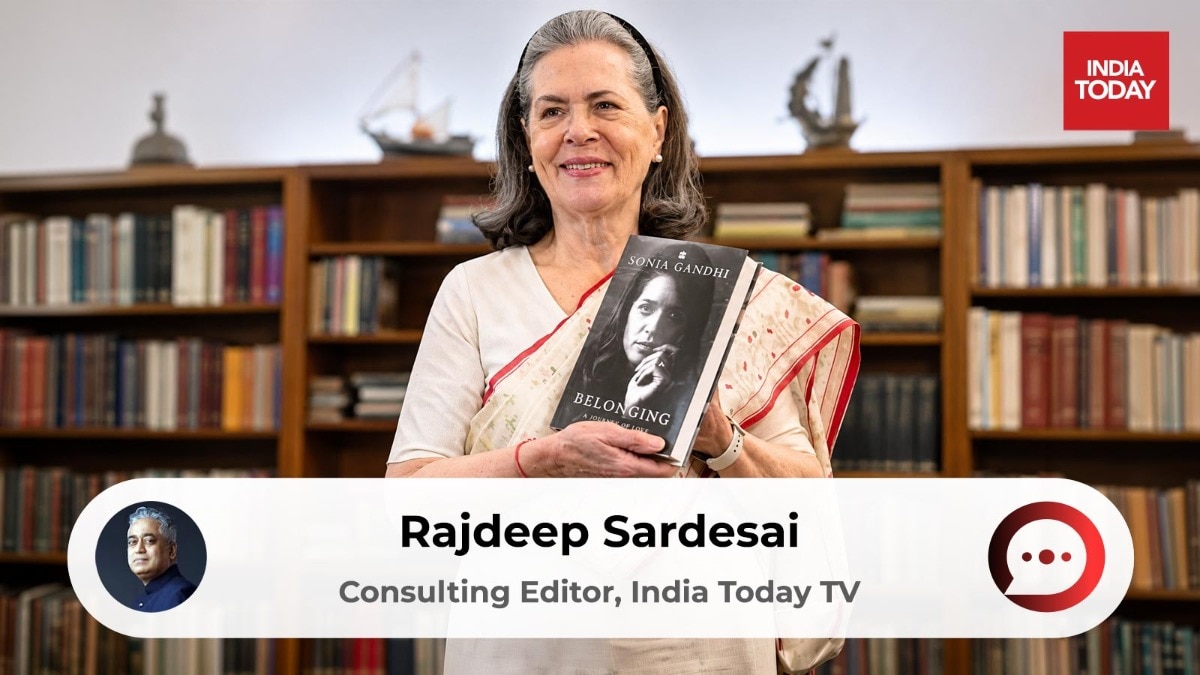
No politician in contemporary Indian politics has been as consistently vilified as Sonia Gandhi. Ever since she stepped out of the shadows and entered public life in 1998, she has been a target of relentless criticism, much of it centred not on her politics but on her origins.
She has been repeatedly reminded that she was born Italian, as if the accident of birth should forever disqualify her from claiming an Indian identity.Which is why her memoir, appropriately titled 'Belonging: A Journey of Love' is a significant moment. Not many Indian politicians are comfortable telling their own life stories, particularly when those stories involve the complicated intersection of family, power and politics.
That Sonia Gandhi has chosen to open up after decades of guarding her privacy suggests a desire to finally lift the veil of silence and tell her side of the story.It is, frankly, an extraordinary story. That a young girl from a small Italian town would eventually become the longest-serving president of the Indian National Congress and, for a decade, arguably the most influential political figure in the country is the sort of unscripted journey that defies imagination.Some of the stories in the book have been heard before.
Her meeting with Rajiv Gandhi at a Greek restaurant in Cambridge has all the ingredients of a Hindi cinema romance: love at first sight, a young Indian student and a nineteen-year-old Italian girl who could hardly have imagined where that encounter would take her. Yet the story deserves retelling.
There is the difficult task of convincing her parents, especially her rather stern father, about her choice, the first meeting with her formidable mother-in-law Indira Gandhi, and the adjustment to life in Delhi as a young bride in a government bungalow, with its peculiar mix of privilege, protocol and prying eyes.There are also deeply personal revelations that are less familiar. I, for one, did not know that Sonia Gandhi lost her first child shortly after birth in 1968-69.
She describes how she fought to ensure that the little body was buried rather than disposed of in a manner that was customary at the time. It is a heartbreaking episode, but also a revealing one: a young woman negotiating grief and unfamiliar customs in a country that was still very new to her.
Indeed, it is this journey from Orbassano to Lutyens' Delhi that makes the memoir fascinating. Learning Indian food and its masalas, wearing saris, dealing with domestic help, absorbing the rituals and rhythms of Indian festivals, gradually making a new country her own.
She admits to moments of self-doubt and loneliness, but what shines through is her deep attachment to Rajiv and his family, and, through them, to India itself.Perhaps the most poignant passages come after the assassinations that transformed her life. Indira Gandhi was killed in 1984; Rajiv Gandhi was assassinated seven years later.
Her sister urged her to return to Italy after Rajiv’s death, warning that she too could be next. It was hardly an unreasonable fear.
She had already witnessed the violence that had taken away her mother-in-law and husband. Sonia reveals that she has never even summoned the courage to look at photographs of Rajiv’s mutilated body.And yet she chose to stay.
Her emotional ties, she suggests, were no longer simply with the country of her birth but with the land that had become home to her and to her children. This is perhaps the central thread running through the memoir: belonging is not necessarily inherited; it can be acquired through love, loss, loyalty and the choices one makes.Her eventual entry into politics was, by her own account, hardly an act of ambition.
She admits to having little affection for politicians, whom she regarded as venal and duplicitous. Her children, too, opposed to her taking the plunge.
Yet she describes her decision as one driven by a sense of duty, even recounting how she read and understood the Bhagavad Gita before entering public life. There is something striking about this explanation, whether or not one accepts it entirely.
Politics, in her telling, was not a destination she had spent her life preparing for, but a responsibility she eventually felt unable to avoid.Of course, critics will read the memoir differently. They will argue that it reinforces the charge that Sonia Gandhi helped institutionalise dynastic politics, ensuring that the Nehru-Gandhi family remained inseparable from the Congress.
Her supporters will counter that she entered public life reluctantly, motivated less by personal ambition than by an abiding sense of obligation to her family and the party. Both interpretations deserve scrutiny.
A memoir, after all, is also an attempt by its author to shape how history remembers her.But there is another dimension to Sonia Gandhi’s story that cannot be ignored. Despite her years at the top of the Congress, she was never entirely accepted by sections of the political establishment.
Her foreign origins became a political weapon, her leadership was mocked, and the attacks frequently extended to her children. A party split over her leadership, and her right to lead was repeatedly questioned.
It could not have been easy: a woman in a deeply patriarchal political world, an outsider by birth, and someone who was often visibly lonely in public life.I have often felt that Sonia Gandhi’s greatest political strength is her understanding of her own limitations. She is a good listener, rarely seeks to dominate every conversation and has understood the importance of allowing others space.
That she helped construct a coalition of disparate political parties which governed India for ten years after 2004 suggests that she could combine political pragmatism with a commitment to certain principles.She has remained resolutely opposed to communal politics – she maintains that the BJP-RSS idea of India is antithetical to the Gandhi-Nehru vision of an inclusive society, and has backed a more compassionate model of rights-based governance.Her decision to decline the prime ministership in 2004 remains one of the most consequential moments of her political career, whatever interpretation one places on it. She says her mind was made up months earlier and was not based on a sudden discovery of her 'inner voice' but clearly there was also a realisation that becoming prime minister would revive the foreign-origin debate in an even more viscerally emotive manner.None of this means that her political record is beyond criticism.
In the book she is very cautious in addressing the chargesheet against her: for those looking for headline-grabbing controversies, the book may appear trapped in political correctness. The Bofors scandal that eventually felled the Rajiv government is glossed over, as are her differences with Narasimha Rao, nor is she willing to tell the reader what went wrong between the Gandhis and the Bachchans.The Congress under her leadership eventually lost power, the party has struggled to renew itself, and the question of dynastic succession has never gone away.
But to reduce Sonia Gandhi to the charge of dynasty, or to define her entirely by her Italian origins or the Congress’s many missteps that stretch back to the 1970s, is to miss the larger story.In the end, Belonging is about a woman’s lifelong search for acceptance: to be recognised not as an Italian-born outsider but as an Indian bahu who made this country her home. There is an irony here.
At a time when questions of identity and nationality have become so politically charged, Sonia Gandhi’s story is a reminder that belonging is not simply about where one is born. It is also about where one chooses to live, whom one loves, what one is prepared to sacrifice and where one feels a sense of home.Why does Sonia Gandhi still matter?
Not merely because she once occupied the commanding heights of Indian politics, or because she remains a member of the Nehru-Gandhi family. She matters because her life raises questions about identity, acceptance and political inheritance that remain relevant to India today.Whether history ultimately judges her kindly is for another day.
But after decades of being spoken about, Sonia Gandhi has finally chosen to speak for herself. And that, in itself, makes Belonging worth reading.P.S.
I am still intrigued by why Penguin decided not to publish the book, which is almost certain to be a bestseller. Having read the memoir, I struggle to see anything in it that should have prompted self-censorship, or fear of those in power.
If anything, it raises a larger question: have we reached a point where even a publisher’s willingness to publish a political memoir of an opposition leader is cause for being fearful of the consequences? And what does that say about free speech in India 2026?- Ends(The writer is senior journalist and author)