


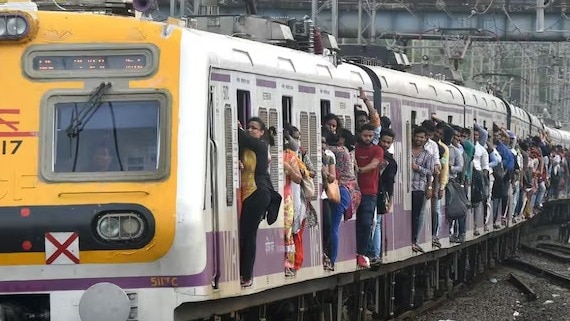
There are many images that come to mind when one thinks of Mumbai — crowded streets, its skyscrapers, the Arabian Sea, and the rush of people trying to get somewhere. But there is another image that is almost synonymous with the city, the commuters hanging precariously from the open doors of local trains, holding on to metal bars and balancing themselves on footboards as the trains hurtle towards their destinations.For millions, this is a routine part of getting to work and back home.
Often romanticised as the "spirit of Mumbai", it is, in reality, a grim reflection of how difficult and dangerous the city's daily commute can be. This picture, however, could now be headed for a change.
Mumbai's first non-AC suburban local train equipped with automatic doors has arrived in the city, according to a report by The Times of India, published on November 7.The 12-coach train, manufactured by the Integral Coach Factory (ICF) in Chennai, will undergo safety and operational trials before being considered for passenger services.The push for safer coaches with automatic doors gathered urgency after the Mumbra train accident on June 9, 2025, when commuters standing at the doorways of two overcrowded trains travelling in opposite directions fell onto the tracks. Five people died, and several others were injured.
Following the tragedy, Maharashtra Chief Minister Devendra Fadnavis announced that Mumbai's local trains would eventually have air-conditioned coaches equipped with automatic doors. Mumbai's AC local trains already operate with automatic doors that remain closed while the train is in motion.Fadnavis said the Centre had agreed to the proposal, which was intended to bring Metro-like safety features to the suburban network without increasing fares.
The arrival of the new non-AC rake marks a step towards making that vision a reality. It must be noted that around 70–80 lakh (7–8 million) commuters travel on Mumbai's suburban local train network every day, according to the Mumbai Railway Police's official website.The scale of the problem that the new train is expected to address is reflected in the number of people who lose their lives on Mumbai's railway network every year.According to Government Railway Police (GRP) data reported by The Indian Express, 2,287 people died on the city's suburban railway network in 2025.
Although this represented a 7% decline from the 2,468 fatalities recorded in 2024, it meant that an average of more than six people continued to die every day.Importantly, these figures cover deaths from different causes and not just passengers falling from moving trains. Of the 2,287 fatalities in 2025, 525 involved commuters falling from moving trains, while 1,063 people died while crossing railway tracks.
In 2024, 570 people lost their lives after falling from trains. The figures underline how unsafe the suburban network remains for people who depend on it daily.WHAT CHANGES WITH THE NEW AUTOMATIC-DOOR TRAIN?The biggest difference in the new rake is that its doors will remain shut while the train is moving and open only when it reaches a station.
This is intended to prevent passengers from standing on footboards or hanging outside coaches during the journey, a practice that has contributed to several fatal accidents on Mumbai's suburban network.However, unlike air-conditioned trains, conventional Mumbai locals depend heavily on open doorways for natural ventilation. Closing them without making changes to the coach design could make compartments uncomfortable, particularly during peak hours when thousands of passengers squeeze into the trains.The ICF-built rake has therefore been designed with ventilation in mind.
Its doors feature louvred sections, allowing air to pass through even when they are shut. Roof-mounted ventilators have also been incorporated to improve circulation inside the coaches.
The idea is to maintain airflow without requiring passengers to travel with the doors open.Another feature is the provision of vestibule connections between coaches. These passages will allow passengers to move from one compartment to another instead of being confined to a single coach.
This could help distribute passenger loads across the train, although its effectiveness will depend on how the arrangement works under actual peak-hour conditions.The train has already undergone trials on the 63-km Khajuraho-Mahoba section. Its arrival in Mumbai does not, however, mean that commuters can begin using it immediately.
Central Railway will first test the rake on different stretches of the suburban network. The findings will then be assessed before the train is submitted for the necessary fitness certification and clearance for passenger operations, according to The Times of India.There are also operational questions that the trials will need to address.
Automatic doors must open and close completely at every station, which could add to the time trains spend at platforms. During peak hours, when hundreds of passengers attempt to board and alight simultaneously, congestion around entrances could make the process slower.This is not the first attempt to bring automatic doors to non-AC Mumbai locals.
In 2019, Western Railway modified selected compartments of a 15-coach train at its Mahalaxmi workshop. The project, which cost around Rs 75 lakh, covered general, first-class, ladies' and differently abled compartments.
However, it did not translate into regular passenger services, with inadequate ventilation emerging as one of the concerns.An earlier automatic-door experiment carried out by Western Railways in 2016–17, as reported by The Indian Express, found that overcrowding frequently triggered obstruction sensors, preventing doors from closing and disrupting train schedules. It also flagged inadequate ventilation, with carbon dioxide levels inside coaches rising to 2,150 ppm during peak hours against a permissible limit of 700 ppm.
The report said a similar Central Railway experiment in 2025 faced overheating door motors and malfunctioning sensors.For a city that prides itself on never stopping, ensuring that its people can reach work safely should be a basic expectation, not an extraordinary achievement. The introduction of automatic doors on Mumbai local trains, a lifeline for millions who call the city and its surrounding areas home, is a step towards realising that basic expectation.- Ends(Written by Anand Singh)