


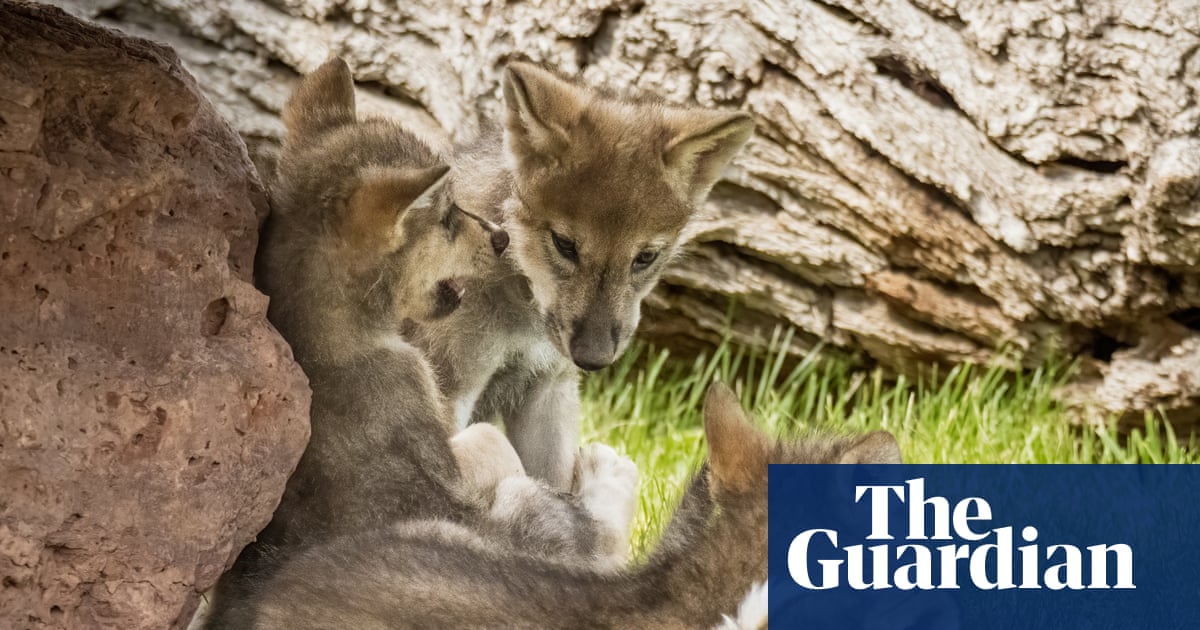
Idaho officials paid hunters thousands of dollars for killing a dozen newborn wolf pups this spring, including what appears to be at least one full litter killed in or near its den, according to state records shared with the Guardian and Public Domain.The wolf pup killings have incensed wildlife advocates in Idaho, where state wildlife officials have been ordered to take extraordinary measures to shrink the state’s re-introduced wolf population amid complaints from the livestock industry and big game hunting outfitters.A law passed five years ago by the Republican-dominated state legislature loosened restrictions on hunting seasons, removed restrictions on killing methods and allowed people to contract third parties to kill wolves. Individual hunters and trappers are able to buy an unlimited number of permits to kill wolves, which cost $14 each for state residents and $32 for non-residents.In 2021, Idaho game officials also entered into an agreement with the Foundation for Wildlife Management, a non-profit devoted to reducing wolves to help boost deer and elk numbers, to reimburse expenses to any hunter and trapper who provides proof of killing a wolf.
The program pays for a wide range of expenses, including truck payments, fuel, ammunition and outdoor clothing.A protest against wolves in Montana and Idaho in September 2011. Photograph: William Campbell/Corbis/Getty ImagesThe reimbursement program paid $2,000 per wolf kill through the hunting season that ended in June, including the 12 pups, records from the state’s fish and game agency show.
The program is funded with a mix of taxpayer money, hunting license sales and contributions from the Foundation for Wildlife Management. .“It’s an abomination,” said Brooks Fahy, director of the advocacy group Predator Defense. “I think most people, even in Idaho, if they actually understood the depth of this, the fact that taxpayer dollars are paying for this – they would be appalled.”“Let’s call this what it is – it’s a goddamned bounty,” Fahy said. “What kind of receipts are you going to show for 12 pups who weigh 12lbs? It’s ridiculous on its face and the state of Idaho should be ashamed.”Neither the foundation nor the Idaho wolf depredation control board, a government entity that oversees payments for third-party wolf killings, responded to requests for comment.Gray wolves were all but wiped off the map in the continental United States by the mid-20th century through government extermination programs, but the population has rebounded in Idaho since being reintroduced by the US Fish and Wildlife Service in 1995.
That has reignited tensions with ranchers and big game outfitters whose livelihoods are affected by the animals.Sawtooth Mountains, Idaho. A gray wolf peers from behind a bush.
Photograph: Jim and Jamie Dutcher/Getty Images/National GeographicThree separate hunters used rifles to kill a total of 12 wolf pups in Idaho’s northern panhandle region on April 25, the records show – though in at least two instances the records also include a contradictory statement saying that “no weapon” was used. The pups were likely between one and three weeks old by that date.
Wolves give birth once a year in the spring.Hunters and trappers must present a skull and hide with proof of sex attached to a wildlife officer for every wolf killed in the state. The officer normally takes a tooth sample, which allows state biologists to estimate the animal’s age and genetic information.Officers did not take teeth samples from the 12 pups, however – likely because their teeth had yet to grow in or were too small to extract, according to Idaho fish and game biologist Cory Mosby.Mosby confirmed that the 12 wolves documented in the records were pups.
No state regulation bars the killing of pups, he said. Wildlife officials would normally restrict killing pups by closing the hunting and trapping seasons during the spring, when wolves typically give birth.But the state management plan, adopted in 2023, mandates culling wolves to about 650 animals in spring, when wolf numbers typically peak.
The state’s permissive hunting and trapping regulations, including the yearlong season, are designed to tamp wolf numbers down to that target and will likely become more restrictive as the population dwindles, Mosby said.That day remains a long way away. Idaho wildlife authorities estimate that the population peaked at about 1,600 wolves in spring back in 2019.
That figure for this year still stood at more than 1,100 wolves, despite aggressive hunting and trapping and state-backed payments to incentivize wolf killings. Mosby said that hitting the target would require consistently killing more than a third of the wolf population annually.“They’re an incredibly impressive and resilient species,” Mosby said. “It takes sustained, high levels of harvest to get into what you call ‘additive’ mortality – where you’re actually removing animals.”Fishing wolves from densThe records state that all 12 wolf pups were killed by “still stalk” – a method in which hunters spot an animal and then sneak up on it to take a shot.But wolf experts said that the hunters responsible had more likely located the dens, monitored them until the mothers had given birth, then pulled the pups out to kill them.The tactic of fishing wild canine pups from dens has a long history in the American west, where livestock interests have historically clashed with wolves and coyotes.
Modern trail cameras with cellular technology make it far easier to watch over dens, said Carter Niemeyer, who spent nearly three decades working at the US Department of Agriculture’s wildlife services, an agency charged with lethal removal of animals that prey on livestock.Angus cows and calves are seen through dead sage brush as they graze on native and non-native grasses in eastern Idaho. Photograph: Allen J Schaben/Los Angeles Times/Getty Images“Killing six wolves or 12 wolves total all on the same day by stalking – that doesn’t happen,” Niemeyer said. “Never heard of it.”“It would be easy to determine when a female had her pups by her physical appearance going in and out of her den,” Niemeyer added. “I think the public should be outraged by it and sportsmen should be outraged by it too.
I’m a sportsman and that’s stooping pretty low – collecting bounties on wolf pups.”Doug Smith, a biologist who oversaw the wolf program at Yellowstone national park, said he has pulled wolf pups out of dens for research purposes. The parents don’t usually protect their young.
Instead, they scurry off about 50 yards away and bark.“It’s easy to do,” Smith said. “If you can’t reach them, you dig them out with a shovel.”Smith raised concerns about killing whole litters, however. Wolves travel more independently in the summer and use the den to regroup later in the year.
Killing a whole litter could fracture a pack or dissolve it entirely, he said.“Wolves breed once a year, so the birth of the pups is a very important thing,” Smith said. “The pack’s life hinges on those pups. They’re the glue that holds the pack together.”Renewed attacks from the White HouseGray wolves remain protected by the Endangered Species Act in most of the continental United States.
But the northern Rocky states of Idaho, Montana and Wyoming have all secured state management of wolves since their reintroduction to the region in the 1990s. All three states have pursued aggressive tactics to beat their numbers back.Idaho hunters and trappers have targeted wolf pups in the past.
Hunters killed three pups with rifle shots in the same region two years ago, according to a report from the Idaho Statesman. Federal wildlife control officers killed eight wolf pups from Idaho’s Timberline pack outside Boise back in 2021 to avoid conflict with a rancher, drawing condemnation from wolf advocates, environmental groups and local students who had adopted the pack as their high school mascot.Bill Ross, a handler with the Wolf People education organization, in Spirit Lake, Idaho in 2011.
Photograph: Jerome A Pollos/APBut advocates view the continuing trend as more worrisome in light of Donald Trump’s recent moves against wolves. In September, Trump signed an executive order encouraging the interior department to consider stripping gray wolves of their Endangered Species Act (ESA) protections across the continental United States – despite the fact that ESA protections for gray wolves remain tied up in federal litigation.At the signing ceremony, Trump appeared to ask an Arizona rancher whether his new order allowed people to kill Mexican gray wolves, a sub-species in the south-west that is also federally protected.“You can shoot them as of today?” Trump asked.The crowd laughed.
US agriculture secretary Brooke Rollins responded that interior secretary Doug Burgum “has to do a little magic, but yes” – despite the fact that Mexican gray wolves remain ESA-protected and have not come close to meeting de-listing requirements.Another rancher at the ceremony told Trump about his struggles with wolves in the state of Washington.“You’re allowed to go and take care of it,” Trump said.“If you say so, sir,” the rancher responded.“We have no choice,” Trump said. “I’ve been hearing about it for a long time.”“Trump says you can go out and kill wolves now – how many people took him at his word?” said Fahy, the wolf advocate. “These are sentient creatures. They’re basically dogs.
They form family bonds. They mate for life, pretty much.
They have a pack structure that is very similar to our social structure. How could we be so wantonly cruel to something that is so similar to us?” This article was co-published with Public Domain, an investigative newsroom covering public lands, the interior department and wildlife