


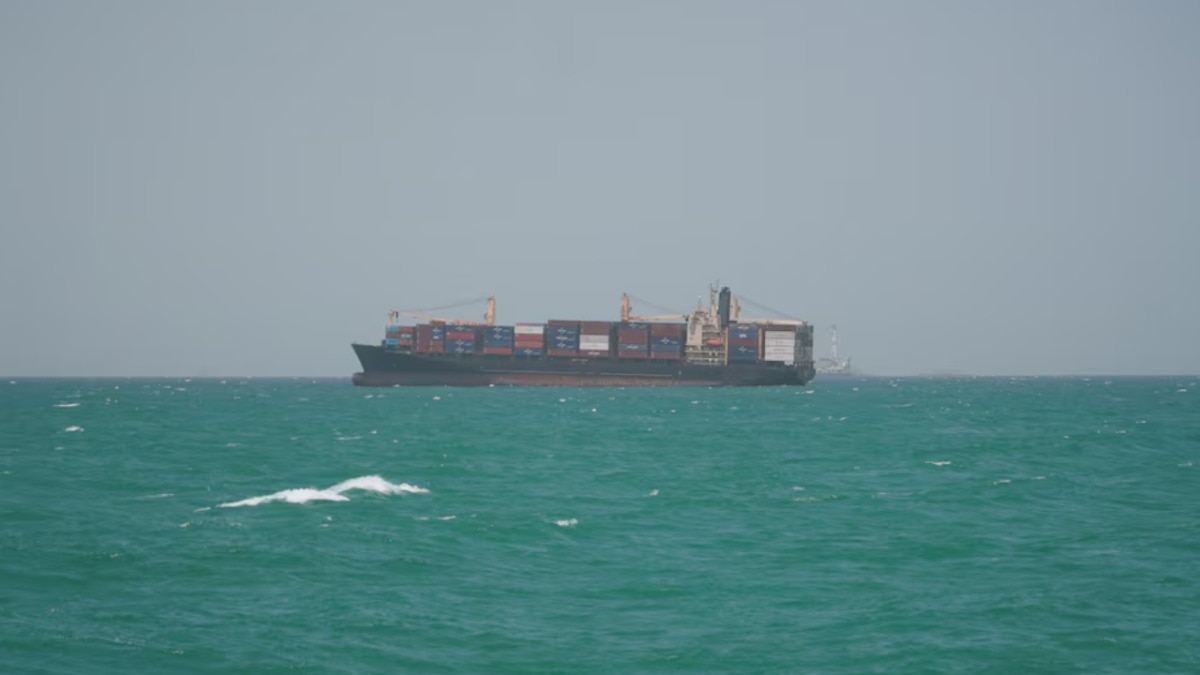
The Red Sea has become so dangerous for commercial shipping that some operators are now emailing the very rebels accused of attacking ships there. The Houthis, an Iran-backed Yemeni group, have set up an informal channel through which shipping companies can provide vessel details and seek assurances before crossing the waterway, according to The Wall Street Journal.While the system has no recognised legal authority, it offers operators another way to assess the risks of sailing through a route that connects the Indian Ocean with the Suez Canal and carries a major share of global trade.The channel runs through the Humanitarian Operations Coordination Center (HOCC), an organisation established by the Houthis in early 2024 to communicate their maritime restrictions to the shipping industry.
The arrangement is not a formal maritime authority and does not give the Houthis any recognised legal right to decide which ships can sail through international waters.However, for some shipping operators, the reality at sea is more complicated. Ships that have no links to the US, Britain or Israel generally do not need to contact the Houthis.
But after the rebels announced a maritime blockade against Saudi Arabia in July, some operators began seeking reassurance before entering waters where Houthi attacks remained a risk.The process is relatively simple. A shipping company can email the HOCC with details about its vessel and planned voyage.
The Houthis can then respond, usually within about 24 hours, indicating whether the ship is considered a target. For operators responsible for expensive ships and cargoes, that unusual exchange can become part of their voyage planning.CHINESE SHIP SOUGHT HOUTHI ASSURANCEOne example cited in the report involved the Chinese container ship Zhong Cheng Chang Ling.
In September, the vessel received approval from the Houthis after its ship-management company contacted them. The captain said the company had instructed him to make contact "out of an abundance of caution".After receiving the response, the ship changed its stated destination on Sept.
8 to “armed guard on board” before continuing its voyage.The vessel later crossed the Red Sea and the Bab el-Mandeb strait, entering the Indian Ocean on Sept. 11.
Its stated destination was eventually changed back to Port Klang. The ship also kept its automatic identification system (AIS), switched on during the journey.AIS allows ships to broadcast information such as their position, speed and course.
Keeping it active can make a vessel easier to track, but it is also an important part of normal maritime operations.The reference to armed guards was intended to signal that security personnel were aboard, a measure that can help deter attacks or piracy.WHY ARE SHIPPING COMPANIES CONTACTING THE HOUTHIS?The answer is straightforward: companies are trying to reduce the risk to their vessels. The Red Sea has become one of the most dangerous stretches of water for commercial shipping since the Houthis began attacking vessels in response to the Israel-Hamas war.Their attacks have forced many shipping companies to reconsider whether the shorter Red Sea route is worth the security risk.
The alternative is to sail around the Cape of Good Hope at the southern tip of Africa. That route can add significant time and cost to a journey between Asia and Europe.For shipping companies, every additional day at sea means higher expenses.That creates a difficult calculation.
Avoiding the Red Sea can be costly, but entering it can expose a vessel and its crew to missile, drone or other attacks.NOT EVERY SHIP IS WILLING TO PLAY ALONGThere is a major problem with this arrangement. International maritime authorities have advised ships against engaging with or registering through the Houthi system.That is partly because communicating with an armed group can create its own legal and security risks.
The United States also designates the Houthis as a foreign terrorist organisation.Many shipping companies therefore continue to avoid any direct contact with the group. But the fact that some operators are willing to communicate with the Houthis highlights how dramatically the security situation in the Red Sea has changed.HOW HOUTHIS TOOK CONTROL OF RED SEA SHIPPINGThe latest Red Sea shipping crisis began with a direct confrontation between the Houthis and Saudi Arabia.
On July 20, 2026, Yemen’s Iran-aligned Houthi rebels announced a maritime embargo against Saudi Arabia, saying they were retaliating for what they described as a long-running Saudi blockade of Yemen. The group warned that ships linked to Saudi ports or carrying Saudi cargo could face attack.The announcement immediately raised fears about the Bab el-Mandeb, the narrow strait at the southern entrance to the Red Sea.
The waterway connects the Red Sea to the Gulf of Aden and is one of the world's most important shipping chokepoints. Around 12 per cent of global trade normally passes through the area, including a significant share of container traffic heading to and from the Suez Canal.
With the Strait of Hormuz already severely disrupted, the Red Sea had become an increasingly important alternative route for moving oil and other goods out of the Gulf.So the development is not really about the Houthis suddenly "owning" or legally controlling the Red Sea.- Ends