


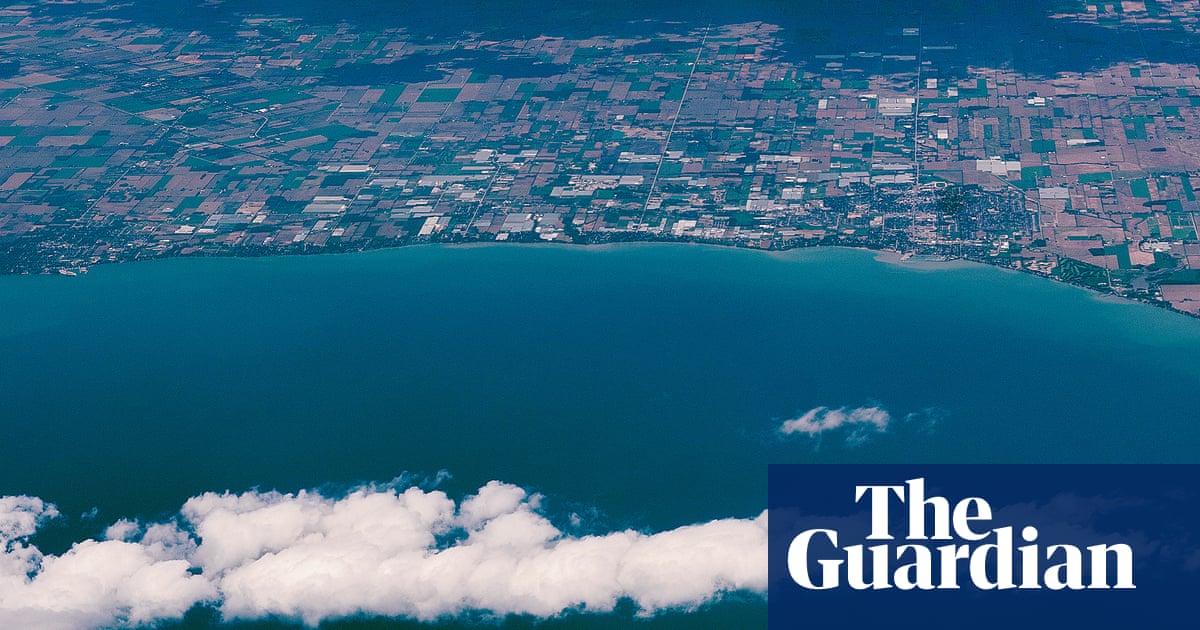
When water last month began gushing through a crack in the ceiling of a Morton Salt mine in Ohio, the company had only one option: shut the mine down for good.For locals in and around Fairport Harbor, it means the loss of 77 jobs; but for the wider region, which depends on its salt reserves to keep roads ice- and snow-free every winter, it could mean travel chaos.On top of that, in the weeks since the mine’s closure what’s been concerning mining experts and residents alike across the Great Lakes region is the mine’s location – about 2,000ft (610 meters) underneath Lake Erie. And that is sending broader warning signals across the region among activists and environmentalists, as to whether the issue could eventually hit other mines underneath the Great Lakes.At the Fairport Harbor facility, one of 12 rock salt mines that Morton Salt runs around the world, around 1.3 million tons of rock salt were mined from underneath the lake every year.Last winter’s colder and snowier than average weather ate into road salt stockpiles at hundreds of municipalities across the region.Situated 30 miles (48km) from the now-shuttered mine, Trumbull county’s 200,000 residents relied entirely on the Fairport Harbor mine for road salt.Trumbull county’s location downwind of Lake Erie means its roads and highways are particularly affected by lake-effect snowstorms and the freeze-thaw process for up to five months a year.“We get about 30,000 tons [of salt] a year from the mine.
But we have a stockpile of around 14,000 tons,” says David DeChristofaro, the Trumbull county engineer.“We are waiting for the Ohio department of transportation [to see about acquiring additional road salt supplies]. If necessary, we will mix salt with aggregate, one to one, as was typically done 15 years ago, to stretch our supply of salt.
But that adds to cost because it needs to be swept up at the end of winter.” Trumbull county gets around 4.5ft (1.4 meters) of snowfall every winter.Authorities in a township in a neighboring county have had to issue a warning to motorists about potentially hazardous driving conditions this winter because of the salt shortage.While the mine closure could mean transportation problems for more than a million residents in a region of Ohio that experiences especially harsh winter conditions, the water intrusion has also raised safety questions.With five salt mines situated partly or entirely underneath Great Lakes waterways – in Fairport Harbor, Detroit and Cleveland, and two over the Canadian border in Ontario – a growing concern is that weeks later, Morton Salt officials say they still can’t find the source of the water intrusion.The salt is extracted by drilling and using explosives, and while the distance between the bed of Lake Erie and Morton’s Fairport Harbor mine is in excess of 1,000ft (305 meters), decades of blasting and the presence of underground aquifers could contribute to significant subterranean rock movement, say experts.“Blasting can fracture rock near an excavation, and removing rock changes the stresses carried by the roof, pillars and surrounding layers. For water to enter, there must also be a connected pathway from a water source to the mine,” says Xiong “Bill” Yu, a professor of engineering at Case Western Reserve University in Cleveland.“A nearby aquifer could supply that water through a fault, connected fractures, or a compromised shaft or seal.
More than 1,000ft of rock is meaningful separation, but the engineering question is whether the layers provide a continuous barrier and whether anything crosses it.”While the likelihood that the lake is the source of the water entering the Morton salt mine appears to be remote, local voices have begun calling for an investigation into just how safe salt mines carved out from under large bodies of water are and whether drinking water resources may be affected.“Could the rock roof be breached, creating saline water swamps in a Lake Erie that’s the source of drinking water for millions in both the US and Canada?” an editorial in the Cleveland Plain Dealer asked this month.skip past newsletter promotionafter newsletter promotionIn 2017, the much larger Cargill-run Whiskey Island salt mine 30 miles (48km) west of Fairport Harbor experienced a water intrusion event that also saw dangerous levels of hydrogen sulfide gas released. That facility, which is one of the largest of its kind in the world, producing up to 4m tons a year and supplying road salt for states across the Great Lakes and midwest, spreads out 16 sq miles (41 sq km) beneath Lake Erie.
More than 200 employees work 12-hour shifts there every day.In 1994, one of the largest salt mines in the world, located in western New York, was inundated with aquifer water and collapsed. And in 1980, Lake Peigneur in Louisiana was accidentally drained when an oil rig breached the roof of an underwater salt mine 1,300ft (396 moeters) under the surface of the lake.
No salt miners were injured in either incident.The Mine Safety and Health Administration, a federal agency, oversees health and safety operations in US mines. But under the Trump administration, a deregulation drive has been enacted that includes, among other measures, eliminating diesel particle matter exposure levels in mines.In 2022, under the Biden administration, a Morton Salt mine in Louisiana was placed on the Department of Labor’s pattern-of-violations notice for “a high number of significant and substantial violations and other safety and health compliance problems”.
That notice was lifted in April 2025.Emails sent and calls made by the Guardian to Morton Salt asking how often the Fairport Harbor mine underwent a full perimeter inspection for water intrusion before its closure, whether the company knows the source of the water intrusion, and if it is scheduling any new or improved safety measures at other mines it operates were not responded to.Emails sent to Cargill inquiring about any potential additional safety steps it may be taking at its Whiskey Island mine, in light of the Morton Salt mine closure, were also not responded to. In 2020, two miners at a Cargill salt mine in Louisiana died while trying to prevent water from flooding the mine, according to lawsuits filed by family members.Miners employed at the Fairport Harbor mine contacted by the Guardian declined to be interviewed, citing restrictions in a non-disclosure agreement.For industry observers, the almost immediate decision to close Morton’s Fairport Harbor mine means that it might be time for monitoring authorities to step in.“I would support a targeted, regulator-led review of water-intrusion risks at operating salt mines beneath the Great Lakes,” says Yu.“[The Morton mine] incident is reason to check how each mine detects and responds to unusual seepage, and to review the condition of shafts and seals, the stability of roofs and pillars, and any known pathways from water-bearing rock.”