


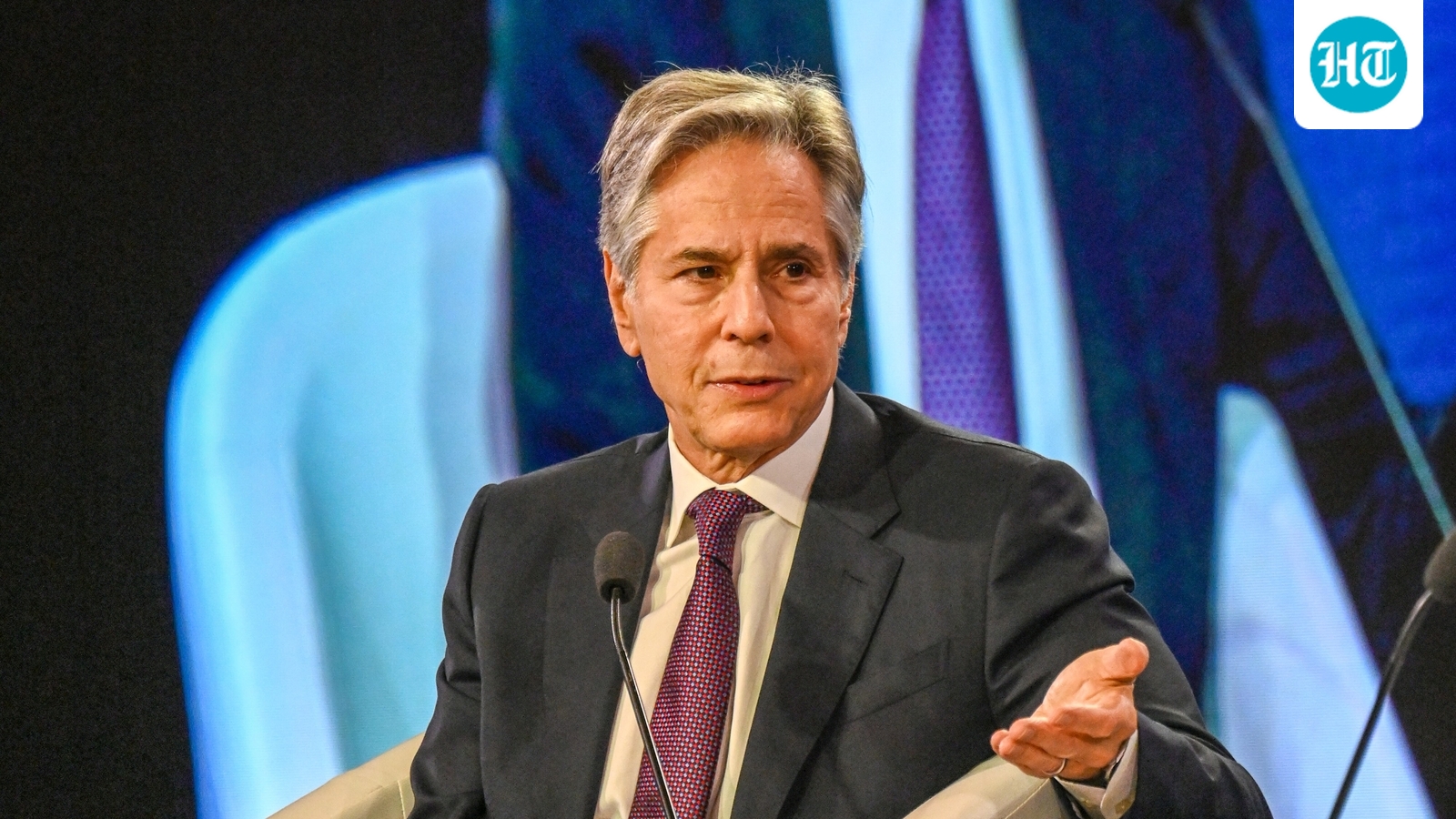
Former US Secretary of State Antony Blinken on Saturday called the US war on Iran “a very unfortunate choice” and “an unnecessary war”. He said any settlement would probably leave Washington with a nuclear agreement no better than the one Donald Trump abandoned, and would have to concede something to Tehran on the Strait of Hormuz.Antony J Blinken at HT Leadership Summit 2026, (HT)Speaking at the 24th Hindustan Times Leadership Summit, Blinken said Trump had gone for regime change, and that it “has not worked out as hoped”.
He said he had expected the conflict to end sooner. Track the HTLS 2026 session live hereBlinken said any settlement would be politically awkward for the president. “What Iran ultimately agrees to do on its nuclear programme may not look any different, or certainly not better, than the agreement that President Trump tore up.
That is going to be very difficult for him to acknowledge.”He said Hormuz had become a new problem. “The Strait of Hormuz was not a problem before this war began but has now become an issue that needs to be addressed,” he said. “Any resolution will almost certainly involve giving Iran something. Whether it is, and I would hate to see this happen, some form of toll that is not officially called a toll, or some other arrangement, the reality is that Iran has demonstrated that it can make life extremely difficult.”ALSO READ | ‘Did not see this coming’: Antony Blinken on Republican losses in US midterm electionsExplaining why he thought the war was “such a foolhardy undertaking”, he pointed to Iran’s size. “Iran is four times the size of California and three times the size of Iraq.
It has a population of 90 million. Its coastline along the Strait of Hormuz is enormous.
Its weapons production facilities are located far enough inland, and their range is sufficiently extensive, that you cannot simply destroy everything.”He said there was “at least a 50% chance that the status quo that we have now will prevail”, and “maybe a 20 or 25% chance that we see escalation, which I think would be very, very dangerous”. Iran could escalate by causing trouble in different places, including through the Houthis, and by going after US partners, troops and bases in the region, he said. “They’ve already done it.” That asymmetry was not to America’s advantage, he said.“The best thing to do would be to get an off-ramp,” he said, but he was not sure that would happen.
He also said the war had contributed to inflation in the US, and that this had shaped voters’ anger in the midterm elections.ALSO READ | Emerging world order will be multipolar, transactional, unstable: Jaishankar at HT Leadership SummitOn what the war meant for Israel, Blinken said a “very different and positive possibility” remained, one that was “absolutely necessary”. He said that in 2023, before the October 7 Hamas attack, he was due to travel to Saudi Arabia and Israel as part of a push to normalise relations between the two.
He credited the first Trump administration with doing “a terrific job” with the Abraham Accords, but called Saudi Arabia “the holy grail”. He said a pathway to a Palestinian state was central for Riyadh and other Gulf states, and that a plan had been worked out before the Hamas attack intervened.“No one is going anywhere, no matter what extremists on both sides say,” he said.
The resolution, he said, should centre on “a secure Israel and a sovereign Palestine”.