


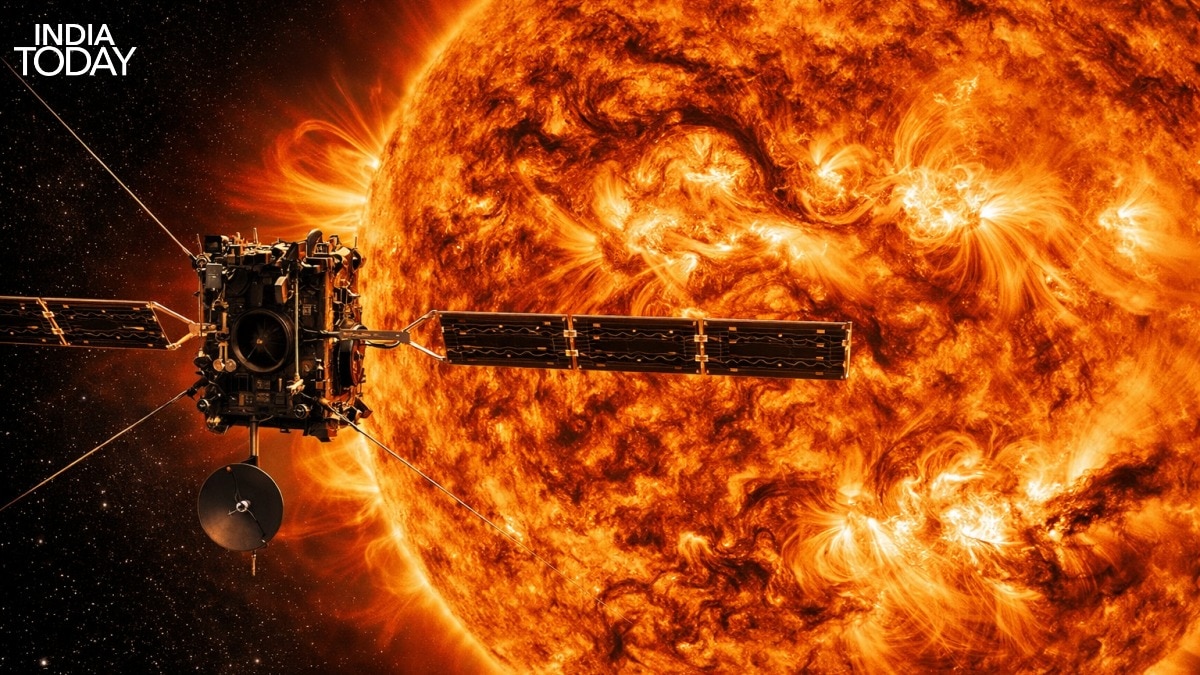
India's Aditya-L1 solar mission has completed a successful first year of observations with its Solar Ultraviolet Imaging Telescope (SUIT), offering scientists a closer look at the Sun's lower atmosphere and its explosive activity.A research paper detailing the instrument's performance describes how it was operated, calibrated and maintained while capturing important features of the Sun, including solar flares.The study, titled 'Unraveling the Secrets of the Lower Solar Atmosphere: One Year of Operation of the Solar Ultraviolet Imaging Telescope (SUIT) on board Aditya-L1', was led by Rahul Gopalakrishnan and a team of researchers.The research paper has been accepted for publication in the Journal of Astrophysics and Astronomy. But what story does it tell?
An image of the SUIT instrument aboard Aditya L1. INDIA'S SOLAR MISSIONLaunched by the Indian Space Research Organisation, or Isro, on September 2, 2023, Aditya-L1 is India's first dedicated space-based solar observatory.The spacecraft reached its designated halo orbit around the Sun-Earth Lagrange Point 1 (L1) on January 6, 2024, approximately 1.5 million kilometres from Earth.
This location gives the spacecraft a largely uninterrupted view of the Sun, without the regular interruptions caused by Earth's shadow or eclipses.Suit Observation of an Offlimb eruption and a following flare arcade on 16 Feb, 2026 in Mg II k 279.6 nm Check out @suitadityal1 for more updates !! https://t.co/p80IbNBDhV @IUCAAScipop @dktripathi @sree_padi @ydnad0 @dipu_iia @isro https://t.co/na1UkBethf— SUIT Aditya-L1 (@suitadityal1) February 26, 2026The mission aims to help scientists understand how the Sun's outer atmosphere gets heated, how solar flares and massive eruptions of material begin, and how these activities influence space weather, potentially affecting satellites, communication networks and power systems on Earth.WHAT DID ADITYA L1 FIND?Aditya L1's SUIT is one of its seven scientific instruments that are aboard Aditya-L1.It captures images of the Sun in near-ultraviolet light, covering wavelengths between 200 and 400 nanometres.The instrument was switched on November 20, 2023, and captured its first scientific images on December 6, while the spacecraft was still travelling towards L1. Unlike observations made using visible light, SUIT's ultraviolet images allow scientists to examine features in the Sun's photosphere and chromosphere, two layers of its atmosphere that provide important clues about solar activity.The research paper details the instrument's calibration, regular maintenance, operating procedures and observations during its first year.The paper also highlights notable solar features and events recorded during this period.Full-disk solar observations on 24 October 2026 using SUIT MgII k 279.6nm.
Stay tuned to @suitadityal1 for more updates !! https://t.co/qfZKAYVIhE @IUCAAScipop @dktripathi @sree_padi @ydnad0 @dipu_iia @isro https://t.co/4UgnlGioLV— SUIT Aditya-L1 (@suitadityal1) November 5, 2026FINDINGS REMAIN IMPORTANTUnderstanding activity in the Sun's lower atmosphere is important because it can help scientists trace how solar disturbances develop and evolve into larger eruptions.Such observations can improve our understanding of space weather and the potential impact of solar activity on technology around Earth.With its five-year planned mission life, Aditya-L1 will continue collecting observations through its seven instruments, helping scientists build a more complete picture of the Sun and its influence on Earth's space environment.- Ends