


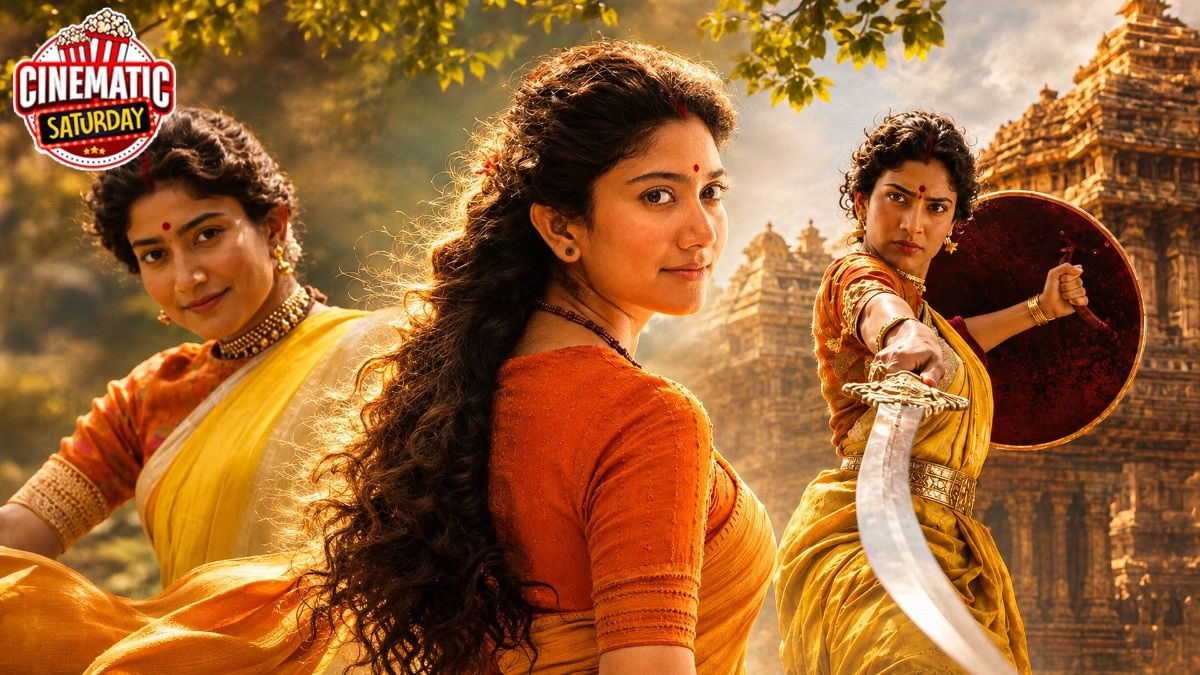
For generations, Sita has been remembered as the woman who followed her husband into exile, endured captivity in Lanka and emerged from an ordeal by fire with her dignity intact. Her patience became her virtue, her suffering became her strength, and her devotion to Rama became the defining feature of her identity.
But somewhere along the way, did the popular imagination become so accustomed to celebrating Sita's ability to endure that it forgot to acknowledge her ability to fight?Nitesh Tiwari's Ramayana: Rise of a Legend, starring Sai Pallavi as Sita, Ranbir Kapoor as Rama and Ravie Dubey as Lakshman, appears determined to ask that question. And it does so with a rather unconventional cinematic choice: it gives Sita a sword.The film has sparked debate over its decision to show Sita fighting demons alongside Rama and Lakshman during their years of exile.
For some viewers, the sight of Sita participating in battle, particularly in the Khar-Dushan episode, is a departure from the Ramayana they grew up watching in television adaptations and Ramlilas. Why should Sita be fighting alongside Rama and Lakshman?
Wasn't Rama the warrior? Wasn't Sita supposed to be protected?These questions are worth examining, but so is the assumption behind them: that there is only one way to tell the Ramayana, and that Sita's place in it must remain confined to the familiar image of a devoted wife.
Tiwari, interestingly, has already offered a textual reference for his interpretation. Speaking to international media at the film's Los Angeles premiere, the director acknowledged drawing from the Adbhut Ramayana, one of the 300 re-tellings of Ramayana, which presents a warrior dimension of Sita. "Maa Sita has somewhere, like you mentioned, the warrior version.
She, in Adbhut Ramayan, is portrayed as a warrior princess. That element we took from there, which kind of adds a nice dimension to her as a character," he said.That explanation is important because Tiwari is not claiming that every version of the epic depicts Sita fighting demons in the forest.
He is drawing from a particular tradition that imagines her as a manifestation of supreme feminine power. And that deserves to be understood before the film is dismissed for taking a creative liberty.The warrior Sita that exists beyond the familiar RamayanaThe Adbhut Ramayana, a Sanskrit text traditionally attributed to Valmiki but of uncertain actual authorship, offers one of the most extraordinary portrayals of Sita in the wider Ramayana tradition.
Here, she is not merely the woman Rama must rescue. She is the divine force capable of rescuing him.The text's most striking episode unfolds after Rama has defeated the familiar ten-headed Ravana.
He learns of another, far more formidable adversary: Sahasramukha Ravana, the thousand-headed demon king. Rama goes into battle against him, but the demon proves too powerful.
His attacks overwhelm the army, and Rama himself is eventually struck down.What follows is a remarkable reversal. Sita steps onto the battlefield, assumes a terrifying form associated with Mahakali and destroys the thousand-headed Ravana and his army.
Rama, on regaining consciousness, witnesses this manifestation of her power and offers prayers to her through a thousand divine names.This is not a passing reference to a courageous woman. It is a theological assertion about the power of the feminine.In Chapter 25, which includes the Sita Sahasranama Stotram, Rama addresses Sita as the supreme Shakti.
One of the verses reads:Maam viddhi paramaam shaktim Maheshwara samaashrayaam,Ananyaam avyayaam ekaam yaam pashyanti mumukshavah.Translation: "Know me as the supreme Shakti, abiding in Maheshvara; the unique, imperishable one whom seekers of liberation behold."Put simply, Sita is declaring that she is not merely a consort or an extension of another divine being. She is the primordial, supreme feminine energy.
The source of power itself.The description of her fierce manifestation is equally striking:Jwaalavali sahasraad hyam kaalanala shatopamam,Danshtra karaalam durdharsham jataamandala manditam.Translation: "Adorned with thousands of blazing flames, resembling hundreds of fires at the end of time; terrifying with her fierce teeth, invincible and crowned with matted locks."The imagery is unmistakable. This is a Sita who is fearsome, invincible and capable of destruction.
She is not defined by the vulnerability of her circumstances but by the enormity of her power.The text's Sita Sahasranama also describes her as:Jaanaki mithilaanandaa raakshasaanta vidhaayini,Raavaanaantakari ramyaa raamavakshasthalaalayaa.Translation: "Janaki, the joy of Mithila, she who brings about the destruction of demons, she who brings Ravana to his end, the beautiful one who dwells in Rama's heart."Pause, and look at the significance of these names. Sita is simultaneously described as the beloved who resides in Rama's heart and the force that brings demons and Ravana to their end.
Devotion and power are not presented as opposing qualities. They coexist.It is this dimension of Sita that Tiwari appears interested in bringing to the screen.
To be clear, the Adbhut Ramayana does not describe Sita fighting Khara and Dushana during the forest exile. Its warrior episode concerns the thousand-headed Ravana.
Tiwari seems to have taken that larger idea of Sita's martial and divine power and extended it into his cinematic interpretation of the forest years.And that is where the film makes its most interesting intervention.A sword, a battlefield and a Sita who knows her own mindIn Ramayana: Rise of a Legend, the sword is not simply an accessory introduced to make Sita look formidable in an action sequence. It becomes part of her characterisation.
She carries it, trains young girls in Ayodhya to defend themselves and fights alongside Rama and Lakshman when the three encounter demons in the forest.The Khar-Dushan sequence is particularly important because it places Sita within the action. She is not waiting for the brothers to finish the battle.
She is participating in it.In Valmiki's Aranya Kanda (Sarga 24), when Rama anticipates the confrontation with Khara, he asks Lakshman to take Sita to the shelter of a cave. Lakshman accompanies her, while Rama prepares to fight the approaching army alone.
Tiwari's version of Ramayana shows that, but then it surprises. As Lakshman takes Sita to the other side and leaves Rama to fight alone, they too, are caught by an army of demons.
Tiwari's depiction is, therefore, not a complete departure from this particular episode in Valmiki's narrative. It is a cinematic expansion of Sita's warrior identity, informed by another strand of the Ramayana tradition.But why should that creative expansion be considered a distortion?The popular imagination has also been shaped by re-tellings that give Sita a more pronounced voice and agency.
Chitra Banerjee Divakaruni's The Forest of Enchantments places Sita at the centre of the narrative, allowing her to tell her own story and explore the lives of women often pushed to the margins of the epic. Amish Tripathi's Sita: Warrior of Mithila goes even further in reimagining her as a trained warrior, strategist and leader.
These are modern literary interpretations, not ancient scriptural accounts, but they demonstrate the continuing interest in exploring dimensions of Sita that conventional re-tellings have not always foregrounded.Tiwari's film takes that exploration into mainstream mythological cinema, giving the warrior dimension a physical vocabulary through the sword, combat training and action sequences.And physicality is only one part of the characterisation. The film also gives Sita a sharper intellectual and emotional presence.Consider the scene in which Ravana approaches her disguised as a sadhu.
In the familiar telling, Sita's hospitality, despite her hesitation towards the disguised ascetic, becomes the opening through which Ravana engineers her abduction. In Tiwari's version, however, she does not immediately accept the stranger's account of himself.
She asks him to recite a particular verse from the Rig Veda to establish that he is indeed the learned man he claims to be, supposedly lost in the forest.It is a small but important change. Sita is not simply responding to the moral obligation of offering food to a wandering ascetic.
She is testing the person before her. She listens, observes and attempts to establish whether his identity matches his claims.
The scene gives her the qualities of a woman who thinks before she acts, and who understands that compassion need not come at the cost of discernment.It also changes the dramatic irony of the abduction. The audience knows the danger standing before Sita; the character, too, is alert to the possibility that something is amiss.
She is not rendered oblivious simply to make Ravana's deception work.Why should a warrior have to cry to prove that she is suffering?One of the most distinct aspects of Sai Pallavi's portrayal comes after the abduction.As Ravana carries Sita away in the Pushpak Viman, the film does not give her the familiar vocabulary of helplessness. She does not spend the journey breaking down or pleading for mercy.
Instead, she looks directly at Ravana and tells him that this is the beginning of his end.There were viewers who questioned Sai's restrained expressions in these scenes, arguing that Sita should have appeared more visibly distressed in captivity. But is the absence of tears necessarily the absence of emotion?
And why should a woman who has been abducted be expected to communicate her suffering through helplessness alone?Tiwari makes a deliberate choice here. His Sita understands the gravity of her situation, but she refuses to grant Ravana the satisfaction of seeing her broken.
Her composure is not indifference; it is defiance. The one moment her eyes well up is when she sees Jatayu, who has risked his life trying to save her, dying after his confrontation with Ravana.Sita's grief is not absent.
It is directed towards the sacrifice of someone who tried to protect her, and not towards the man who believes he has conquered her. Even in captivity, she refuses to let Ravana become the centre of her emotional world.There is a difference between portraying a woman as emotionally strong and making her emotionally invulnerable.
The film attempts to negotiate that difference. Sita feels deeply, but she does not surrender her resolve.A woman who questions violence is not a woman without strengthAnother interesting intervention comes in the treatment of Surpanakha, Ravana's sister and the princess of Lanka.When Lakshman disfigures Surpanakha by cutting off her nose, Sita does not simply accept the incident as an inevitable consequence of protecting Rama.
She questions Lakshman's decision and reprimands him for resorting to violence when there could have been other ways to stop Surpanakha from harming them. She also challenges the idea that a woman's beauty can be treated so casually as something to be destroyed.It is an important moment because it establishes that Sita's strength is not just about her ability to fight.
It is also about her moral compass. She can disagree with the men she loves, question their decisions and recognise the humanity of another woman, even when that woman has threatened her family.It is in these scenes that the film also gives Surpanakha a dimension beyond that of a convenient antagonist.
It also allows Sita to question the consequences of violence rather than simply celebrate it when directed at an enemy.This is where the film's treatment of its women becomes particularly interesting. Sita is not the only woman whose choices and motivations are given space.
Surpanakha, too, is presented as a character with an identity and agency of her own. The women in this world are not narrative devices whose actions exist to advance the journeys of the male protagonists.Sita, naturally, leads this shift.
She is a healer, a fighter, a woman with her own interests and convictions, and a devoted wife who does not need to surrender any of those identities to remain devoted to Rama.When the three royals leave Ayodhya for their fourteen-year exile, Tiwari's treatment of them is rather worth observing. They are not simply a husband, a wife and a younger brother travelling into the wilderness.
They are three individuals entering an unfamiliar world, each with their own strengths and responsibilities. The forest becomes a space in which Sita's capabilities are allowed to emerge, and not a place where her identity is reduced to the hardships she must endure.But whose Ramayana are we defending?The outrage over Sita fighting alongside Rama and Lakshman also raises a larger question about how the epic is understood and passed down.The often-cited figure of 300 Ramayanas is associated with scholar A.
K. Ramanujan's celebrated essay, Three Hundred Ramayanas: Five Examples and Three Thoughts on Translation.
Drawing on the work of scholar Camille Bulcke, the essay brought attention to the extraordinary plurality of Ramayana tellings across languages, regions, religious traditions and cultures. The number is best understood as a widely cited estimate of the tradition's many tellings, not a definitive census of 300 identical, complete texts.The point, however, is far more important than the number.
The Ramayana has never existed as a single, unchanging narrative in the cultural imagination. It has travelled across centuries, languages, performance traditions and communities, acquiring new interpretations along the way.
Characters have been re-examined, episodes have been reshaped and the moral questions at the heart of the story have been viewed through different social and philosophical lenses.That does not mean every cinematic invention can be passed off as scripture. There is a difference between a textual reference, a regional retelling and a filmmaker's creative interpretation.
Tiwari himself has acknowledged taking liberties with world-building and action while drawing on the Adbhut Ramayana for Sita's warrior dimension. Audiences are entitled to debate whether those choices work dramatically.
But dismissing them on the grounds that the Ramayana they remember does not contain such a Sita is a much narrower argument.The familiar television adaptations and Ramlilas have undoubtedly shaped generations of viewers. Their Sita has a particular emotional and cultural resonance.
But should familiarity be mistaken for exclusivity? One re-telling cannot claim ownership over an epic that has survived precisely because it has been retold.And there is another question worth asking those uncomfortable with Sai Pallavi wielding a sword.
What exactly is being threatened by the sight of Sita fighting? Does her ability to defend herself diminish Rama's heroism?
Does her physical strength make her any less devoted to her husband? Does a woman become a less ideal wife because she has the capacity to protect herself, rather than depend entirely on someone else to do it?A woman can love her husband and still have an identity beyond marriage.
She can be devoted without being dependent, compassionate without being vulnerable to manipulation, and emotionally strong without having to suppress her anger. She can fight alongside her husband without competing with him.For centuries, audiences have celebrated Rama for going to war to rescue Sita.
The Adbhuta Ramayana offers a striking reversal: when Rama falls, it is Sita who enters the battlefield and saves him. That is not a rejection of Rama.
It is an acknowledgement that the divine feminine is powerful in her own right.That is exactly the image worth taking away from Tiwari's film. Not a Sita made less devoted by her strength, or less graceful by her ability to fight, but a Sita whose love does not require her to be powerless.If the Ramayana is a story we continue to return to, it must also be a story we are willing to read beyond the version we inherited.
Otherwise, what exactly are we preserving: the richness of an epic, or our own limited imagination of the women who are in it?- Ends