


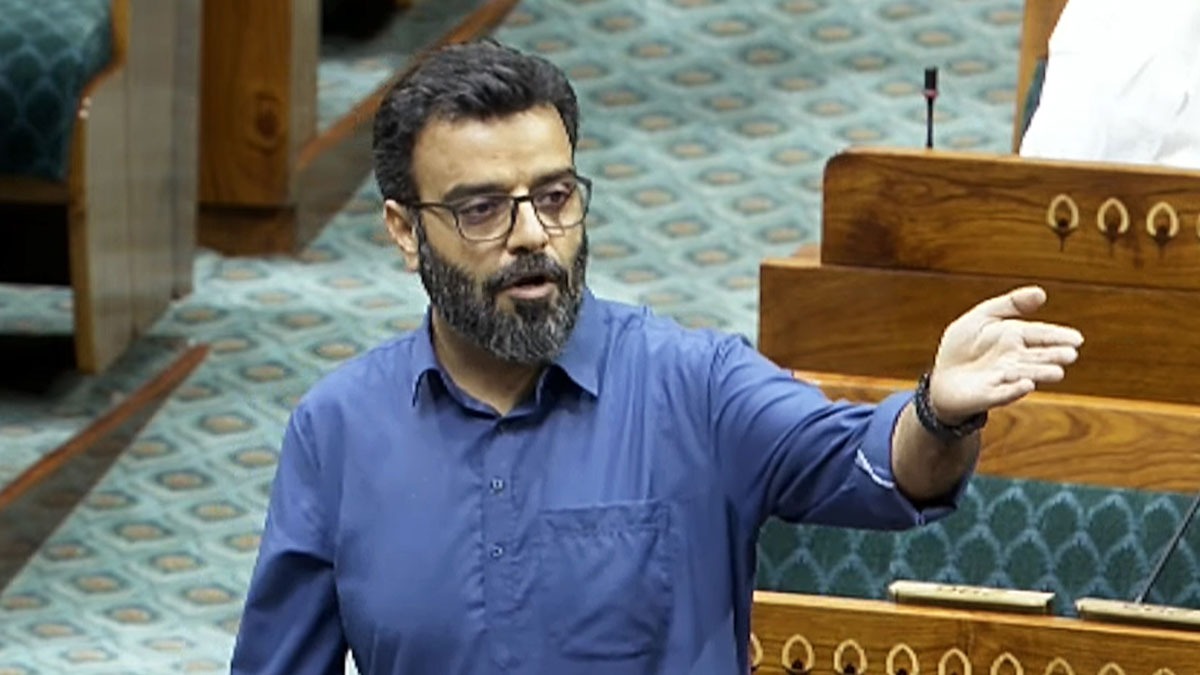
Amidst intense sloganeering by supporters, he also launched a scathing attack on chief minister Omar Abdullah and NC president Farooq Abdullah, alleging a sellout on Kashmir and appeasement of the BJP leadership.Mehdi dramatically waved his resignation letter and said he would dispatch it to the NC bosses through Mohammad Ashraf Mattoo, whose son Tufail Matoo was killed in 2010 in action by security forces during a protest. This was during Omar’s previous term as chief minister. “I am signing the document of my freedom.
From this moment, I am free from the National Conference and no longer its part,” Mehdi declared, indicating the eventual launch of an alternative political set-up that he claimed would strive to restore the honour and dignity of the people of J&K as well as Ladakh.Mehdi, 44, is a prominent Shia leader from Budgam. His father was a Congress leader and cleric.
Mehdi had entered mainstream politics at the invitation of Farooq. He won the Budgam assembly seat in 2002, 2008 and 2014, served as J&K minister for science and technology and animal husbandry.
At one point, he was also NC’s chief spokesperson, a post he resigned in 2020. In 2024, he won the Srinagar Lok Sabha seat by a comfortable margin and was recognised as one of the NC’s star faces.
His departure thus marks the most-serious internal rupture in the NC since returning to power in J&K.Known for his consistent advocacy of J&K’s special status and non-sectarian politics, Mehdi emerged as the party’s most prominent internal critic after the NC formed the government. Events from thereon are thought to have culminated in his decision to resign from both the party and Parliament.Mehdi’s exit comes amidst another crisis: at least 20 NC MLAs have openly voiced concerns over the cabinet expansion on October 27.
In a memorandum to the party leadership, they have sought a time-bound roadmap to implement the party’s 2024 manifesto and make an intensified push for restoration of J&K’s statehood and special status.“If we have any concerns, we will place them before our leader once he returns from Delhi. He is our leader and nobody can stop us from bringing to his notice whatever we genuinely feel needs to be brought to his attention,” said Hilal Akbar Lone, the NC MLA from Sonawari, on November 1.While Lone dismissed talk of rebellion, NC provincial secretary (Kashmir) Showkat Mir had earlier described the meeting of MLAs as a cordial get-together ahead of the Darbar Move, the administrative tradition in J&K of relocating the capital to Jammu during winter months and back to Srinagar in summer.Political observers see Mehdi’s resignation as a significant setback for the party.
Prof. Noor Ahmad Baba, former dean of the Central University of Kashmir, said: “The party’s image is already dented by the growing perception that it has abandoned its core commitments and failed to deliver satisfactorily on the restoration of Article 370, Article 35A and statehood to J&K.” Mehdi, in his view, had “reasonably” raised these concerns both publicly and inside the party but was alienated.Prof.
Sheikh Showkat Hussain, former head of the School of Legal Studies at the Central University of Kashmir, said the real impact would depend on Mehdi’s next move. “If he joins mainstream parties, he may lose the Srinagar seat as well. Only a local forum reflecting the dominant sentiment can ensure his survival in Kashmir politics,” he said.Veteran commentator Muhammed Sayeed Malik placed the exit in a wider context of vulnerability. “The exit coincides with an awkward moment for the NC as well as its government.
The recent ministerial reshuffle has exposed chinks in the armour,” Malik said. Whether Mehdi can harm the party, and how, was uncertain, yet the timing was clearly unfavourable for the NC, he warned.The crisis has sharpened questions about Omar’s leadership of the government and his ability to manage growing dissent after the cabinet expansion. “Omar Abdullah has so far not demonstrated particularly effective leadership in managing factionalism within the party,” opined Baba, pointing to a failure to cultivate leadership beyond the NC’s hereditary line.“With Farooq Abdullah’s advancing age, the succession question becomes increasingly pressing.
The party has long drawn political mileage from Sheikh Abdullah’s legacy, which is gradually losing its electoral appeal,” he felt.According to Malik, Omar “lacks the temperament” needed to deal with “threats” to his position, yet he can be blamed only partly because after his crushing Lok Sabha poll defeat from Baramulla in 2024, Omar had vowed not to contest until full statehood was restored in J&K. “Yet at the ground level, anti-establishment dissatisfaction has set in. The rare combination of factors that delivered the NC’s assembly majority—accumulated grievances since 2019 and a backlash against the Peoples Democratic Party’s earlier collusion with the BJP—has already changed complexion,” he cautioned.Baba believes Mehdi’s exit could seriously weaken the NC unless “substantial corrective measures” are taken. “Factionalism is brewing, particularly after the recent cabinet expansion, and the [Mehdi] crisis risks further eroding organisational cohesion and political credibility,” he said.Hussain predicted gradual decline rather than a sudden collapse: the party may lose ground the way it has in the past—through a perceived betrayal of the mandate rather than open revolt by legislators.Mehdi’s future remains open.
Baba said all would depend on his ability to mobilise public support around the issues he has raised. Hussain is more optimistic: “Ruhullah Mehdi has established himself as a vocal pro-minority, anti-BJP voice in Parliament.
As long as he sticks to this policy, no one can deny him a political role in J&K and beyond,” he said.According to Malik, Mehdi “must have weighed the pros and cons” before confronting the leadership. “So it is safe to presume that in the fallout of the recent ministerial changes, he would be seeing himself stronger than before,” he said.Taken together, Mehdi’s resignation has exposed the NC’s vulnerabilities less than halfway through the government’s term and revealed deeper problems, including a bunch of peeved MLAs. Whether the party can regain some of the lost credibility, manage internal fissures and win back the electorate’s trust will shape the next chapter of NC and J&K politics.Subscribe to India Today Magazine- Ends