


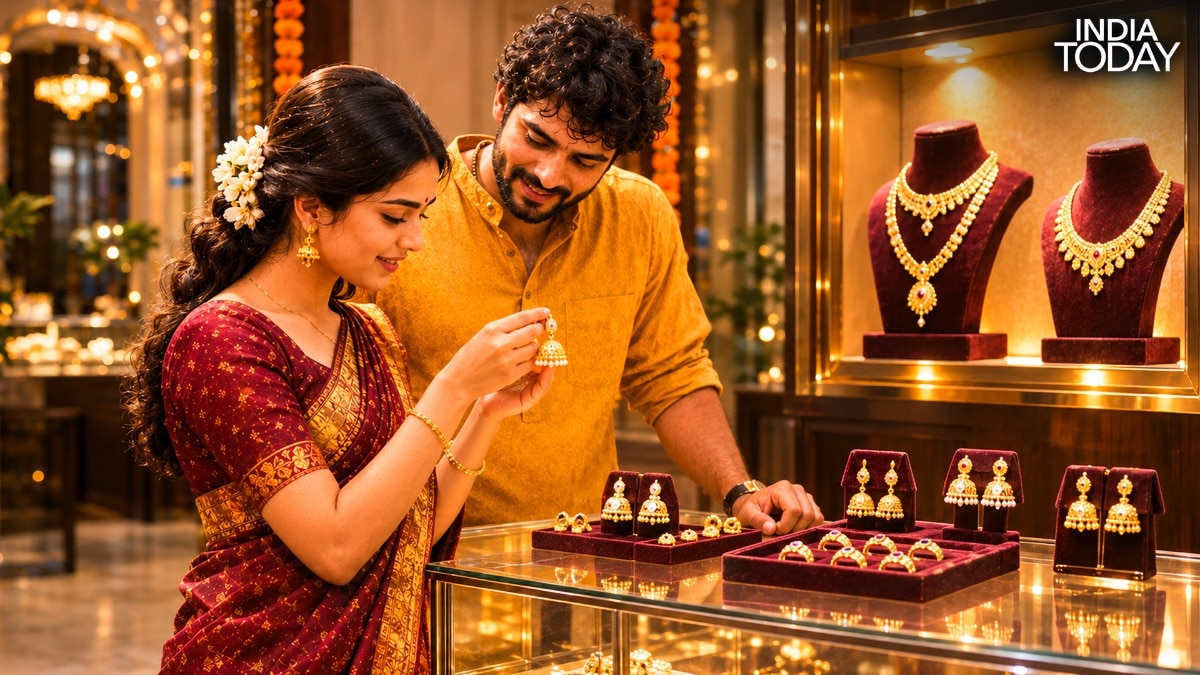
Priya Vashishtha* from Noida wants a gold ring she can wear every day. Neha Ranjan* from Indore has her eyes on a lightweight necklace and earrings set for the festive season.
Sanjay Malviya* from Gurugram, meanwhile, plans to buy a 5-gram gold coin as part of his savings.Three buyers. Three different choices.
One common attraction: gold."Gold has become so expensive. A heavy necklace would mean spending a lot more.
I would rather buy a lightweight ring that I can wear every day without stretching my budget," says Priya.Neha, too, is keeping an eye on her spending. "I have always preferred jewellery to coins because I can actually wear it. But with gold prices rising so much, buying a heavy set does not make sense right now.
A lightweight necklace and earrings set is a better choice," she says. Amit has a different approach. "I prefer gold coins because I see gold as a long-term investment.
Jewellery comes with making charges, which add to the cost. A coin is a simpler way to accumulate gold.
Even though prices are high, I don't want to miss the tradition of buying gold on Dhanteras," he says.Their choices reflect a larger shift in how Indians are approaching Dhanteras shopping this year. While the tradition of buying gold remains firmly rooted, the form in which consumers choose to own it is changing.
Some are opting for lightweight, everyday jewellery, others are looking at coins and bars, while digital gold is also finding interest among younger buyers. So, what is driving these choices?
Are high gold prices changing buying habits, or are consumers simply finding new ways to celebrate the festival without overshooting their budgets?GOLD GETS DEARER, BUYERS GET SMARTERGold prices have become an important consideration for households planning their Dhanteras purchases. However, expensive gold does not necessarily mean consumers are walking away from the market.
Instead, they are adjusting what they buy to fit their budgets.Sudeep Nagar, Co-founder and Chief Operating Officer of BlueStone, says consumers are not necessarily spending more, buying less or switching to cheaper alternatives. They are simply buying differently."Consumers arrive with a budget rather than a weight — thirty thousand rupees, fifty thousand, a lakh.
When the metal moves, that number does not move with it. So what changes is what the budget reaches, not whether she buys or how often," he says.According to Nagar, customers are not necessarily looking for cheaper products.
They want something that offers value within the amount they have decided to spend.He also points out that demand has remained resilient despite gold prices staying elevated for an extended period. Consumers have absorbed higher price levels and continued purchasing, suggesting that the appeal of jewellery has not diminished.For Ankur Daga, Founder and CEO of Angara, the movement in silver prices has also influenced festive buying decisions.He says buyers had held back when silver prices were touching record highs earlier this year.
However, the subsequent correction has brought shoppers back to the market."Indian buyers watch precious metal rates very closely. The moment they saw prices slip below the Rs 2 lakh mark, they treated it as a window to buy.
On our own platform, we're seeing festive sales up roughly 35% to 40% in value year on year," Daga says.HEAVY SETS OUT, EVERYDAY BLING INRemember when buying gold for Dhanteras often meant bringing home a heavy necklace, an elaborate set or traditional bangles? That preference is gradually making room for jewellery that can be worn beyond festivals and family functions.Consumers increasingly want jewellery that does not remain locked away in a locker after a festival.
Lightweight rings, earrings, delicate necklaces, hoops and stackable bracelets are finding favour because they can be worn on multiple occasions.Nagar says this shift towards lightweight jewellery began even before the current rise in gold prices. According to him, jewellery is moving from the locker to the wardrobe."The question a consumer asks has changed from what a piece is worth to where else she will wear it," he says.Everyday rings and earrings, bolder hoops, cocktail rings and layered chains are among the categories seeing interest.
The common factor is versatility, with buyers looking for designs that can work across different settings, says Nagar.He adds that lighter jewellery does not necessarily mean less elaborate or less valuable. Rather, consumers want pieces designed for everyday life instead of being reserved for special occasions.For context, studded jewellery accounted for 55.7% of BlueStone's revenue in the September quarter.Daga, too, sees a growing preference for jewellery that combines contemporary designs with everyday wearability."This festive season, we are seeing the strongest traction in contemporary fine silver jewellery, particularly pieces that pair hallmarked 925 sterling silver with genuine coloured gemstones," he says.Rings, delicate necklaces and stackable bracelets featuring emeralds, sapphires and rubies are seeing stronger traction than plain metal pieces, he adds.Buyers want jewellery with personality that they can wear to work the following week, rather than heavy traditional pieces that may remain unused for most of the year.COINS OR JEWELLERY: WHAT'S YOUR PICK?While jewellery remains an important part of Dhanteras shopping, gold coins and bars continue to attract buyers who look at the metal primarily as an investment.For such consumers, the appeal lies in owning gold without paying the making charges associated with jewellery.
Coins and bars are also seen as a straightforward way to accumulate the precious metal.Nagar believes these are two different purchases driven by different motivations."Someone buying a coin or a bar is making an investment decision — she is buying metal, and she responds to the metal price. Someone buying a piece to wear is responding to design, to the occasion and to her budget," he says.He adds that while Dhanteras is widely associated with buying precious metals, a significant number of consumers take home jewellery they intend to wear."The auspiciousness attaches to acquiring something, not to the form it takes," he says.Daga agrees that gold coins and bars continue to appeal to those looking at gold as an investment or an auspicious purchase.
Buyers who prioritise liquidity and lower transaction costs may prefer coins to jewellery.However, he says the recent correction in precious metal prices has moderated the earlier tilt towards bullion, making jewellery relatively more accessible again.The choice, therefore, depends on what the buyer wants from the purchase: an asset to accumulate or a piece to wear.DIGITAL GOLD FINDS YOUNG TAKERSThe changing preferences are also visible across age groups. Younger consumers are increasingly open to different ways of owning gold, including lightweight jewellery, small coins, bars and digital gold.According to Kaushlendra Sinha, CEO of the Indian Association for Gold Excellence and Standards (IAGES), gold continues to appeal across generations, although the way people buy it is evolving."Gold remains a favourite across generations, although their approach towards buying it is changing.
Younger consumers are generally more open to exploring different ways of owning gold, including coins, bars and digital gold. Older consumers are more used to traditional jewellery and standardised ways of buying gold," he says.The growing interest in digital ownership is also reflected in industry data.
Sinha points to the World Gold Council's latest report, which showed that digital gold purchases in India rose 76% between January and September 2026.However, he cautions against drawing a strict age-based distinction. Physical gold continues to remain important for festive and wedding purchases, irrespective of age.Daga, meanwhile, says younger buyers, particularly those in the 25-35 age group, are driving a larger share of festive volumes.
Their preferences lean towards lightweight, versatile daily-wear jewellery, lower-carat options and, occasionally, digital gold or small coins.Older consumers continue to favour traditional, heavier pieces for weddings and festive gifting, although contemporary designs are also gaining popularity among them.Nagar, however, believes everyday jewellery is no longer restricted to younger buyers. Consumers across age groups are increasingly looking for pieces they can wear regularly.HOW MUCH ARE BUYERS WILLING TO SPEND?With gold prices remaining high, budgets are playing a crucial role in determining what consumers eventually take home.For a festive gifting budget of Rs 30,000 to Rs 50,000, the choice between gold and silver can make a significant difference to the quantity and design a buyer can afford, says Daga.He says this amount could fetch roughly two to three-and-a-half grams of gold, typically enough for a small coin or a lighter studded jewellery piece.
The same budget could buy a considerably more substantial design-led silver piece.He adds that demand is clustering in the mid-range of around Rs 30,000 to Rs 1.5 lakh, where consumers can purchase design-led silver or lighter gold and studded jewellery without stretching their budgets.Meanwhile, Nagar says BlueStone's average order value stood at Rs 77,290 in the September quarter, marking a 29% increase year on year. It was down around 1% sequentially, reflecting a higher number of first-time buyers entering at lower price points.The industry is also seeing consumers consider exchanging old gold to fund fresh purchases rather than spending entirely from their savings.Sinha points to the World Gold Council's consumer sentiment findings, which show that consideration of old-gold exchange has increased from 70% to 76%.This suggests that more consumers are willing to use jewellery they already own to make new purchases, balancing their desire for fresh designs with the rising cost of gold.IT'S NOT JUST GOLD, IT'S WHY YOU BUY ITDhanteras has traditionally been associated with buying gold as a symbol of prosperity and good fortune.
That sentiment remains intact, even as consumers become more conscious of prices, designs and the different ways of owning the metal.For some, a lightweight ring or necklace is a way to celebrate the occasion without overspending. For others, a coin is a more practical addition to their savings.
And for those exploring digital gold, owning the precious metal no longer necessarily means bringing home a physical product.As Sinha points out, gold continues to hold value across generations, whether people buy it as an investment, a form of savings or as part of family traditions.The bigger change, perhaps, is not that Indians are buying less gold. It is that they are becoming more particular about what they buy, how much they spend and what they expect from their purchase.(*Names changed for anonymity)- Ends