


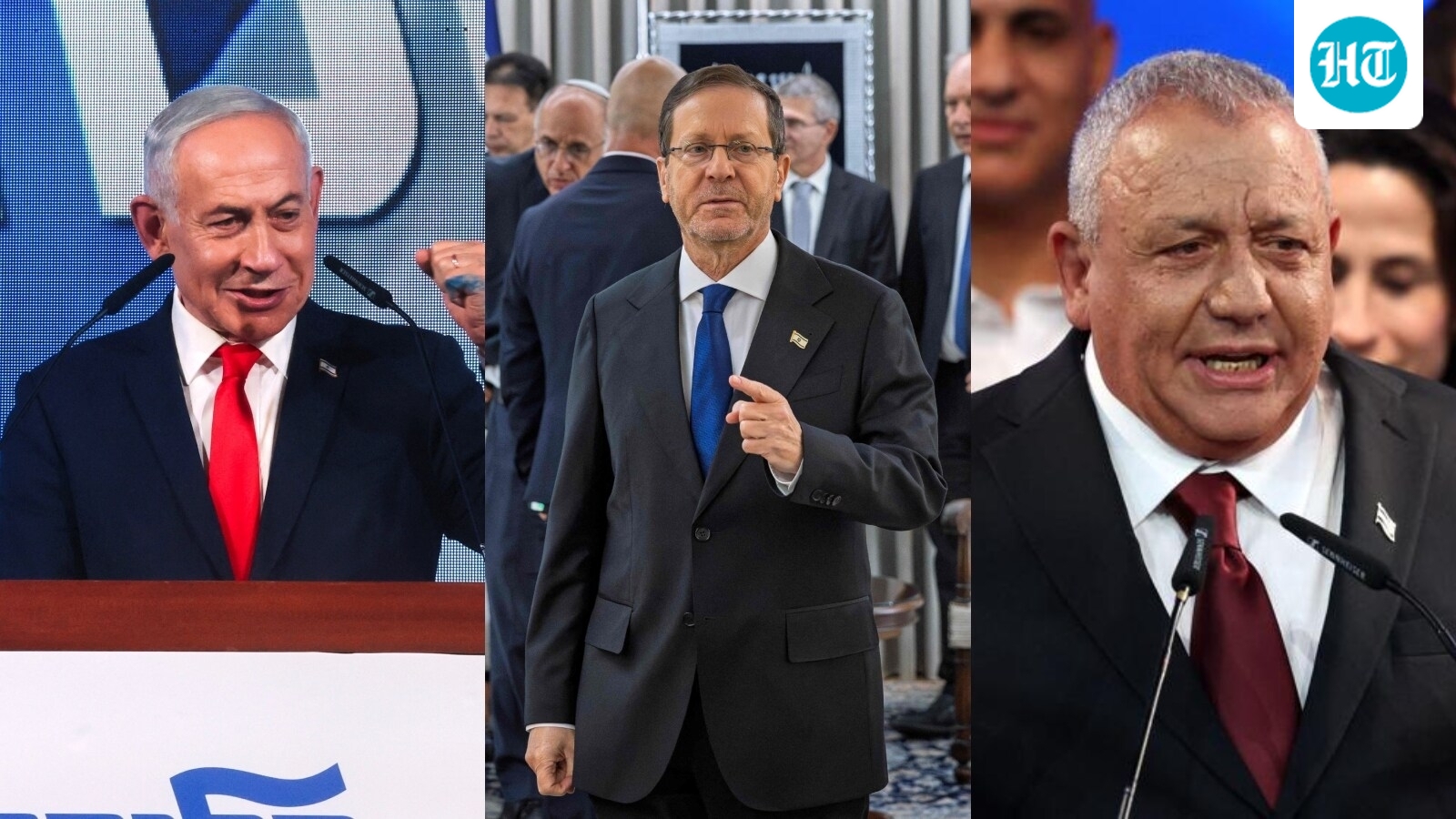
This means that parties must stake their claims by November 11.ALSO READ | How Israel elects its prime minister without voters choosing a candidatePresident Herzog's consultations with partiesMore than a week after the October 27 vote, President Isaac Herzog began consultations with party leaders after accepting the official election results. With neither the Netanyahu-led bloc nor his rival Gadi Eisenkot-led bloc achieving a majority in the 120-seat Knesset, Herzog urged both sides to accept the reality.He asked parties to understand that "not every commitment and promise can be fulfilled" and to avoid new elections."In the current reality, in which there is no clear winner after the elections, I ask for originality and creativity, courage and goodwill, so that the State of Israel emerges the winner," Herzog said during a press conference.During consultations, he also slammed the rejection remarks against Arab parties, which delivered a surprising performance in this election. "I condemn the coarseness and racist expression that we have heard recently," he added.Even as Herzog began a series of sit-downs with political parties on Wednesday night, questions remain about the possibility of an alliance between the two rivals -- Netanyahu and Eisenkot -- or between Eisenkot and some of the Arab parties.Religious Zionism, Otzma Yehudit, and Shas recommended that the incumbent PM be given a chance to form a coalition government.
Meanwhile, Yisrael Beytenu, led by Avigdor Liberman -- a former Netanyahu ally-turned-rival -- recommended Eisenkot.ALSO READ | Israel opposition backs Gadi Eisenkot for PM, vows to replace Netanyahu's ‘October 7 government’According to the Times of Israel, Yashar, the Democrats, B'Yachad, Yisrael Beytenu, and Ra'am had said that they would recommend Eisenkot.Arab-led Joint List had reportedly not confirmed whether it would back Eisenkot as of Wednesday night.Meanwhile, the Degel HaTorah faction of the ultra-Orthodox United Torah Judaism confirmed that it would not endorse any candidate for the top office. The faction holds four of UTJ's seven Knesset seats and includes the party's overall chairman, MK Yaakov Asher, the Times of Israel reported.Degel HaTorah said that its decision came after instructions from its spiritual leaders, Rabbis Dov Lando and Moshe Hillel Hirsch.The other three UTJ lawmakers who are seated in the Knesset belong to the Hasidic Agudat Yisrael faction, which has also not yet made clear whether it would recommend a candidate or abstain from endorsing one.Talks to resumeOn Thursday, eight parties, including the two Arab-led factions, are set to meet Herzog.
Netanyahu's Likud and Eisenkot's Yashar party are scheduled to speak at the end. The consultations are due to begin at 8:30am (local time) with United Torah Judaism.Eisenkot is reportedly widely expected to receive the mandate to form a government, as Wednesday night's recommendations gave him a clear lead after the Arab-led Ra'am party announced that it would back him.ALSO READ | The options before Israel: A Netanyahu-Eisenkot deal, a minority government or no new governmentBy the end of the talks, Eisenkot is expected to have received at least 56 recommendations, while Netanyahu is expected to have 53, the Times of Israel reported.If Eisenkot receives the mandate, he will have up to 42 days to form a coalition.
However, that may be a difficult task, considering the opposition within his bloc to working with both the Arab and the Haredi parties.Netanyahu's fresh interference allegations; poll body's rejectionIncumbent Israeli Prime Minister Benjamin Netanyahu on Wednesday once again alleged "serious suspicions" of foreign interference in the October 27 elections.The fresh allegations came despite Israel's election commission clarifying that it found "no evidence" of any such interference.In a video message, Netanyahu said, "There are serious suspicions that foreign states have spent considerable sums to influence the outcome of the elections in Israel."He also supported an investigation ordered by the Central Elections Committee chairman, Justice Noam Solberg, and called for all barriers to be removed so authorities could establish the facts. "We must get to the full truth, without cover-ups and without delays," he added.Additionally, Netanyahu also warned that "extremist Islam" threatens Israel's security and Jewish identity, accusing opposition leaders of trying to form a government with parties he described as supporters of terrorism.The incumbent PM called for a broad national government led by his Likud party. He said that a government dependent on Islamist parties would not be able to protect Israel from its enemies.Israel's acting CEC Director General Dean Livne rejected allegations of fraud and said that the Knesset elections were conducted lawfully."The integrity of the elections at polling stations was rigorously safeguarded, and to the best of our knowledge, there is no basis for allegations of systematic violations of election integrity,” Livne said.Additionally, a separate investigation into allegations of foreign interference is being conducted by the Shin Bet intelligence service, headed by David Zini, a Netanyahu loyalist.
Shin Bet's probe is still ongoing.Shin Bet reportedly believes that there has been a "widespread phenomenon involving the influx of substantial funds into Israel from foreign states." However, it did not provide any evidence for this assertion.The Shin Bet has also sought approval from Israel's attorney general to interrogate several elected officials, including Ra'am party leader Mansour Abbas and other senior Arab lawmakers, as part of its probe, Israeli media reported.Attorney General Gali Baharav-Miara, however, rejected the request, saying, "It is not permissible to interrogate citizens or elected officials without evidence to justify such action."The Joint List condemned the request and termed it a "campaign of incitement" by Netanyahu and his allies to delegitimise the Arab vote.Asmita Ravi Shankar is a Senior Content Producer at Hindustan Times, based in New Delhi. She covers breaking news and focuses on crime, geopolitics, and the domestic political landscape.
She has an eye for the intricacies in criminal investigations and a keen interest in how diplomacy and complexities affect politics, within India and globally. She has written extensively about Operation Sindoor, the Iran-US conflict, elections in India, Trump tariffs and diplomacy.
Asmita also engages in multimedia storytelling, using interactive elements to enhance readers' news experience and build a high-traffic news ecosystem. With nearly three years of experience in the journalism industry, Asmita has been with HT for a little over a year.
She has previously worked with online news teams at Outlook India and Network18, covering a wide range of beats and building her specialisation. In HT, she has been recognised for her comprehensive reportage and her contribution to coverage of the Bihar assembly election results, having single-handedly driven over 2 million users on that day.
Asmita earned a bachelor's degree in journalism from Delhi College of Arts and Commerce, the University of Delhi. She went on to earn a postgraduate diploma in integrated journalism from the Asian College of Journalism, sharpening her skills in multimedia storytelling, editing and sourcing to enrich her reportage.
Additionally, Asmita holds a degree in Bharatanatyam from the Pracheen Kala Kendra. She is also a teacher of the Indian classical dance form.
When not working on news, Asmita can be found dancing, binge-watching true crime docu-series, cooking and exploring various genres of music.Read More