


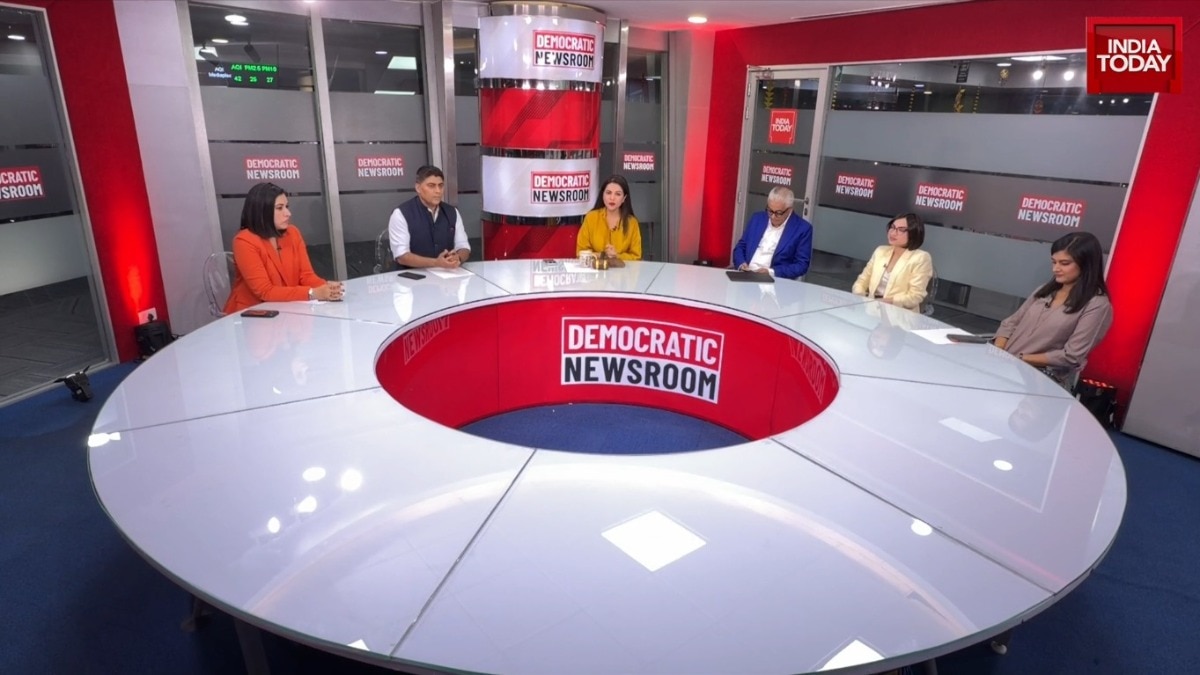
The debate examined why air pollution remains a limited electoral concern despite recurring hazardous air quality, focusing on farm fires, vehicular emissions, construction, public transport, enforcement, festival restrictions and the responsibilities of governments and citizens.Democratic NewsroomNov 6, 2026 23:24 ISTLast UpdatedNov 6, 2026 23:24 IST Published byIndia Today Web Desk Nov 6, 2026 23:23 ISTThe discussion opened just before Diwali, as Delhi and several other Indian cities recorded terrible air quality. Preeti Choudhry highlighted the severity of the situation, including the relocation of an India-Sri Lanka match scheduled for Delhi in December.
Calling the conditions abysmal and embarrassing, she asked whether pollution would ever move beyond social-media hashtags to become a politically emotive issue. The central question was whether politicians would respond seriously when clean air has yet to emerge as a decisive public or electoral demand.The roundtable was moderated by Preeti Choudhry, Managing Editor, India Today TV.
She was joined by Rajdeep Sardesai, Senior Journalist & Consulting Editor; Gaurav C Sawant, Managing Editor, India Today TV; Akshita Nandagopal, Senior Editor, India Today TV; Pooja Shali, Editor, India Today TV; and Aneesha Mathur, Associate Editor. Together, the panel brought editorial, reporting and legal perspectives to questions concerning pollution, governance, agriculture, transport, enforcement and individual responsibility.The panel debated whether pollution persists primarily because of weak governance, limited electoral pressure, inadequate enforcement or citizens’ resistance to inconvenience.
The discussion covered stubble burning, unsuitable cropping patterns, vehicular and industrial emissions, construction dust, geographical factors and deficient public transport. Participants differed over how much governments had achieved and whether Diwali restrictions unfairly narrowed a year-round crisis to one festival.
There was broader agreement that seasonal emergency measures alone were insufficient and that sustained cooperation among governments, citizens, farmers, experts and civil society was required.Preeti Choudhry Managing Editor, India Today TVPollution remains outside electoral politics because most Indians face more immediate livelihood pressures, but that makes government responsibility greater, not smaller. Successive governments across parties have treated the environment as a low priority and responded reactively instead of planning ahead.
Graded restrictions cannot compensate for weak public transport, inadequate footpaths and a lack of practical alternatives to private vehicles. Clean air is fundamentally a governance issue, and governments must prioritise it even when citizens do not vote on it.Gaurav C Sawant Managing Editor, India Today TVGovernments and citizens must act together rather than pretend that nothing has been achieved.
Railway electrification, solar energy, electric vehicles and falling farm-fire numbers show that measures are being taken, although much more remains necessary. Delhi-NCR needs intensified, COVID-like restrictions during November, including work from home, fewer vehicles and curtailed construction.
Restrictions on firecrackers should apply consistently throughout the year and across celebrations; environmental concerns should not appear to target Diwali or other Hindu festivals selectively.Rajdeep Sardesai Senior Journalist & Consulting EditorPollution is a year-round national emergency, not merely Delhi’s seasonal problem or a pretext for political blame. Transport and construction are major contributors, while livelihood pressures keep clean air below immediate voter concerns.
No government has made pollution its foremost priority or pursued the tough, coordinated measures required. Citizens also have obligations, including restraint during celebrations, but durable progress needs partnership among governments, civil society, environmentalists, farmers and other stakeholders rather than communalised disputes, selective accusations or annual crisis management.Pooja Shali Editor, India Today TVPunjab’s farm fires must be examined through cropping choices, soil, rainfall, cultivation patterns and compressed harvesting windows rather than reduced to partisan blame or hostility towards farmers.
Experts and governments should develop long-term alternatives and incentives instead of repeatedly imposing emergency restrictions on ordinary residents. People can accept limits, including avoiding firecrackers, but deserve to know what governments did before pollution reached crisis levels.
Industries cannot escape scrutiny while households, construction projects and commuters bear the immediate burden of reactive measures.Aneesha Mathur Associate EditorCourt filings and judicial proceedings show that crop cycles, transport, industry and biomass burning require structural, long-term responses. Punjab’s narrowed interval between wheat harvesting and rice planting followed legal changes, yet the underlying problem has remained unresolved for years.
Farm-fire counts have fallen in several states, but pollution cannot be confined to Punjab or Delhi. Firecracker restrictions were intended more broadly than Diwali alone, and repeated violations reveal an enforcement problem: laws cannot work when citizens reject even limited, court-approved safeguards.Akshita Nandagopal Senior Editor, India Today TVMost Indians understand that pollution is harmful, and concern about it should not be dismissed as a privilege of those using air purifiers.
Governments are taking steps through graded response plans and additional restrictions, though stronger cooperation and implementation are needed. The difficulty is that people resist inconvenience even while demanding cleaner air, continuing to use private vehicles or opposing curbs on construction and daily activity.
Progress will therefore take time and require both effective state action and greater public compliance.- Ends