


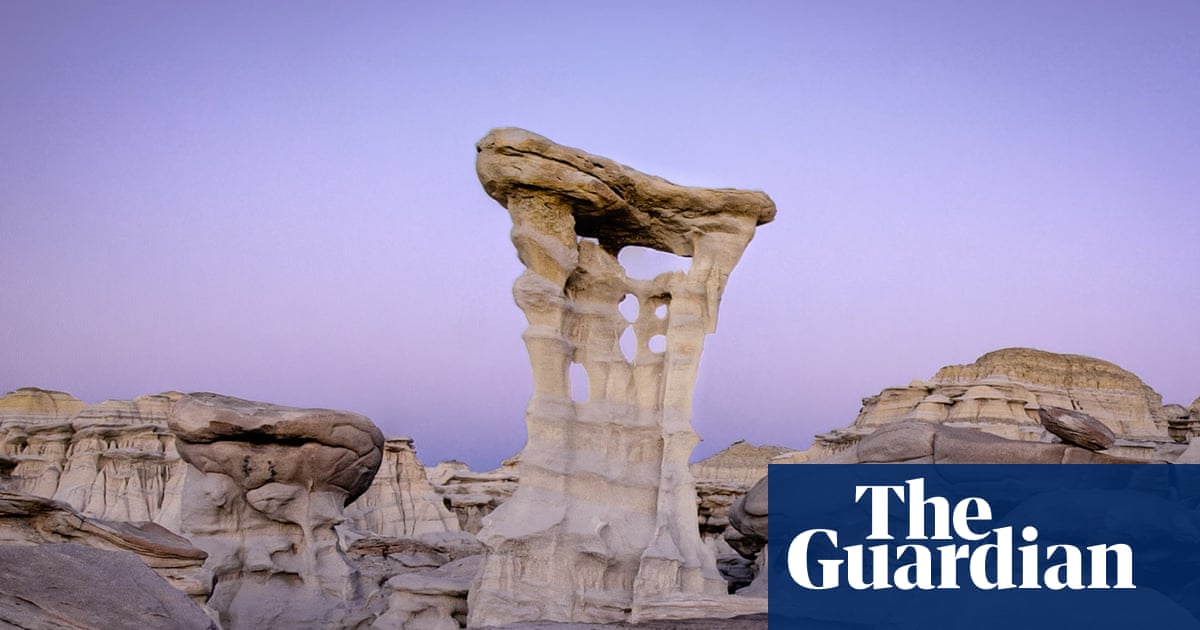
Undulating, gravity-defying rock spires are one of the most magical parts of the landscape of the US south-west.But after torrential rainstorms linked to the super El Niño season, at least one famous rock formation in north-west New Mexico has been found in pieces.And as local communities in the Four Corners region struggle with the aftermath of flooding, washed-out roads and damaged homes, more damage to the region’s natural wonders may still be discovered.Kialo Winters was leading a tour of the Valley of Dreams trail in New Mexico, near the Ah-Shi-Sle-Pah Wilderness, on 30 October when he discovered that one of the area’s most famous spires, or “hoodoos”, had been destroyed.“We turned the corner, and my heart just dropped,” he said. “The highlight feature that everyone wants to see is the Alien Throne.”The majestic formation, which is featured prominently on a local tourism website, had broken into pieces. Winters said he immediately assumed that the heavy rains and the super El Niño season were to blame.A week before, rainstorms and flooding had hit north-west New Mexico hard, forcing evacuations and hundreds of water rescues of stranded residents.
In Farmington, the nearest town to the Valley of Dreams area, some families spent the night on rooftops watching the river flood their homes before they were rescued, officials said.A rock formation in north-west New Mexico. Photograph: Kialo Winters / Navajo Tours USA.Winters has been guiding visitors to the region for 13 years as part of Navajo Tours USA, a company he founded.
The rock spires, which are on Navajo Nation land, are beloved by visitors and photographers, but they also have a deeper significance to the region’s Indigenous residents, he said.“They are traditional waypoints in our Indigenous history that have guided our people across the land for many generations,” Winters said.And it was not just the Alien Throne that had tumbled down, Winters said. Another nearby formation, the King of Wings, what Winters called “the unicorn of hoodoos”, has also been damaged in recent weeks.
Multiple user posts on AllTrails, a hiking website, suggested the formation had broken sometime before 9 October, before intense rains hit the region.“Those are heavy losses for us,” Winters said. But, he added: “The land is alive, and we understand it changes.
The same erosion that made them also brings them down, that is what our elders tell us.”Winters called for visitors to the damaged spires to “let that site rest,” and not to climb what’s left of the formations, or take stones home for relics. “It’s illegal to do that,” he said, adding: “It’s disrespectful to the community as a whole.”While his assumption is that the Alien Throne broke because of “natural causes”, Winters said, the Navajo Nation and the Bureau of Land Management are expected to examine the site and confirm the cause.It’s not yet clear how much damage may have been done to other rock spires across the Four Corners region of Utah, Colorado, Arizona and New Mexico during the past weeks of heavy rain and flooding. Park rangers at the Chiricahua, Goblin Valley, Gold Butte and Cathedral Gorge state and national parks with extensive “hoodoo” formations, told SFGate that they had not yet documented any damage.In a super El Niño year of ongoing intense storms in the Pacific, famous rock formations across time zones are showing damage.
Earlier in October, Hawaii’s centuries-old Hōlei sea arch collapsed into the Pacific.“We’ll keep honoring those sentinels and waypoints through story and photographs and art installations,” Winters said of the lost formations on Navajo Nation land. “Their legacies live on.”