


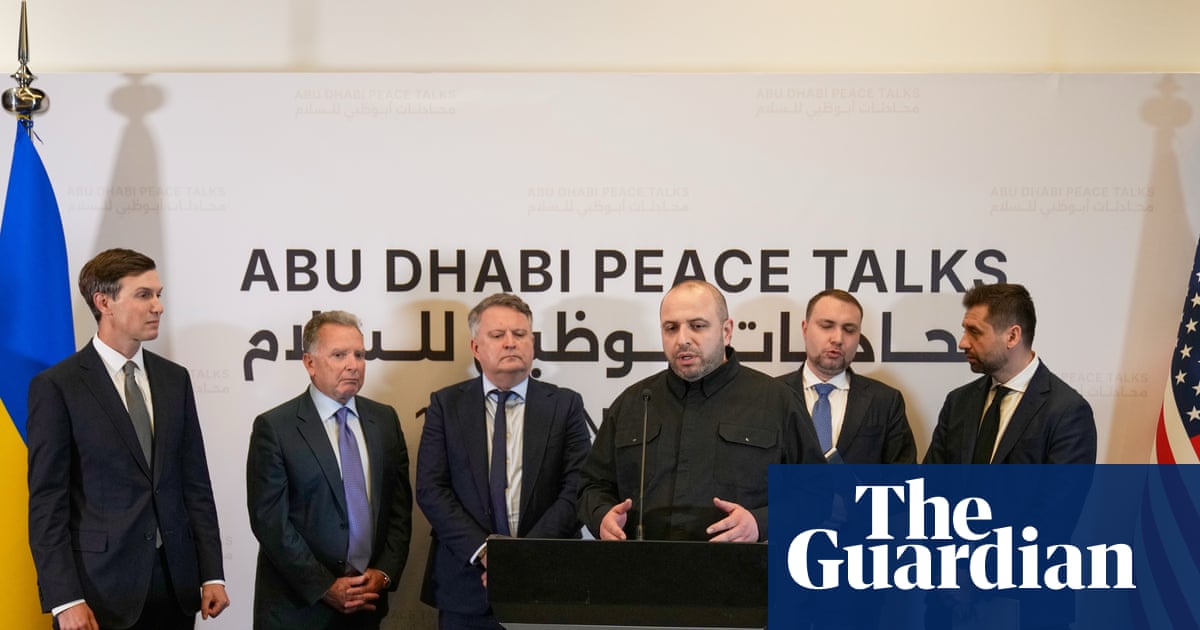
Russia and Ukraine have agreed to the “largest prisoner exchange” of the war at their first US-brokered talks since February, but made little progress towards a broader peace agreement.Both sides sent senior delegations to the two-day talks, led by Donald Trump’s envoys Jared Kushner and Steve Witkoff, in an effort to find a solution to end the nearly five-year war.David Arakhamia, a senior member of Ukraine’s delegation, said the Russian team had arrived with “very, very strict directives”, making it difficult to narrow differences. But he said there had been “really big progress” on security guarantees for Ukraine after the war. “I think we have good momentum to bring about a solution before the new year,” Arakhamia said.Trump’s son-in-law, Kushner, also struck an upbeat tone, saying he could see a path to an agreement. “These deals are very hard and complex, and this one is very emotional, very complex.
It’s a very hot war,” he said. “But we see all the different ingredients to make a deal. We just have to figure out how to refine those ingredients, organise them and create the right structure and pathway.”Kushner said the planned exchange, expected to involve more than 1,000 prisoners from each side, would “reunite families, build trust and create momentum towards peace”.The US envoys are due to travel to Moscow on Thursday to discuss the Abu Dhabi talks with Vladimir Putin, before heading to Dublin, where they are expected to meet Volodymyr Zelenskyy and a group of European partners.“In close coordination with Ukraine and our European partners, we have aligned on proposals we will discuss with President Putin in Moscow tomorrow, followed by consultations with President Zelenskyy,” Kushner said.But despite the optimism, Kushner also said that the two sides have yet to resolve their territorial dispute.Russia’s territorial demands have shifted over time, but Moscow has made clear it wants control of all the Donbas, including areas still held by Kyiv, as well as the parts of two southern regions it does not yet occupy.Vladimir Medinsky, the hardline Russian official who led Moscow’s delegation, said that “every inch of our land will be returned to Russia, one way or another,” in a sign that Moscow was unwilling to soften its territorial demands.
Russia would be satisfied with the negotiations only “when there is peace on its terms”, he added.He also said the main task was to create a new security system in Europe that would become “a new Yalta and Potsdam”.Medinsky said Europe’s post-second world war security system was failing, with Ukraine merely the place where its wider problems had erupted. “Essentially, the whole body is sick, and Ukraine was just a cyst that burst. The whole body must be cured.
A Band-Aid won’t be enough,” Medinsky said.His focus on Europe’s wider security order is likely to heighten concern among European leaders that Washington and Moscow could reach a broader agreement on the continent’s security, potentially limiting Nato’s military presence in eastern Europe. Russia appears to be seeking to revive demands it presented to Nato in 2021, including a halt to further enlargement that would rule out Ukraine’s membership, restrictions on Nato forces and weapons in European countries that joined after 1997, and limits on missile deployments.That ultimatum was dismissed as non-starters by the west and, weeks later, Russia invaded Ukraine.Concerned that Europe’s security future could be discussed over their heads, European governments sent envoys to Abu Dhabi to try to influence the talks, although they are not believed to have taken part directly.Medinsky dismissed their presence, saying that if they had come “as tourists”, they could talk in the hotel lobby, and that Russia would consider proposals only if they had “something specific” to offer.European leaders have increasingly discussed the need for a direct channel to Putin, but no clear candidate has emerged.
The leaders of Norway and Finland have recently spoken to the Russian president, while Germany’s chancellor, Friedrich Merz, said on Wednesday that he was open to doing so.Kushner, meanwhile, said Europe should choose a single representative to speak on its behalf. “If Europe could identify one person to speak on their behalf, that would be a bigger achievement than getting the Russians to include them in the negotiations,” he said.He stressed that one of the aims of his trip to Moscow was to “see if we can get Europeans added” to future talks. “The issues that were covered in these discussions were really postwar security,” he said. “How do we make sure that once this war ends, it doesn’t start again?”Russian officials have long opposed European participation, arguing that countries supplying weapons to Kyiv cannot act as impartial mediators. Medinsky said Russia would speak to European countries only “when their conscience awakens” and they stop supplying Ukraine with weapons.As diplomatic efforts continued, both sides kept up their attacks.
Russia launched drones at Kyiv and other regions during the day, while Ukraine struck the Ust-Luga port on Russia’s Baltic coast overnight. The port, in the Leningrad region, is a major route for Russian energy exports and was still burning on Wednesday.