


The strongest argument against Legislative Councils comes from India's own political history. West Bengal abolished its Council in 1969.
Punjab did so in 1970. Tamil Nadu followed in 1986.
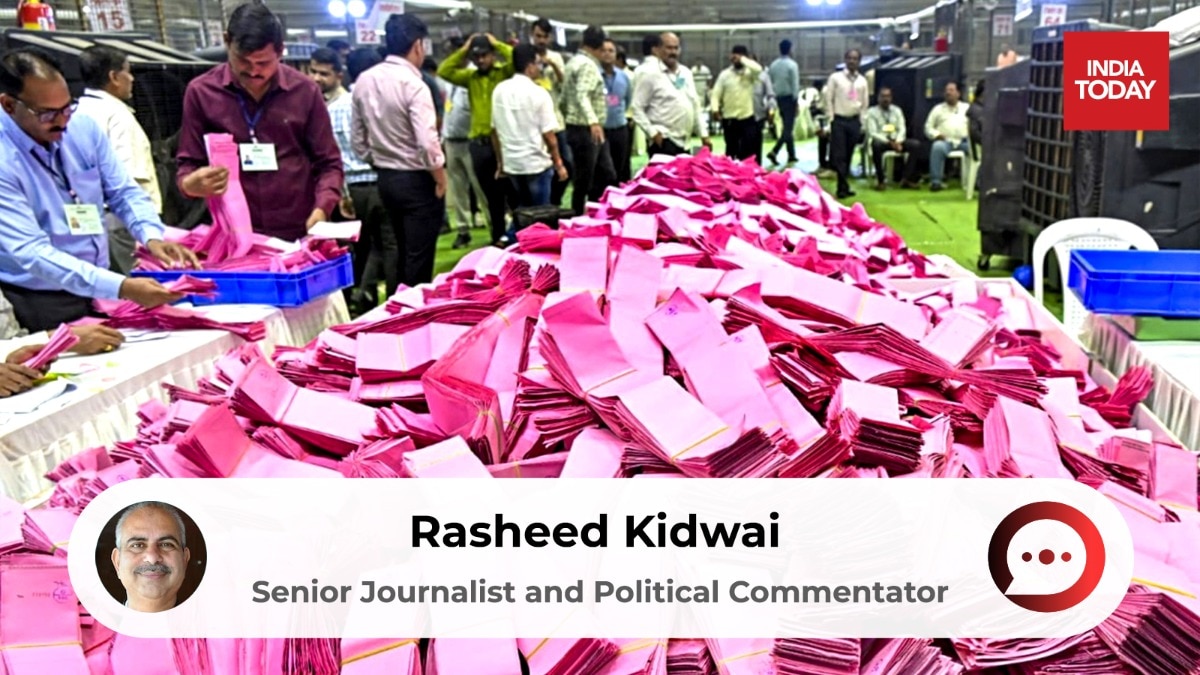
These states have continued to function with unicameral legislatures, without any compelling evidence that the absence of a second chamber has fundamentally weakened their democratic legitimacy.Polling officials handle ballot papers during the counting of votes for the Maharashtra Legislative Council election, in Nagpur on October 27, 2026. Prime Minister Narendra Modi had reason to celebrate the latest round of Legislative Council elections.
The BJP-led National Democratic Alliance won 16 of the 28 seats contested across Uttar Pradesh, Bihar, Maharashtra, and Karnataka. The Samajwadi Party secured five, the Congress managed one, and the remaining seats went to other parties and Independents.
The verdict was promptly interpreted through the familiar prism of political triumph and humiliation.Yet the results also exposed the limitations of such interpretations. In Uttar Pradesh, the BJP won six seats against the Samajwadi Party’s five, an outcome that could tempt Akhilesh Yadav’s supporters to read encouraging signs ahead of the 2027 Assembly elections.
In Karnataka, the BJP-Janata Dal (Secular) alliance swept all four seats, embarrassing the ruling Congress. In Maharashtra, the Congress prevailed in the Nagpur Graduates’ constituency, defeating the BJP in the political backyard of Devendra Fadnavis and Nitin Gadkari.
Bihar produced another surprise when Prashant Kishor’s Jan Suraaj Party defeated the Congress in Darbhanga Teachers’ constituency.Interesting results, certainly. But representative of what?These elections were not conducted among the ordinary electorate.
They involved specially registered graduates and teachers, constituencies whose very existence raises questions about the relationship between educational qualifications and democratic rights. The irony is difficult to miss.
A professionally conducted opinion survey, drawing upon a carefully stratified sample of voters across caste, class, gender, age, and geography, might offer a more representative picture of public sentiment than an actual election restricted to particular educational categories. A survey, of course, is not a democratic mandate.
But neither should a victory among a narrow, self-selecting electorate be mistaken for the verdict of an entire state.The real story of these elections, therefore, may have less to do with who won than with the continued existence of the institution itself.THE RAJ'S UNFINISHED BUSINESS India has six states with Legislative Councils: Uttar Pradesh, Bihar, Maharashtra, Karnataka, Andhra Pradesh, and Telangana. Their origins lie in colonial arrangements that sought to accommodate selected interests without surrendering control to the masses.The Montagu-Chelmsford reforms of 1919 and the Government of India Act of 1935 helped institutionalise bicameral legislatures in the provinces.
The underlying philosophy was unmistakable. Political participation was to be mediated through property, education, occupation, and social standing.
Universal adult franchise was still a distant prospect.Independent India made a revolutionary departure from this philosophy by granting every adult an equal vote. Yet, curiously, it retained a structure that assigns special electoral privileges to graduates and teachers.Under Article 171 of the Constitution, approximately one-third of a Legislative Council is elected by local authorities, another third by MLAs, one-twelfth by graduates, and one-twelfth by teachers.
The remaining one-sixth is nominated by the Governor from prescribed fields of expertise.Consider the absurdity. A university graduate who obtained a degree three years ago qualifies to enrol in a special electoral constituency.
A farmer with decades of practical knowledge, a skilled artisan, a small entrepreneur, or a homemaker has no equivalent entitlement by virtue of that experience.The teachers’ constituency is no less anachronistic. Teachers deserve respect, fair remuneration, and a meaningful voice in education policy.
But why should their profession alone merit reserved legislative representation? What about doctors, nurses, agricultural workers, engineers, or sanitation workers?The Constitution’s architects debated these questions.
They were divided over whether a second chamber could improve legislation or merely become an expensive and unnecessary appendage. Seventy-six years into the Republic, the burden of proof ought to rest with those defending the institution.A REFUGE FOR POLITICAL LOYALISTSThere was once a respectable argument for Legislative Councils.
They could accommodate scholars, artists, social reformers, and distinguished individuals unwilling or unable to participate in the rough-and-tumble of electoral politics. They could scrutinise legislation without the pressures of immediate electoral calculations.In practice, however, political expediency has frequently prevailed over intellectual distinction.The Legislative Council offers a convenient route for defeated politicians, party functionaries, loyal retainers, and individuals whose usefulness to the leadership exceeds their appeal to voters.
It can also provide a constitutional route into ministerial office for someone who has not secured an Assembly seat.This is hardly the monopoly of one political party. Congress, BJP, Samajwadi Party, and regional formations have all found the arrangement useful.There have, of course, been able legislators in these chambers.
Nor does electoral defeat necessarily disqualify an individual from public service. The objection is to a system that makes political rehabilitation an institutional function, rather than an occasional exception.The comparison with the Rajya Sabha is frequently invoked but remains misleading.
The Council of States represents India’s federal structure and possesses substantial legislative authority. State Legislative Councils, by contrast, can generally delay ordinary legislation but cannot permanently veto the elected Assembly’s will.
Their powers over Money Bills are even more restricted.If the second chamber cannot decisively restrain the first, and if its composition does not demonstrably enrich legislative deliberation, what exactly is the taxpayer financing?A chamber that exists largely to accommodate political convenience cannot claim constitutional sanctity merely because it has survived.DEMOCRACY DOES NOT NEED A WAITING ROOMThe strongest argument against Legislative Councils comes from India’s own political history.West Bengal abolished its Council in 1969. Punjab did so in 1970.
Tamil Nadu followed in 1986. These states have continued to function with unicameral legislatures, without any compelling evidence that the absence of a second chamber has fundamentally weakened their democratic legitimacy.There is an important political irony here.
Parties that condemn legislative extravagance when in opposition sometimes discover the virtues of bicameralism upon assuming power. A Council offers additional positions, ministerial possibilities, and opportunities for political accommodation.
Its usefulness to party management is considerably easier to establish than its usefulness to governance.Article 169 provides a constitutional route for abolition. A state Assembly must adopt a resolution by the prescribed special majority, after which Parliament can legislate to abolish the Council.
No constitutional amendment under Article 368 is required.The question, therefore, is not whether abolition is possible. It is whether the political class has the appetite to dismantle an institution from which it benefits.India certainly needs better legislative scrutiny.
State Assemblies often suffer from hurried lawmaking, inadequate committee examination, and declining opportunities for substantive debate. But these weaknesses call for stronger committees, longer sittings, independent research support, and greater transparency, not necessarily another chamber populated by indirect and restricted elections.If expertise is required, legislatures can invite specialists, strengthen committee hearings, and commission independent assessments.
Expertise need not be rewarded with a six-year legislative tenure.The October 2026 results will soon be overtaken by the next political contest. BJP leaders will celebrate their victories, the Samajwadi Party will search for favourable signals, and the Congress will take consolation from Nagpur.
Each party will construct a narrative suited to its immediate interests.Yet, how much do these results really tell us about the political mood of the country? They may offer clues about party organisation, local loyalties, and the mobilisation of specific interest groups, but projecting them onto future Assembly elections would be politically convenient rather than analytically sound.
The danger lies in mistaking the outcome of a restricted electoral exercise for the verdict of a democracy at large.But beyond these competing claims lies a more consequential question. Can a democracy founded upon political equality continue indefinitely with an institution that preserves the logic of privileged electorates?The British created such arrangements because they distrusted mass democracy.
Independent India has no reason to perpetuate that distrust.- Ends