


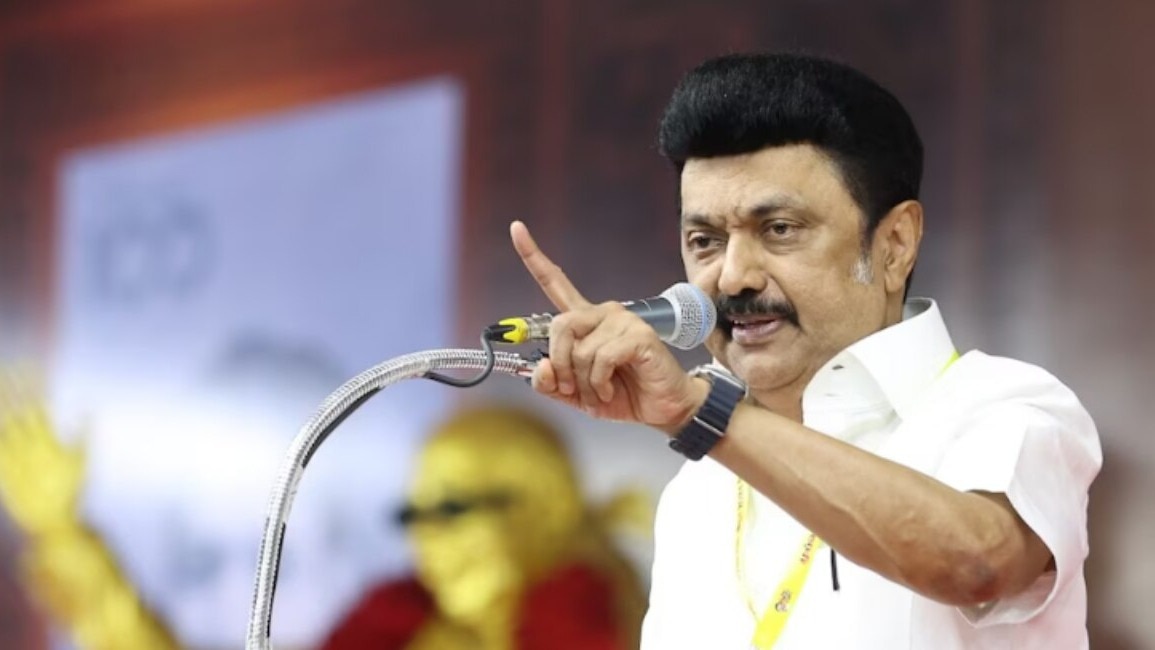
M K Stalin accused the TVK government of weakening Tamil Nadu's economy and losing a major Korean project. The criticism spotlights sluggish GST growth, falling domestic production revenue and mounting employment concerns.Stalin also accused Chief Minister Vijay of being detached from the state's economic problems.
DMK chief and former Tamil Nadu chief minister MK Stalin on Monday accused the ruling Tamilaga Vettri Kazhagam government of pushing the state into an economic downturn marked by weak tax revenue growth, policy paralysis and the loss of a major industrial project, news agency Press Trust of India reported.Stalin cited Tamil Nadu's Goods and Services Tax revenue growth and the reported relocation of a Rs 1,614-crore Korean investment proposal to Andhra Pradesh to allege fiscal mismanagement and administrative failure by the state government.In a post on X, Stalin said Tamil Nadu's GST revenue growth under the TVK government had fallen well below the national average of 22.9 per cent in October. “The economic growth of Tamil Nadu has been completely buried under the TVK rule,” he said.: 1) GST ... . 2) 1,614 ... . @Guidance_TN ego- .
Reverse Gear- . , show . Brace for tough times.
Tamil Nadu is doomed under the TVK government. #TVKfails #KIA #Hyundai #AndhraPradesh #Automobiles @nidhi_sharma— M.K.Stalin (@mkstalin) November 2, 2026According to PTI, Stalin said the Korean investment proposal was originally intended for Tamil Nadu but moved to Andhra Pradesh because of the TVK government's “sheer negligence”. He also claimed that Guidance Tamil Nadu, the state's nodal agency for investment promotion and single-window clearances, had been systematically weakened to satisfy the “personal egos” of people in the ruling establishment.
He said the agency had earlier brought global recognition to the state.“One must learn from them how to move so rapidly in reverse gear across all sectors,” Stalin said, taking a swipe at the government's performance. Stalin also accused Chief Minister C Joseph Vijay of being detached from the state's economic problems.
He said the chief minister was holding public roadshows and waving to crowds in Assembly constituencies facing bypolls while the state's financial future remained uncertain.Warning of financial difficulties, Stalin said: “Brace for tough times. Tamil Nadu is doomed under the TVK government.”DMK leader and former finance minister Thangam Thennarasu also criticised the TVK government, alleging that Tamil Nadu was witnessing economic stagnation and a sharp decline in its performance.Citing official figures for October, Thennarasu said Tamil Nadu's GST revenue grew by 3 per cent, while Andhra Pradesh recorded 24 per cent growth, Kerala 23 per cent, Karnataka 18 per cent and Telangana 14 per cent.
Tamil Nadu's collections had contracted by 1 per cent in August and 5 per cent in September, according to figures shared by him.“It is concerning that Tamil Nadu, once among India's leading states in economic growth, continues to witness a decline under the TVK government,” Thennarasu said in a post on X.He said taxes collected on key goods imported into Tamil Nadu had contributed to a modest increase in overall receipts, but tax revenue from domestic production had steadily declined. “I wish to point out to the TVK government that this must be viewed as an indicator of the broader economic stagnation prevailing in the state,” he said.Thennarasu urged the government to increase manufacturing within the state instead of depending heavily on taxes from imported goods. “I therefore urge the TVK government to take immediate steps to increase domestic production and expand sales to other states and overseas markets, instead of relying solely on revenue from imported goods. This is essential to strengthen Tamil Nadu's overall economy and create more employment opportunities for our young people,” he added.Stalin and Thennarasu cited Tamil Nadu's recent GST figures and the reported loss of the Korean investment proposal to accuse the TVK government of economic and administrative failures, while calling for measures to strengthen domestic production and employment.- Ends