


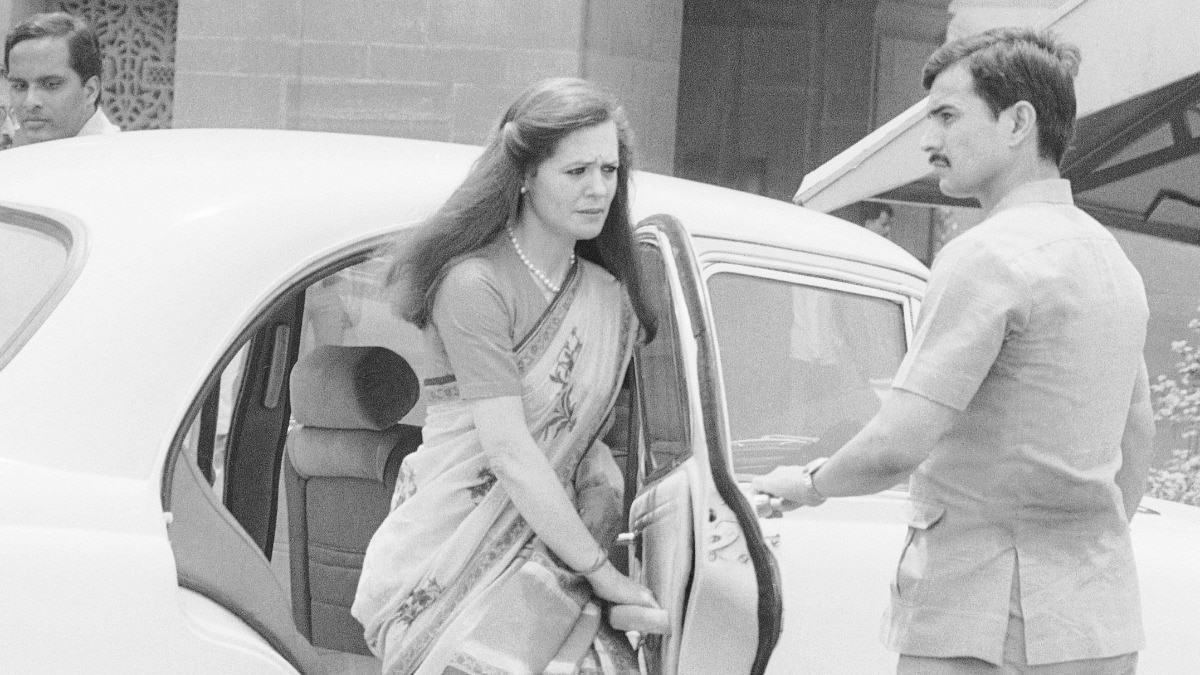
In her autobiography, Belonging: A Journey of Love, Congress matriarch Sonia Gandhi recalls losing her first child, a premature baby boy, in January 1969. She recounts her grief, her refusal to let the newborn's remains be consigned to a river, and how Rajiv and Sanjay Gandhi buried him at the family's Mehrauli farm.In her memoir, Belonging: A Journey of Love, Sonia Gandhi recalls losing her first child, who was born prematurely and died shortly after birth. (ITG Image) The joy of expecting their first child, the preparations for their arrival and the anticipation of becoming parents gave way to heartbreak for Sonia Gandhi and Rajiv Gandhi in January 1969.
What followed was a deeply personal tragedy, compounded by grief, questions over the baby's final rites and a cruel newspaper report that the now Congress matriarch says continued to haunt her.In her autobiography, Belonging: A Journey of Love, released on Tuesday, Congress leader Sonia Gandhi has recounted the loss of her first child, a baby boy who died shortly after birth. She has also written about the circumstances surrounding his burial, the support she received from her family and the emotional toll of the tragedy.Sonia writes that she and Rajiv were overjoyed when they learnt in September that she was expecting.
Her mother-in-law, Indira Gandhi, too, was delighted at the news. Writing to a friend posted abroad, Indira said, "May I let you into a secret?
I am expecting to become a grandmother in April. We are all thrilled."Indira Gandhi greeted the news with a kiss and a hug, playfully remarking, "One big baby having another baby!" Sonia writes that she appreciated the affection but questioned Rajiv about the remark, wondering whether she behaved like a baby despite trying her best.
Rajiv assured her that it was meant affectionately, although she remained unconvinced. Her mother-in-law soon took charge of preparations for the baby.
She instructed Sonia on her diet, emphasised the importance of exercise and regular walks, and began preparing a list of things needed for the layette from an old book. She asked Amie Aunty, a senior member of Indira Gandhi's staff, to find the softest muslin and explained to a tailor how five layers of the material should be stitched together to make a perfectly soft nappy.
She also began looking for possible names and asked Amie Aunty, to find a good doctor to oversee Sonia's pregnancy.Sonia, however, writes in her autobiogrpahy that she was not particularly enthusiastic about all the instructions. She disliked exercising, could not bear the taste of spinach, which she was expected to eat at least three times a week, and had to drink two large glasses of milk every day.
She would gulp down spinach with water after every mouthful and occasionally sulk over her meals, sometimes pushing her plate aside. She writes that while she would have firmly resisted her own mother's instructions, she was still too timid to do the same with her mother-in-law.Apart from these dietary struggles, the pregnancy was proceeding smoothly.
Sonia underwent regular check-ups and had no discomfort, although she missed Italian food. She also developed a craving for jamun (Java plum), phalsa (Indian cherry) and Fanta, the orange beverage, of which she would drink as many as 12 glasses a day.SONIA GANDHI ON THE SEVENTH MONTH AND A TRAGIC LOSSThings changed unexpectedly one morning at the beginning of the seventh month of her pregnancy.
Sonia began experiencing uneasiness and mild abdominal pain. The doctor was called and she was advised to rest.
But the pain intensified, and by the evening of the following day, she had to be rushed to hospital.On January 18, 1969, Sonia gave birth to a baby boy. The delivery was normal, and she heard his first cry as he was placed in an incubator.
Later, Rajiv took her to see their son. She describes him as a tiny, perfectly formed boy with thick black hair and long, slim fingers.The couple immediately fell in love with the child. "Later Rajiv took me to see him, a tiny, perfectly formed boy, with thick, black hair and long, slim fingers.
We fell in love with him immediately, but Rajiv had been told already that there were doubts about his survival. With Amie Aunty beside him, he broke it gently to me when at 6:30 in the morning the end came.""No, it was not possible!
Why, why," Sonia recalls asking.Both were shocked and heartbroken. They held each other tightly as Sonia cried inconsolably.
Rajiv, despite his "stiff upper lip" upbringing, also wept copiously.Indira Gandhi, on learning of the tragedy, flew back directly, interrupting her tour. She reached them at 11.30 pm, embraced Sonia and Rajiv, and sat with them for a long time, her eyes red and swollen.
Although she wanted to remain with them, she had to complete her tour engagement and left early the following morning.Sonia writes that she, too, longed to have her own mother beside her. Rajiv's brother, Sanjay Gandhi, rushed to the hospital to be with him.
Although his manner could sometimes appear abrupt or arrogant, Sonia says he had a warm and empathetic side. He tried to cheer them up with funny stories and riddles.
On one occasion, he even brought her a "bouquet" of freshly picked green lentil and bean plants from a field, wanting to show her what the ingredients of their everyday yellow dal looked like.THE BURIAL OF THE BABY BECAME A QUESTIONBut another painful question soon confronted Sonia and Rajiv Gandhi, what should be done with their newborn's remains?Rajiv explained that, according to Hindu tradition, a newborn child was simply released into the river rather than cremated. Burying the child in a cemetery was also complicated.
Neither the Christian cemetery nor the nearby Parsi cemetery was considered an option. Sonia writes that using the Christian cemetery would, in any case, have created a furore, while Rajiv's father, Feroze Gandhi, had been a Parsi but had not followed Parsi religious customs.Exhausted by grief, Sonia initially struggled to respond.
Rajiv gently reminded her that they had to take the decision together."No," she whispered. "No matter what, I'm not going to allow our baby to be thrown into the river."She recalled having visited the Okhla barrage with Rajiv and friends for drives and picnics. On one occasion, she had seen a swollen male body floating in the river, its journey interrupted by a heap of garbage.
The current had pushed it towards the bank, where hungry scavenging dogs were trying to pull it out.The sight had horrified her. She could not imagine allowing her newborn to be disposed of in the same manner, irrespective of the religious significance attached to the river.Sanjay then joined Rajiv in discussing what could be done.
They eventually decided that the baby would be buried on their father's farm in Mehrauli.Sonia recalls the property as a place the family would visit on Sundays in her mother-in-law's Ambassador car, which had belonged to Rajiv's maternal grandfather, Jawaharlal Nehru. The plot was then largely bare, with a well, several old trees, newer trees planted by Feroze Gandhi and bougainvillea bushes along the boundary.Rajiv and Sanjay buried the baby deep beneath a beautiful pink bougainvillea bush, in full bloom, on the left side of the inner boundary wall.
For a long time, Sonia and Rajiv would stop there and place a flower over the spot whenever they visited. It did not ease their grief, she writes, but they eventually had to accept what had happened.- Ends