


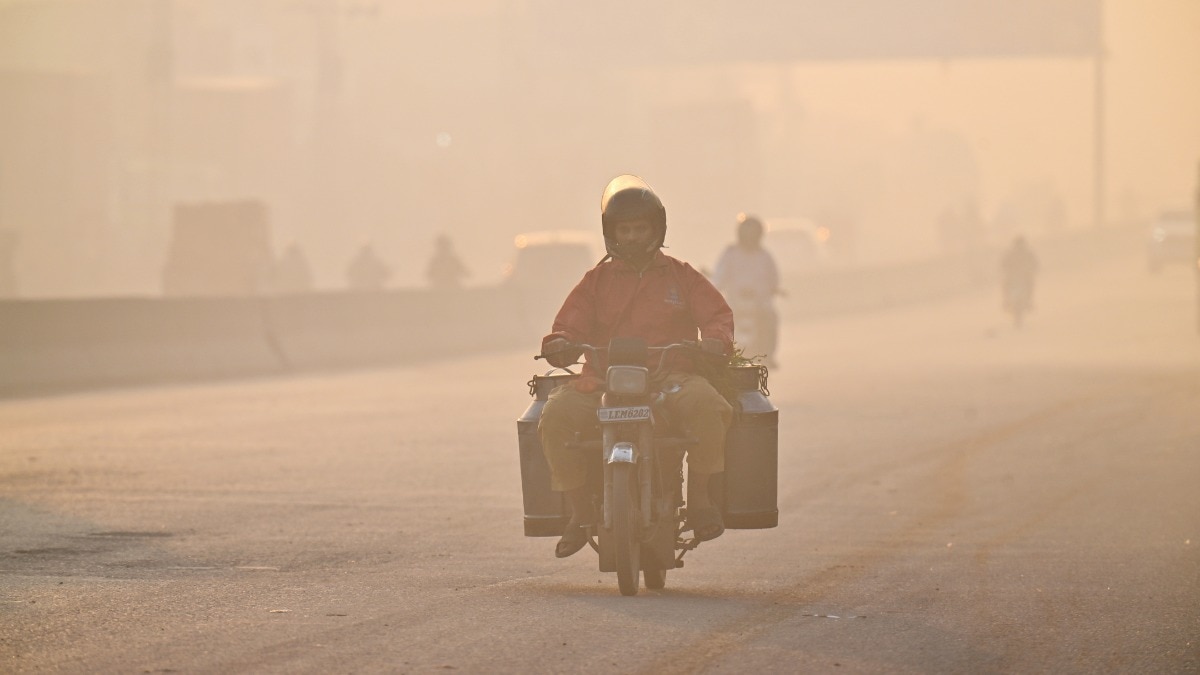
Pakistan blamed Diwali fireworks in India for Lahore's worsening smog, but its own air quality report challenges the claim, pointing to thousands of farm fires within the country and sharper pollution spikes in cities farther from the international border.The report found that cities located farther from the international border recorded a sharper rise in PM2.5 concentrations than those closer to it. As Lahore choked under a thick blanket of toxic smog, Pakistan pointed fingers across the border, blaming firecrackers burst during India's Diwali celebrations for worsening air quality.
But a report by its own air quality monitoring agency has now raised questions over that explanation, finding no conclusive link between the fireworks and the post-Diwali pollution spike.The Pakistan Air Quality Initiative (PAQI), in its report released on Tuesday, flagged persistent crop-residue burning in Pakistan's Punjab province, with satellite data detecting 16,714 likely farm fires between October 1 and November 9, nearly unchanged from the same period last year.According to Pak media, the report also challenges the argument that pollution drifting from India was the primary reason behind Lahore's worsening air quality. Cities located farther from the international border recorded a sharper rise in PM2.5 concentrations than those closer to it, a pattern that does not fit the expected footprint of cross-border pollution.NO CLEAR LINK BETWEEN DIWALI FIREWORKS AND LAHORE SMOGThe PAQI assessment examined whether fireworks during Diwali celebrations in India on November 8 had contributed to deteriorating air quality in Pakistan's Punjab province.
It acknowledged that easterly winds carried air from Indian territory towards Pakistan during the night. Of the 48 air routes tracked towards Lahore, Kasur and Sialkot between 9 pm on November 8 and midnight on November 10, 45 had passed over India in the previous 12 hours, mainly near Tarn Taran, Amritsar and Jammu.However, the report cautioned that this alone was not sufficient to attribute Lahore's poor air quality to fireworks across the border.
It also found that emissions from New Delhi had not reached Lahore during the period under examination. Air from Delhi entered Pakistan near Rahim Yar Khan and Bahawalpur only after 3 am on November 10, with its closest approach to Lahore remaining 266 km away.The report further pointed to a geographical pattern that complicates Pakistan's claim.Lahore's average PM2.5 concentration rose by 10 per cent during the period between 6 pm on November 8 and 1 am on November 10, compared with the preceding seven-day average.
Kasur recorded a 27 per cent increase and Sialkot 33 per cent, while Narowal saw a 2 per cent decline.But the increase was significantly higher in cities farther inland. Faisalabad, around 130 km from the international border, and Multan, around 180 km away, both recorded a 40 per cent rise in PM2.5 levels.The average increase across the four border cities of Lahore, Kasur, Sialkot and Narowal was 36 micrograms per cubic metre, compared with 85 micrograms in Faisalabad and Multan.The report noted that if cross-border pollution were the dominant factor, a greater increase would ordinarily be expected in areas closer to the border.Sialkot was an exception, recording a 37 per cent rise in PM2.5 levels during the night after Diwali, with air trajectories passing over the Jammu region.PAK'S OWN FARM FIRES ADD TO POLLUTION BURDENThe report identified crop-residue burning as another important factor in the region's deteriorating air quality.
Satellite instruments detected 18,825 fires across Punjab during the assessment period, with 89 per cent classified as likely crop-residue burning.The highest daily count was recorded on November 1, with 1,102 detections.Sheikhupura recorded the highest number of fires at 2,559, followed by Jhang (2,192), Okara (2,062), Hafizabad (1,893) and Gujranwala (1,417). Together, these five districts accounted for 54 per cent of all detections.The assessment found a positive correlation between fire activity in areas upwind of Lahore and the city's PM2.5 levels.On days when air trajectories passed over areas where crop burning was taking place, average PM2.5 concentrations in Lahore stood at 175 micrograms per cubic metre, compared with 93 micrograms on other days.A similar trend was observed in Multan, where concentrations averaged 203 micrograms on days influenced by fires, against 88 micrograms on other days.
In Bahawalpur, the corresponding figures were 125 and 65 micrograms.However, PAQI cautioned that the association did not establish the precise contribution of farm fires to urban pollution. Stagnant weather conditions and reduced atmospheric dispersion also played a role in trapping pollutants.Lahore's average PM2.5 concentration stood at 126 micrograms per cubic metre during the assessment period, eight times the World Health Organisation's guideline value.
The city exceeded Pakistan's 24-hour National Environmental Quality Standards on all 40 days for which valid data were available.The report also noted that the number of farm fires was 1 per cent lower than in 2025 but remained 8 per cent higher than the 2020-2025 average.LAHORE AMONG WORLD'S MOST POLLUTED CITIESThe findings come as Lahore continues to battle severe air pollution. The city topped Swiss air quality monitoring group IQAir's ranking of the world's most polluted major cities for a third consecutive day on Wednesday, recording an AQI of 263, categorised as 'very unhealthy'.The city's average PM2.5 concentration was also reported to be 37.2 times the WHO's annual guideline, according to IQAir.Pakistan's Punjab Environment Protection and Climate Change Department, meanwhile, reported an improvement in Lahore's air quality on Monday following emergency mitigation and enforcement operations.The city's average AQI reading fell from 489 at 9 am to 232 by 3 pm, a decline of around 53 per cent.The pollution crisis has also disrupted sporting events, with the Pakistan Cricket Board shifting the second Test between Pakistan and Sri Lanka, scheduled to be held in Lahore from November 17 to 21, to Rawalpindi.As pollution continues to blanket parts of South Asia, the latest report adds another dimension to the debate over cross-border air pollution, pointing to the need to distinguish between pollutants transported across national boundaries and emissions generated within the region itself.The report also acknowledged that establishing whether particulate matter came from fireworks or agricultural fires would require chemical analysis of pollutants, including elements such as potassium, strontium and barium.
Such measurements were not available at Pakistani monitoring stations.- Ends