


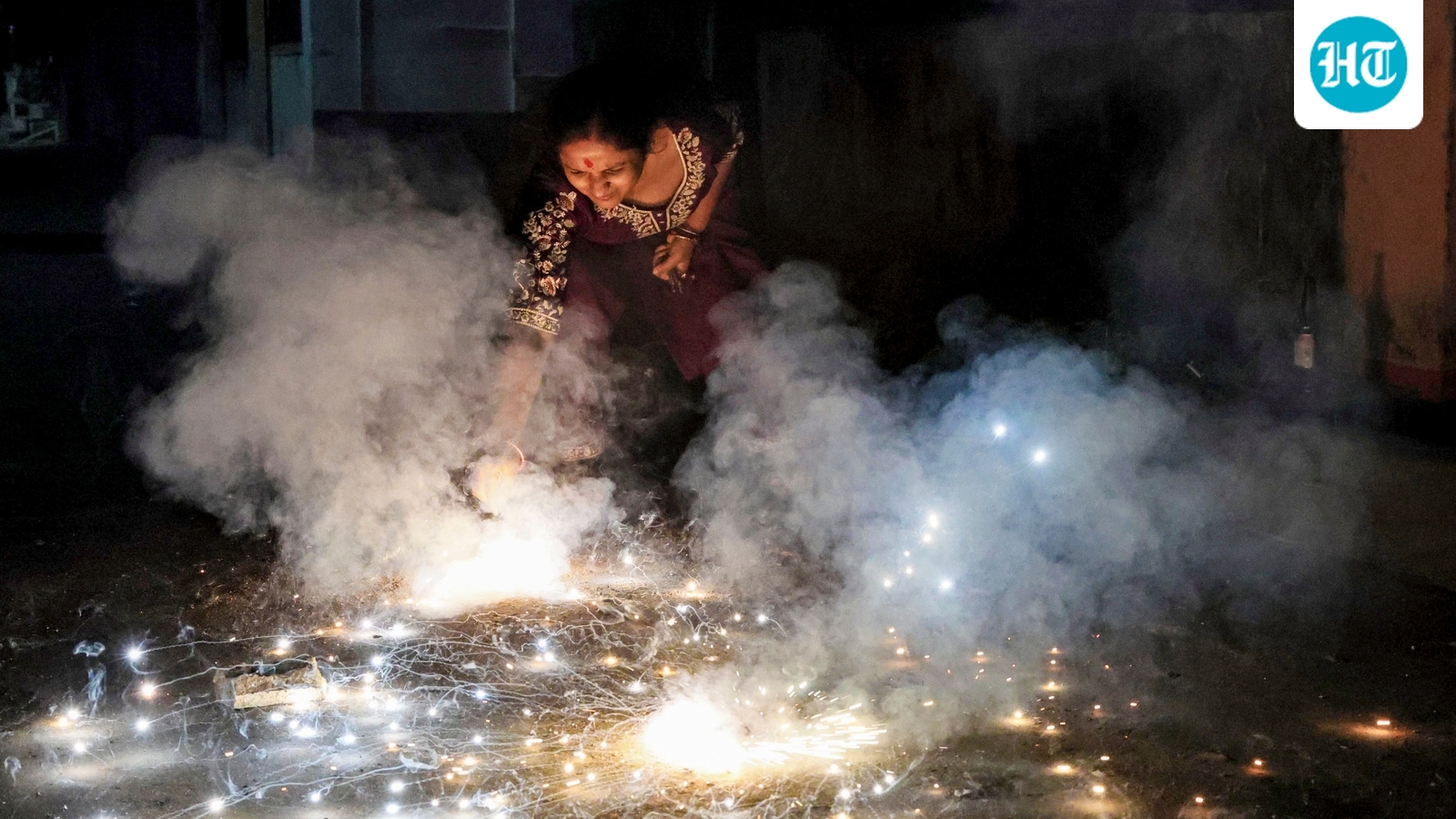
A study claims that firecrackers contributed the most as the air quality took a hit after midnight on Diwali.Vehicle emissions, biofuel combustion, wood burning, and mineral dust were also contributing factors to pollution during the period but their contributions were negligible compared to those from firecrackers. (PTI/Representative)According to an assessment of scientific data by the Indian Institute of Tropical Meteorology (IITM), Pune, firecrackers contributed to 71.1% of PM2.5 pollution from 1am to 9am on November 9, shortly after people wrapped up their Diwali celebrations. PM2.5 is fine dust, particles 2.5 micrometres across or smaller, and micrograms per cubic metre (µg/m³) measure how much of it is in the air.Vehicle emissions, biofuel combustion, wood burning, and mineral dust were also contributing factors to pollution during the period but their contributions were negligible compared to those from firecrackers.Deep DiveFirecrackers' contribution to PM2.5 pollution on Diwali night was significantly higher than what was seen on days preceding it, according to the IITM study.
Firecrackers are believed to have contributed to 43.4% of pollution on Diwali eve and only 5.6% from 1am to 9am on November 7. They accounted for over 29% air toxicity during the same period a day after Diwali.Also Read: On Diwali night, Delhi's PM2.5 readings climbed towards 1,000, then went blankAs reported by HT earlier, even as Delhi turned into a gas chamber on Diwali night, none of the monitoring stations in the city recorded PM2.5 readings that went past 1,000.Last Diwali, 29 of the 39 stations recorded at least one hour above 1,000, the highest 2,224 at NSIT Dwarka, according to a copy of CPCB's live feed kept by OpenAQ, an open-data platform.Also Read: PM2.5 readings of 1K+ excluded from AQI: CPCB clarification after HT reports on ‘dark monitors’The Central Pollution Control Board (CPCB) later clarified that the upper limit of these readings is capped at 1,000 micrograms per cubic metre (μg/m³).The clarification came a day after HT reported that more than two-thirds of the Capital’s 59 air-quality monitoring stations went offline between 10pm and 6am on Diwali, when exposure to pollution was at its highest.Several areas recorded an Air Quality Index (AQI) of over 400 in Delhi on the morning after Diwali and the average AQI at 376 in the 'very poor' category as of 7am.
Sonia Vihar, Burari Crossing and Vivek Vihar were among some of the most polluted areas.The Supreme Court had allowed the bursting of green crackers for limited hours on November 7 and 8, adding that a complete ban would be reinstated starting November 9.Poorva Joshi is a Senior Content Producer with nearly five years of experience in journalism. She covers Indian politics and geopolitics, with a focus on diplomatic relations, trade negotiations, and economic policy between countries.
She has previously worked at India Today, CNN-News18 and India TV. Over the years, she has reported extensively on major national and international developments, including the Air India plane crash, the Pahalgam terror attack, India–US trade tensions, tensions in the Middle East, high-profile crime stories in India, multiple state Assembly elections, and the 2024 Lok Sabha elections.
She spearheaded the Bihar Assembly elections live blog, which drew over one million users to the Hindustan Times website. Her reporting on India–US tariff and trade tensions has consistently driven strong readership and engagement for the platform.
In addition to reporting, she has spent a significant part of her career leading newsroom shifts, ideating stories, editing and fine-tuning copies, and seeing coverage through from planning to publication, alongside writing original articles. At HT, she received the Insta Award for being the top contributor to the HT News Team in November.Read MoreAir QualityGet Latest News, breaking headlines, and top India News, and today real-time updates from across the nation.
Stay informed on politics, government policies, crime, Today Weather, and major developments on Hindustan Times