


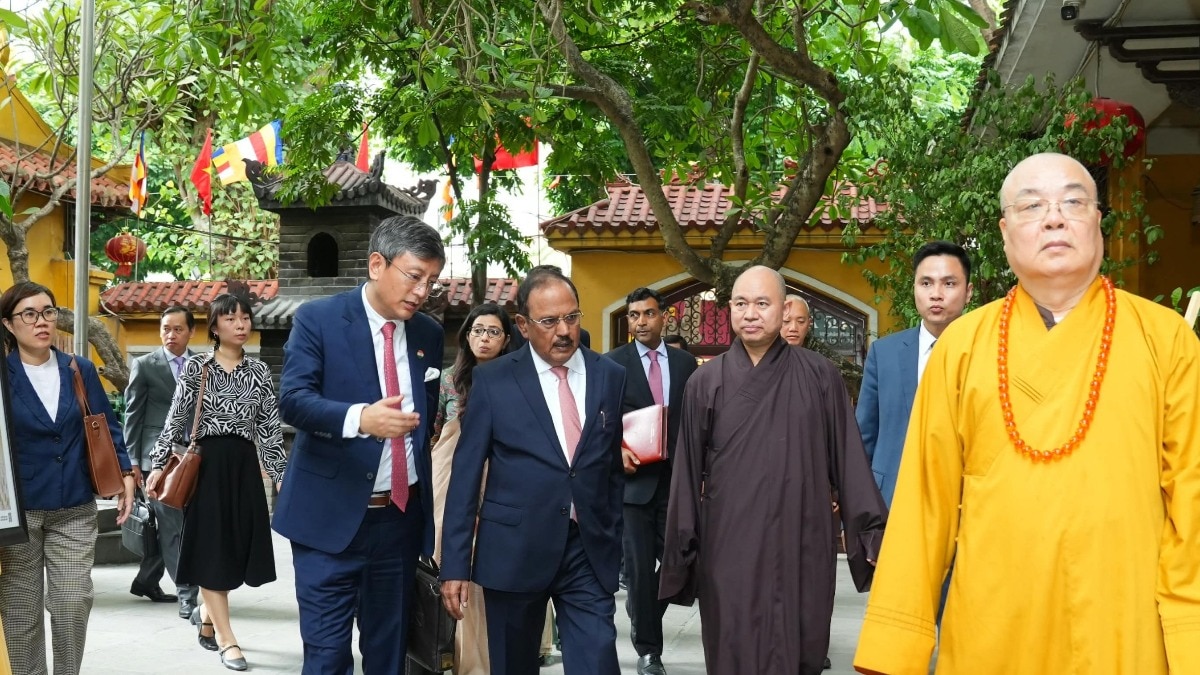
National Security Adviser (NSA) Ajit Doval is in Vietnam and the coverage in India focused on his visit to a Buddhist temple and the rituals he performed there. A closer look at Vietnamese government statements and media reports, however, reveals a much bigger security agenda between the two nations.
It involves discussions on intelligence sharing, access to classified information, and cooperation in cybersecurity and defence. This comes even as China grows more aggressive in the South China Sea, putting Southeast Asian nations like Vietnam on edge with maritime claims and military assertions.Vietnam has proposed an agreement with India for exchanging and protecting classified information, even as the two countries agreed to strengthen real-time sharing of strategic intelligence.
The proposals emerged during Doval's meetings with Vietnam's top defence and security leadership in Hanoi on Monday (November 2). With hundreds of Chinese naval and coast guard vessels operating in waters near key shipping routes, the deepening India-Vietnam security partnership carries significance beyond routine diplomacy.Ajit Doval arrived in Hanoi on Sunday (November 1), and met Vietnam's Deputy Prime Minister and Defence Minister General Phan Van Giang, and Public Security Minister General Luong Tam Quang on Monday.
His visit comes even as Vietnam faces continuing pressure from China's expansive claims in the South China Sea, while India, which advocates for a free Indo-Pacific, seeks to strengthen its presence in South East Asia.India and Vietnam have expanded their bilateral relationship over decades, with defence cooperation emerging as a major pillar. The two countries upgraded their ties to an Enhanced Comprehensive Strategic Partnership during Vietnamese President To Lam's visit to New Delhi in May this year.
India has supplied Vietnam with patrol boats, gifted a missile-armed warship and signed a deal to sell BrahMos supersonic cruise missiles. Just two weeks earlier, Leader of the Opposition in the Lok Sabha Rahul Gandhi travelled to Vietnam for a four-day private visit.
The BJP mocked Gandhi for taking a break amid the Opposition's protests over alleged Election Commission irregularities, while Congress defended his right to personal travel.Coming back to Doval's visit, what did the Indian NSA discuss in Hanoi, and why does it matter for a free Indo-Pacific where China is trying to gain presence?VIETNAM SEEKS REAL-TIME INTELLIGENCE SHARING WITH INDIA The most significant disclosure came from Vietnam's Ministry of Public Security, which published a detailed account of Ajit Doval's November 2 meeting with General Luong Tam Quang. According to the ministry, both sides agreed to improve strategic information exchanges, including "real-time data sharing" on political and strategic developments.The discussions also covered assessments of the regional and international security environment, emerging threats and non-traditional security challenges affecting national interests.The Vietnamese statement referred to strengthening a rapid and trusted communication channel between the countries' senior leadership.This is a step ahead of conventional intelligence cooperation and could help both governments exchange information on regional security developments more efficiently and quickly.Vietnam's state broadcaster, Voice of Vietnam, also reported that Hanoi wanted to accelerate negotiations on agreements covering classified information, transnational crime and human trafficking.However, it must be noted that no new intelligence-sharing treaty was signed or announced as signed during Doval's visit.HANOI WANTS A CLASSIFIED-INFORMATION PACTDuring his November 2 meeting with NSA Ajit Doval in Hanoi, Vietnam's Public Security Minister, General Luong Tam Quang, proposed exploring an agreement between the two governments on the "mutual protection and exchange of classified information", according to an official statement issued by Vietnam's Ministry of Public Security.According to the ministry, Hanoi requested India's National Security Council Secretariat (NSCS) to help advance discussions with relevant Indian agencies.
The NSCS, headed by NSA Ajit Doval, coordinates national security policy and advises the Prime Minister on strategic, defence, intelligence and cybersecurity matters.The Vietnamese side also sought cooperation in artificial intelligence, digital transformation, cybersecurity incident response and specialist training.These proposals build on several engagements earlier in 2026. India and Vietnam held a Cyber Policy Dialogue in January, their first Cybersecurity Consultation in September and their fourth deputy-ministerial Security Dialogue in New Delhi on October 16.
The October dialogue covered economic security, maritime engagement, counterterrorism, emerging technologies and cybersecurity.The two countries have also discussed establishing a joint counterterrorism working group, although its creation has not been confirmed.WHAT INDIA SAID ABOUT DOVAL'S MEETINGSOn Monday, the Indian Embassy in Hanoi offered a short account of Doval's meeting with Vietnam's Defence Minister."NSA Ajit Doval met General Phan Van Giang, Politburo Member of the Central Committee of the Communist Party, Deputy Prime Minister and Minister of National Defence of Viet Nam, today. They reviewed ongoing bilateral defence cooperation and agreed to further deepen engagements in this domain," the embassy posted on X.However, according to the Vietnamese government, General Giang described defence cooperation as an important pillar of the upgraded relationship and invited Indian defence manufacturers to participate in the Vietnam International Defence Expo scheduled for December 2026.Doval, according to the Vietnamese readout, emphasised the importance of cooperation with "trustworthy partners" in a rapidly changing world.Vietnam also sought Indian support for training police peacekeepers and securing the APEC summit it will host in 2027.INDIA-VIETNAM TIES: BRAHMOS, WARSHIPS AND THE CHINA FACTORIndia's growing security partnership with Vietnam has been years in the making.
In July 2023, New Delhi gifted the missile corvette INS Kirpan to the Vietnamese Navy, complete with its weapons. India also supplied 12 high-speed guard boats under a $100-million defence credit line, strengthening Vietnam's maritime capabilities.Vietnam has been facing an agressive China in the South China Sea (SCS).The relationship gathered momentum in May 2026.
During Defence Minister Rajnath Singh's visit to Hanoi, India and Vietnam signed an agreement on artificial intelligence and quantum technology. They also discussed maritime security, defence manufacturing and military training, while stressing the importance of freedom of navigation in the Indo-Pacific, according to the Ministry of Defence.Then came the signing of the BrahMos deal.On May 30, India's Defence Secretary Rajesh Kumar Singh confirmed that an agreement to supply BrahMos supersonic cruise missiles to Vietnam had already been signed.
Reuters reported that the proposed deal could be worth around Rs 6,000 crore, although its final terms and delivery schedule remain undisclosed.The significance of the strategic ties lies in Vietnam's geography and its longstanding disputes with China. Beijing claims vast stretches of the SCS, including waters and islands also claimed by Vietnam.
So, is the case with other SCS littoral states. The waterway carries major international shipping routes and has witnessed repeated confrontations involving Chinese and Southeast Asian vessels.India, which advocates a rules-based order and a free Indo-Pacific, has been expanding its defence and maritime cooperation with Hanoi under its Act East Policy.For Vietnam, Indian missiles, naval assistance and intelligence cooperation offer additional capabilities and another strategic partner without requiring it to enter a formal military alliance.
For India, the partnership strengthens its presence in a region where China's military and maritime influence is substantial. Doval's latest meetings in Hanoi suggest that defence-focused bilateral cooperation is now entering the domain of intelligence sharing, cybersecurity and strategic communication.Neither New Delhi nor Hanoi has publicly said that China was specifically discussed during Doval's meetings.
But with Vietnam facing Beijing's maritime claims and India strengthening its security footprint in Southeast Asia, the geopolitical significance of the visit is tough to ignore.Obviously, India and Vietnam have not mentioned Beijing. But China might be the catalyst that is prompting India and Vietnam to build a deeper security partnership in a region where Beijing's actions are increasingly shaping the strategic calculations of its neighbours.- Ends