


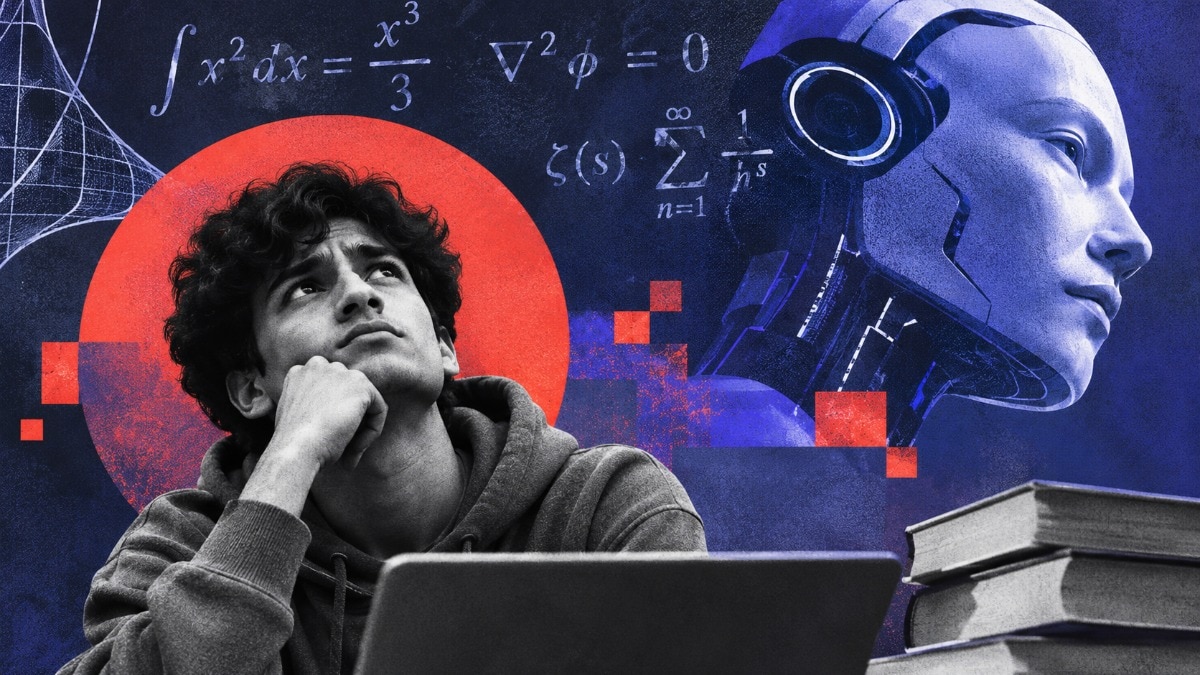
The younger generation is feeling increasingly vulnerable as AI gets smarter by the day. Software developers are worried, researchers are anxious, and now even young mathematicians are questioning whether they should stay in their chosen field.
A new MIT study finds that many young mathematicians are now questioning their future in the field, with some wondering whether pursuing mathematics still makes sense as AI becomes increasingly capable of doing research.Three MIT researchers, Anna Brandenberger, Hanna Mularczyk and Dora Woodruff, asked mathematics graduate students and postdoctoral researchers how they feel about the rapid rise of AI in their field. And the answers are far from cheerful.
Titled 'Early Career Researcher Responses to AI in Math', the study surveyed 268 early-career mathematicians from nearly 60 institutions across at least five countries, including India. Around 85 per cent of respondents were graduate students, while the remaining 15 per cent were postdocs.
What does the study reveal?Around 70 per cent of the young mathematicians surveyed said they were now less likely to continue working in academic mathematics. Meanwhile, 9 per cent said they were more likely to stay.
Another 76.3 per cent believed AI would make it harder for them to get a permanent teaching and research job at a university, known as a tenure-track position. According to the study, AI is also affecting their enthusiasm for research.
Around 76.5 per cent said they felt less motivated to work on mathematical problems because of AI. The same percentage said they would be unhappy if AI solved a problem they had been working on.Why are mathematicians worried about AI?According to the study, some young researchers fear that AI could solve problems they have spent months working on, making their own efforts feel less valuable.
This has even made some hesitant to share their unfinished research with others. Others fear universities could start cutting research jobs and funding as AI becomes more capable.
Interestingly, the study notes that many of these researchers already use AI for their work, mainly to search for research papers, edit writing and check mathematical errors. Yet 54.8 per cent said they dislike using it for research.
Their biggest worry is what this means for the future of mathematics. Around 69 per cent fear research funding could shift from universities to private AI companies, while 59 per cent wonder whether mathematics will remain an enjoyable and meaningful career in the next 10 years.The Navier–Stokes controversyThe survey comes amid growing tensions in the mathematics community over AI-generated research.
In September, OpenAI announced that an unreleased AI model had produced a solution to the Navier–Stokes problem, a famous fluid dynamics puzzle that has challenged mathematicians for nearly a century. The company said its system used around 10,000 AI agents working for 88 hours to produce the solution.However, the announcement angered several mathematicians and sparked a debate over who deserved credit for the work.
Two New York University mathematicians who had been working on related problems raised concerns about whether OpenAI had used their research. OpenAI denied using their unpublished work.
The Clay Mathematics Institute, which awards a $1 million prize for solving the problem, has also not recognised OpenAI's claimed solution.- Ends