


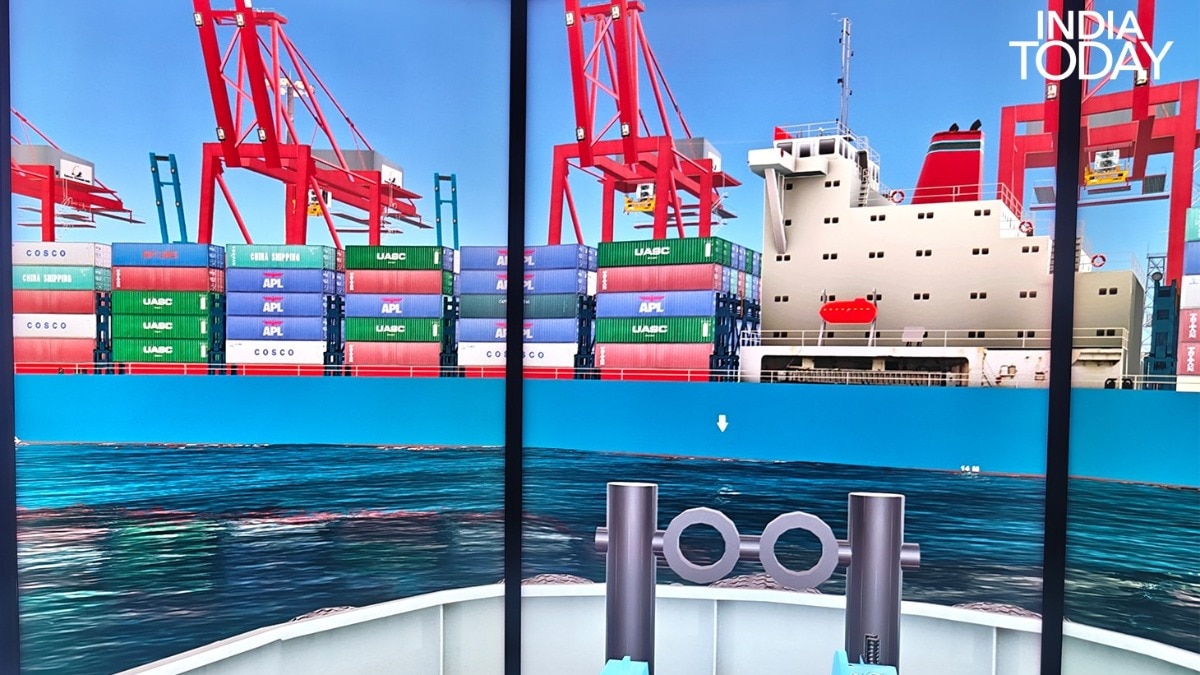
The horizon heaves, white crests race across the water and the stomach begins to lurch. Yet the floor has not moved by a single millimetre.Inside a 360-degree ship simulator at IIT Madras, engineers can raise a 12-metre swell, a thunderstorm and blinding fog on demand, so that the people who steer India's ships can rehearse the worst day at sea on dry land.
The team demonstrated it to India Today Digital in an exclusive interview at the IIT Madras campus. A swell is a long, rolling wave, usually born in a distant storm.
Twelve metres is roughly the height of a four-storey building.The simulator belongs to the National Technology Centre for Ports, Waterways and Coasts, which was inaugurated on April 24, 2023 as the technology arm of the Union shipping ministry.WHAT IS THE SHIP SIMULATOR AT IIT MADRAS?A ship’s command deck that sails nowhere. The bridge is the room from which a ship is steered.
The IIT Madras version replicates one in full, with its steering unit, its telegraph (the lever that tells the engine how fast to run) and its engine control panel.Around it, 13 projectors throw stitched images onto a cylindrical screen, giving whoever stands on the bridge an unbroken 360-degree view, marine officer Nitin Praveen told India Today Digital in an exclusive interview. Newer simulators use LED panels, he said, but projection feels more immersive.
The simulator was developed jointly with a company from Delhi, Professor K Murali, who leads the centre, told India Today Digital in an exclusive interview. The institute says it has been used for more than 25 navigation studies and training programmes for major Indian ports and overseas clients.HOW CAN A SHIP SIMULATOR FEEL REAL IF NOTHING MOVES?Sight and sound do most of the work.From an instructor panel, the team can set wind speed, humidity, temperature and the state of the sea.
As the wave height climbs, the virtual ship rolls (tilts from side to side) and pitches (rocks from front to back) on screen, and whitecaps appear, the foamy crests that sailors call white horses. The engine sound is deliberately exaggerated, Praveen said, to strengthen the sense of motion.Then the weather turns.
Rain begins, thunder rolls and fog thickens until visibility falls to zero. In such conditions, a captain leans on radar, which uses radio waves to draw a picture of what lies outside.
The instructor can also add traffic, such as an outbound ship crossing the vessel's path, and the trainee must steer clear without putting anyone at risk.WHY DO WE FEEL SEASICK ON A FLOOR THAT IS NOT MOVING?Because the eyes and the ears disagree.Deep inside the ear sits the vestibular system, the body's balance organ. It reports that you are standing still.
Your eyes insist that the world is rolling. Scientists call the false sensation of moving that vision alone can create vection, and one long-standing explanation for motion sickness is this clash between the senses.
Researchers are still studying how vection and visually induced motion sickness are related.We felt the effect first-hand. As the swell was raised to 12 metres, seasickness set in, even though the platform stayed perfectly still.HOW DO SHIP PILOTS TRAIN FOR STORMS AND FOG?By rehearsing the dangers that no one can safely arrange at sea.A marine pilot is a veteran mariner who guides incoming ships through the narrow, risky final stretch into port.
Those who train here have risen from cadet to ship's master, as the captain is formally known, and spend six months training on board before returning for a simulator certification course, Praveen said.The course covers different ship types, different berthing arrangements (how a vessel docks) and mooring systems (how it is tied up), as well as the handover between pilot and master, and how tugboats work with a large ship. Tugs are small, powerful boats that push and pull giant vessels into position.
A separate tug simulator runs two azipods, propeller units that can swivel, and the controls behave in ways beginners do not expect. The pilots already have experience, Praveen said.
What they practise here is decision-making at crucial moments.Unlike a video game, the simulator has to run in real time. "Here real lives are involved," Professor Murali said, which is why the industry and the pilots would not accept anything slower.HOW DID IIT MADRAS PUT ALL 12 MAJOR PORTS INSIDE ONE SIMULATOR?By feeding it the real data of each harbour.To recreate a port, the team collects its layout, infrastructure and ocean engineering data. It also gathers siltation data, which tracks sand and mud settling in channels, and erosion data, along with details of the breakwater (the wall that shields a harbour from waves), the harbour mouth, the flow of water and the charted depth at different points, Praveen said.
Everything is updated as conditions change.India's 12 major ports and two waterways are already inside the simulator, Professor Murali said, and minor and private ports are now being added. A demonstration run took us into the container terminal of Jawaharlal Nehru Port in Navi Mumbai.Professor Murali said the simulator was built at nearly a third of the cost of an imported one.
His larger aim, he said, was to create world-class tools at home so that India stops being "a knowledge importer" and becomes "a knowledge exporter".WHAT CAN A SHIP SIMULATOR NEVER TEACH?The surprise.Professor Murali recalls asking his team to build the most dangerous scenario possible. The 12-metre swell was raised until tugboats and islands vanished beneath the virtual water.
It is a hypothetical, he stressed. Such waves belong to the open ocean, not to a harbour, and berthing would be impossible in them.Even so, a simulator can only play what its designers can imagine. "Whatever is not predicted and happens in a surprise manner is what the pilot or the captain will see in the real world," he said. "As long as we can think about the surprises, we can create the surprises here."The centre has also built a simulator for Matsya, the deep-sea submersible mission of the National Institute of Ocean Technology, where scientists and pilots will rehearse dives to 6,000 metres inside a replica of the vessel.Back on the bridge, the fog lifts, the swell settles and the floor is as still as it always was.
The sea, as every captain knows, will not be so polite.- Ends