


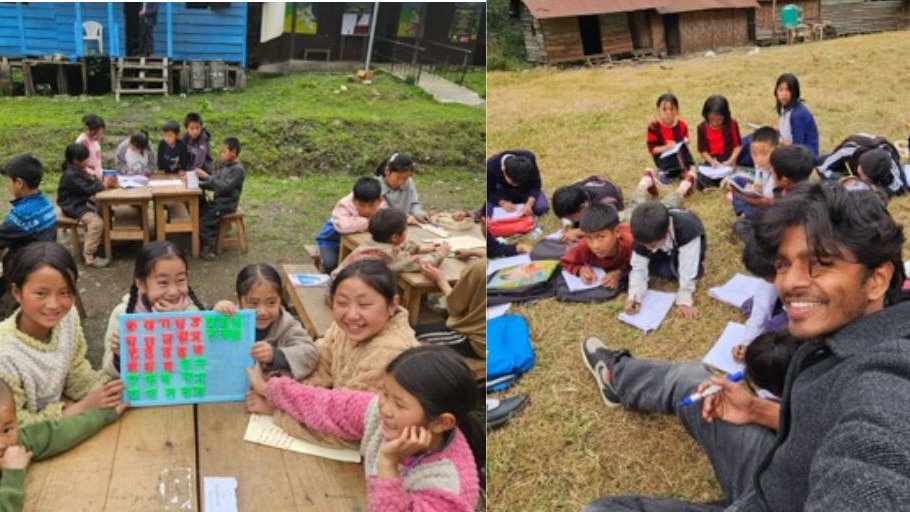
“I came here to teach, but the children have taught me so much,” says 29-year-old Ashqar from Areekode in Kerala’s Malappuram district. Nearly 3,000 km from home, Ashqar is making a difference in the lives of children at Netaji Subhas Chandra Bose Awasiya Vidyalaya (NSCBAV), located in Karo village in Arunachal Pradesh’s Shi-Yomi district, near the India-China border.Through activity-based lessons and cultural celebrations like Onam, Ashqar is finding new ways to make learning fun and meaningful for children in a remote village.
Despite challenges such as poor roads, frequent landslides, unreliable internet connectivity and power shortages, he remains committed to making learning more engaging for his students.Established in 1975, the residential school now has 102 students, up from fewer than 40 when NGO Sunbird Trust began working in the area. It has five classrooms for Classes 1 to 5, while its hostel, originally built to accommodate 60 students, now houses 62.Ashqar has been teaching at the school for a little over two years.
He holds an MA from the Central University of Punjab, a BEd from Pondicherry University and an MEd from North-Eastern Hill University (NEHU), Shillong. He previously taught in Poonch for one-and-a-half years.
FROM KERALA TO ARUNACHAL: A DREAM THAT TURNED INTO REALITYAshqar's decision to move from Kerala to Arunachal Pradesh was not sudden. His interest in the Northeast developed while pursuing his MEd at NEHU in Shillong, where he interacted with students from different parts of the region."During my MEd, I got great exposure to the Northeast.
I made a lot of friends from across the region, and coming here became a dream for me. Not as a student, but to do something meaningful," he says.
His interactions also made him aware of the educational challenges faced by children in remote areas. He wanted to contribute wherever his skills could be useful.After completing his studies, Ashqar began looking for teaching opportunities in the Northeast.
That search led him to Sunbird Trust, an organisation whose work in the region impressed him."I felt Kerala already had many systems in place, especially in education. Teaching in a city is something many people can do, but I felt rural areas needed more support.
I thought I could be of help here," he adds.For Ashqar, the decision was about taking his teaching experience to a place where access to education and basic facilities remained a challenge.NO ELECTRICITY, LIMITED CONNECTIVITY AND DIFFICULT ROADSMoving from Kerala to Karo meant adjusting to a very different way of life. Poor roads, frequent landslides, limited internet access and the lack of regular electricity made everyday activities difficult.
Even accessing essential supplies and transporting materials to the school was a challenge."The biggest issue in rural areas is access. Even if you have money, you might not be able to reach what you need.
The roads are in poor condition, and that affects almost everything," he shares.When Ashqar arrived, the school depended on a generator for electricity. This year, Sunbird Trust installed a solar power system, providing electricity to the school, though the village still lacks a regular supply.
Children rely on small solar lamps and generators to study at home, but high fuel costs limit the use of generators.Language was another initial challenge. Although he knew some Hindi, Ashqar was not fluent.
He gradually became more comfortable communicating with students and the local community and is now learning the local language.Living on campus keeps him involved in students' daily routines. Classes run from 9 am to 2 pm, followed by afternoon study sessions and evening visits to parents and community members.
With darkness setting in by 4:30–5 pm, the village follows an early routine.WHEN NATURE BECOMES THE CLASSROOMFor Ashqar, the biggest academic challenge is addressing gaps in foundational literacy and numeracy rather than teaching itself. Many children need additional support in basic English and other learning skills.
The school has introduced programmes to strengthen these foundations.With limited access to digital resources and smart classrooms, teachers rely on experiential learning to make lessons more engaging."Most of the things mentioned in textbooks are actually present in our surroundings. If a book talks about mountains, the children can see mountains all around them.
We try to connect nature with the classroom through activities and natural walks," he explains.During the initial phase of classroom renovations, lessons were often held outdoors, with students sometimes taught together through interactive and activity-based methods.The school has 18 staff members, including five Sunbird Trust teachers (among them Ashqar), seven government teachers and six support staff members.Parents, teachers, government staff and the local community have all contributed to this progress. Sunbird Trust and the government are also working together, with the NGO supporting infrastructure and academic initiatives while the government provides assistance and develops school facilities.HOW ONAM BROUGHT A PIECE OF KERALA TO ARUNACHAL PRADESHAshqar's Onam celebrations at the school recently drew widespread attention on social media, with videos of the event receiving millions of views.
However, for him, the idea was not to create viral content but to introduce children to India's cultural diversity.While teaching English and Environmental Studies (EVS), he came across lessons on different cultures and festivals. He felt Onam would be a good way to bring one such cultural experience into the classroom."The education department always encourages us to celebrate different festivals and promote inclusivity.
When I thought about organising Onam, I discussed it with the staff, and everyone was interested. That became the motivation," he recalls.The celebration involved the entire school staff.
His colleague Anjali travelled nearly 200 km to arrange ingredients for the traditional feast, while other staff members contributed vegetables, helped with cooking and collected banana leaves from the village for serving food and decorating the venue.Ashqar also taught the children traditional Malayalam and South Indian dance performances."It was a collective effort. Everyone contributed in whatever way they could, and that is what made the celebration successful," he explains.THE CHILDREN TAUGHT HIM LESSONS NO UNIVERSITY COULDDespite the challenges of living far from home, Ashqar says the children and the local community have taught him some of his most valuable life lessons.He describes the children as resilient and positive, even when they have limited access to basic facilities.
He recalls how something as ordinary as having a sink felt like a luxury in the village, where people traditionally wash themselves and clean utensils while sitting on the floor.Children also take on responsibilities that many others their age may not experience. They help collect firewood from the mountains and visit fields located in hilly areas, particularly during winter.Comparing their lives with his own childhood in Kerala, Ashqar says he had access to many facilities but did not always make the most of the opportunities available to him."Here, children are happy with whatever they have.
Even though there are so many things they do not get in the village, they remain positive. I had everything during my childhood, but I was still lazy about studying.
From these children and the community, I have learnt that life can be simple, and you can still be happy," he adds.Being away from his family is another challenge. Ashqar manages to visit his hometown only once a year.
In an emergency, reaching the nearest airport from Karo can take nearly two days by road, while poor network connectivity can make it difficult to receive updates from home.He also had an opportunity to study abroad this year. He was considering pursuing a master's degree in biodiversity and bio-resources in Russia but eventually decided not to go after interacting with school staff and community members."I am not thinking too far into the future.
As of now, I am sticking with what I am doing," he further explains.HIS MESSAGE TO YOUNG TEACHERS: GIVE RURAL EDUCATION A CHANCEAshqar believes more young teachers should consider working in remote regions, despite the difficult living conditions. He acknowledges that the journey is not easy, but says the impact teachers can create in underserved communities makes the effort worthwhile."Of course, there are challenges and hardships.
The road is not going to be easy. But when you understand the impact you can make in these places, you begin to feel that these challenges are nothing.
If you can hold on for a while and work towards a greater impact, I would urge others to take this step and at least give it a try," he says.Asked what one change he would like to see in education across remote border regions, Ashqar says children should have access to facilities comparable to those available in cities.He believes improving infrastructure and access to educational resources can make a significant difference to students growing up in geographically isolated communities.Looking back at his journey from Areekode in Kerala to Karo in Arunachal Pradesh, Ashqar describes it as a roller-coaster ride. "It had a lot of ups and downs, but in the end, it led me to a very beautiful place with a lot of good things," he further adds.For now, Ashqar's journey continues in Karo, where the classroom extends beyond textbooks and lessons. Thousands of kilometres away from home, he may have arrived to teach, but the children and the community have given him an education of their own.- Ends