


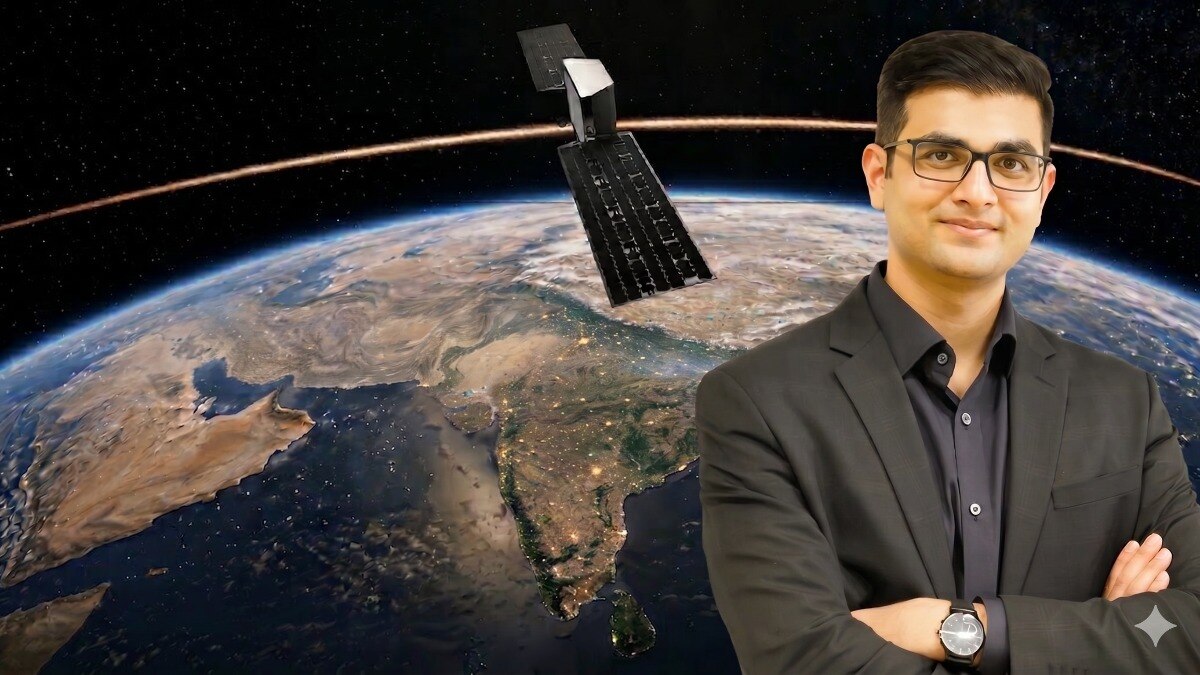
Awais Ahmed has responded to trolling and threats following Pixxel Federal's announcement. He maintains that Pixxel remains Indian-owned and its domestic technology stays under Indian control.Pixxel CEO and co-founder Awais Ahmed maintained that Pixxel would continue building satellite technology in India for global markets.
Indian space-tech startup Pixxel's founder Awais Ahmed has spoken out against what he describes as a sustained online trolling campaign, alleging that the company and its leadership have been subjected to personal attacks, threats and misinformation following the announcement of its US-focused subsidiary, Pixxel Federal.In a strongly worded statement, Awais said he had initially chosen to ignore the criticism but decided to respond after what he described as repeated attempts to question the company's ownership, technology and credentials."I've been called a 'traitor', accused of 'selling our soul', of being 'bought by American PE', and even had people claim that the CIA is running Pixxel," he said.300+ Indians have spent years of their lives building satellites and critical technology for this country. They deserve better than having their work and patriotism questioned by manufactured controversies.
I owe them a response. Here it is: https://t.co/vZnnwus4LP— Awais Ahmed (@awaisahmedna) November 2, 2026He also alleged that the campaign extended beyond social media, with targeted edits to Wikipedia pages, anonymous emails sent to government customers and threats directed at his co-founder's family through direct messages.
Pixxel builds and operates a constellation of high-resolution hyperspectral Earth observation satellites. Its satellites capture detailed images of Earth across hundreds of spectral bands, allowing them to detect information invisible to conventional cameras and satellites.The backlash intensified following Pixxel's announcement of Pixxel Federal, its US government-focused subsidiary, and the appointment of Allyson Jenkins as its chief executive officer.
Jenkins previously led the company's US government business and brings 18 years of experience in national security and geospatial intelligence, including nine years at the National Geospatial-Intelligence Agency. Addressing concerns over the company's international expansion, the founder asserted that Pixxel remains an Indian-headquartered, Indian-owned, Indian-managed and Indian-controlled company.He said the company's primary Indian entity was incorporated in 2018, before its US entity, and continues to execute its Indian government, space and defence programmes.
According to him, the company's largest shareholders by percentage are Indian investors, including its founders.Every satellite begins as an act of belief that something which does not exist today can be imagined, engineered, and sent into orbit tomorrow. A week ago, I had the privilege of meeting Prime Minister @narendramodi and presenting to him a frame of images captured by our satellites as a reminder of the transformation India has undergone under his aegis.
He was especially pleased that the images revealed the extraordinary beauty of our own country from the Himalayas to the Ganga to the Sunderbans. His support for India’s private space sector has been both consistent and consequential.
By opening the ecosystem and placing real trust in Indian entrepreneurs, his government has allowed a generation of companies like ours to dream at an entirely different scale. We also spoke about what comes next.
It is bolder, larger, and much closer than it once seemed. What began in a college room has travelled farther than we could have imagined.
The scale of our ambition at Pixxel is about to go a few orbits higher. More soon! @PMOIndia— Awais Ahmed (@awaisahmedna) August 28, 2026He clarified that the leadership and board of Pixxel Federal have authority limited to the US subsidiary and its operations, with no control over Pixxel's Indian government programmes or domestic business.The founder also sought to address concerns around intellectual property and national security, stating that all technology and IP developed for Indian government projects remain under Indian ownership and control, within Indian entities and under Indian laws.He added that the company complies with applicable export-control requirements and that having an American entity does not automatically subject Indian-developed satellite technology to US ITAR restrictions.Questioning the criticism directed at Indian companies expanding overseas, he said international subsidiaries were a standard part of building a global business."India needs more companies building world-class space technology," he said, adding that criticism should be based on technical merit, execution and delivery rather than speculation about corporate structures.The founder maintained that Pixxel would continue building satellite technology in India for global markets, despite the online backlash.- Ends