


Let's play a word association game. Read a word, think of a city.Ready?Pollution.
Rashtrapati Bhavan shrouded in a thick layer of smog as air quality deteriorates, in New Delhi. Did the name start with a D?
Did an image of buildings and streets engulfed in smog pop up? It shouldn't be surprising if the national capital was the one you thought of.The truth is that Delhi has become the face of India’s air pollution crisis, and rightly so.
What's also true is that thinking of India's pollution as something confined to Delhi and its neighbouring cities is outdated. The case can be made rather simply by looking at a smaller agricultural town in Rajasthan that has recorded even higher particulate pollution.
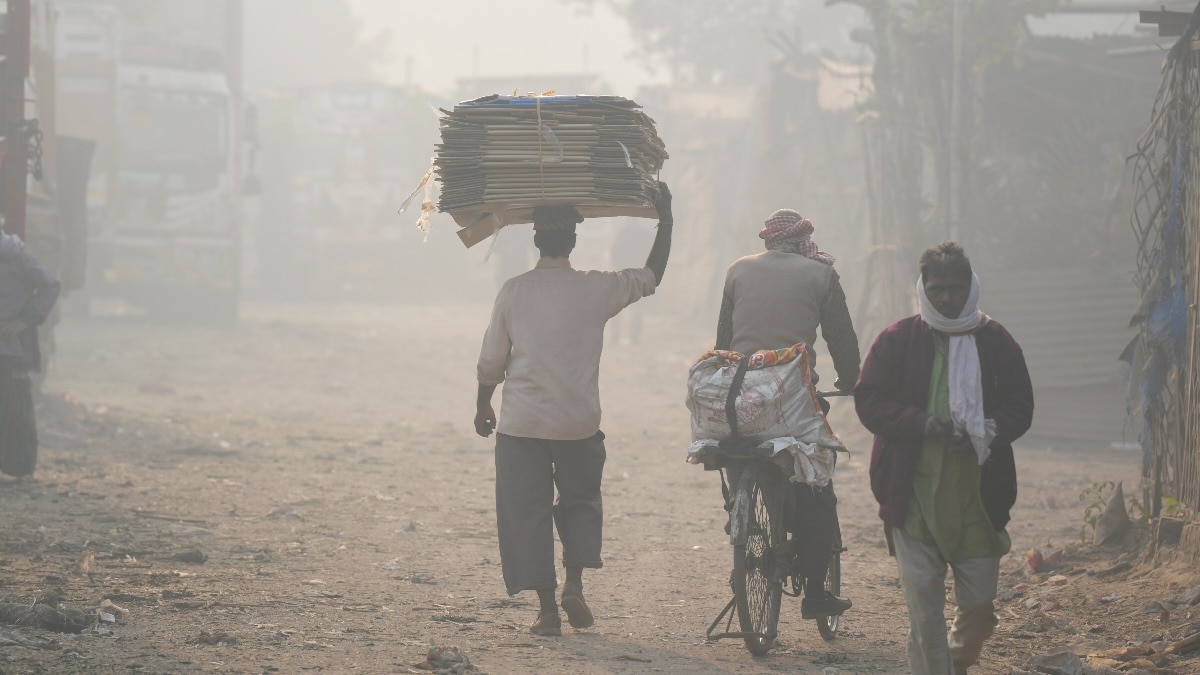
Look harder and closer (as if through a layer of smog) and the obvious question arises — are we looking at India's pollution crisis in a way that can only be described as myopic? A person rides a bike amid deteriorating air quality with his face and mouth covered.
A POLLUTION HOTSPOT IN RAJASTHANThe scale of the problem becomes clear as a 'Good' AQI day when Sri Ganganagar’s air quality is compared with that of New Delhi’s.The Rajasthan town recorded an average AQI of around 321, compared with 296 in the national capital, with its daily reading higher than Delhi’s on 17 of the last 30 days from October 15 to November 13, according to the available AQI.in data.In the same period, both cities recorded eight days when AQI shot past 400, although Delhi had a longer consecutive spell at those levels.The data comparison serves to show that severe pollution is not confined to Delhi.The problem is not limited to recent daily readings either. A graph comparing Delhi's AQI with that of Sri Ganganagar in the last 24 hours.
Sri Ganganagar recorded an annual average PM10 concentration of 236 micrograms per cubic metre in 2024, higher than Delhi’s 211 per cubic metre, according to an assessment by the Centre for Research on Energy and Clean Air’s (CREA).That was nearly four times India’s annual permissible limit of 60 per cubic metre. Sri Ganganagar has recorded annual average PM10 levels above 200 per cubic metre for multiple years, said Arindam Datta, senior fellow at the Centre for Air Quality Research, TERI.The figures translate to a question worth asking: Is India’s worst pollution concentrated only in its biggest cities or is that assumption deeply flawed.The answer is obvious when you consider how Delhi receives sustained attention, funding, and coverage, while Sri Ganganagar is over 400 kilometres away from the national conversation.WHY IS SRI GANGANAGAR’S AIR SO POLLUTED?Sri Ganganagar sits on the northern edge of the Thar Desert.
Naturally, its pollution comes from natural dust and human activity.It comes from its loose, sandy soil that becomes airborne in dry conditions. From its industry and agriculture, that adds to the burden.
National Green Tribunal (NGT) proceedings document more than 570 brick kilns across the district’s tehsils.Many of these brick kilns burn mustard crop residue and coal, releasing particulate matter and sulphur dioxide; some of these kilns consume up to six tonnes of fuel daily.Brick kilns account for an estimated 15% of India’s particulate matter emissions and 8-14% of Indo-Gangetic Plain air pollution, Datta said.Some of the pollution share is taken up by stone crushers, mining and industries that add pollution through excavation, material handling and emissions. An image of a brick kiln spewing emissions.
These include the Suratgarh Super Thermal Power Station, cement-grinding units, cotton-ginning factories and edible-oil industries functioning in the same district.What percentage remains is comfortably accommodated by the seasonal pollution from crop-residue burning after harvests and clouds of dust that rise from unpaved roads.POLLUTION INVADING THE BORDERSEmissions from neighbouring regions, particularly agricultural fires around Bathinda and Firozpur, also affect Sri Ganganagar during the post-harvest season. Pakistan border is not far away either, allowing Lahore to spew more pollution towards the region.Datta said prevailing northwesterly winds in October and November can carry fine particulate matter (PM2.5) from these hotspots into the city.
A satellite image showing recorded fires around Sri Ganganagar from November 7-14. Surendra Dhaka, professor of atmospheric physics at Delhi University, said slow winter winds help explain how pollution travels between regions without dispersing quickly.“During winter, wind speed is low, moving at around 1-1.5 metres per second on average, often blowing southward from Lahore and Punjab,” Dhaka explained.When stubble burning begins in Punjab and around Lahore, he added, pollutants move south across the Indo-Gangetic Plain."At 1-1.5 metres per second, they can take about 48 hours to reach Delhi," Dhaka said. “This is mostly the atmospheric dynamic that explains the pollution in places like Sri Ganganagar, where there are barely any crackers on Diwali as compared to Delhi or vehicular emissions,” Dhaka said A graph illustrating the AQI comparison between New Delhi and Sri Ganganagar days after Diwali.
AQI.in readings around Diwali illustrate how differently pollution levels can behave in the two cities.On November 9, a day after the festival of lights, Sri Ganganagar recorded an AQI of 547, close to Delhi’s 541.9.The following day, Delhi’s reading fell to 360.2, while Sri Ganganagar’s climbed to 700, remaining as high as 567 even two days after Diwali, on November 11.While these readings do not establish what caused the difference, they show that severe pollution in Sri Ganganagar cannot be understood through Delhi’s experience alone. Dense smoke billows into the sky as a farmer burns paddy stubble.
Dhaka's assessment of how winds alter the way pollution covers a region was drawn from a three-year project he was a part of.The project, named Aakash, looked at wind patterns and pollution in Delhi-NCR.Researchers, in collaboration with Japanese scientists from the Research Institute for Humanity and Nature (RIHN) in Kyoto, observed wind data collected from 2022 to 2025. They found that stubble burning in Punjab and around Lahore can contribute 10-40% to pollution in Delhi-NCR on days when average wind speeds are 1-1.5 metres per second, Dhaka said.For Sri Ganganagar, he explained, a city sitting much closer to the pollution sources, the exposure to the same polluted air is much faster and much worse.In this special report, India Today investigates the worsening air pollution crisis across northern India, with Delhi-NCR recording hazardous post-Diwali pollution levels.
From stubble burning in Punjab and Pakistan's Punjab to the illegal operation of banned BS4 diesel buses in Delhi, Operation Smog Syndicate exposes the growing pollution threat. The report also examines why Sri Ganganagar in Rajasthan has emerged as a severe pollution hotspot. #DelhiPollution #AirPollution #OperationSmogSyndicate #DelhiNCR #GRAP #StubbleBurning #AirQuality #PollutionCrisis #IndiaToday @Sreya_Chattrjee @Sonal_MK— IndiaToday (@IndiaToday) November 14, 2026WHY IS NOBODY TALKING ABOUT IT?Sri Ganganagar receives far less attention than Delhi, partly because of the capital’s political and economic importance, Datta said.
Delhi-NCR has more than 30 million people, and poor air quality affects schools, businesses, transport and daily life.Smaller agricultural and border towns, like Sri Ganganagar, have less national visibility, a gap that also reflects shortcomings in India’s air pollution policy and monitoring.Sri Ganganagar was not included among the cities identified under the National Clean Air Programme (NCAP). A brick kiln is seen emitting smoke at sunset.
Launched in 2019, the programme initially covered 131 cities selected using historical air-quality data. Later, million-plus urban clusters were also brought into the programme.Rajasthan’s selected cities included Jaipur, Jodhpur, Kota, Udaipur and Alwar, but not Sri Ganganagar.Datta said the town’s lack of historical monitoring data during the selection period contributed to its exclusion, leaving it without the same dedicated institutional advantages as cities covered by the programme.The result is a gap between a city’s pollution burden and the attention it receives through national monitoring and policy.
Birds perch on tree branches as the sun rises amid smog. Sri Ganganagar has exposed the Achilles' heel in India's pollution-control strategy — polluted air cares little about geographical borders, and the issue of worsening air-quality extends beyond major cities.Where desert dust, brick kilns, industry and agricultural emissions conspire, a strategy designed mainly around metropolitan pollution sources may just not be enough.- Ends