


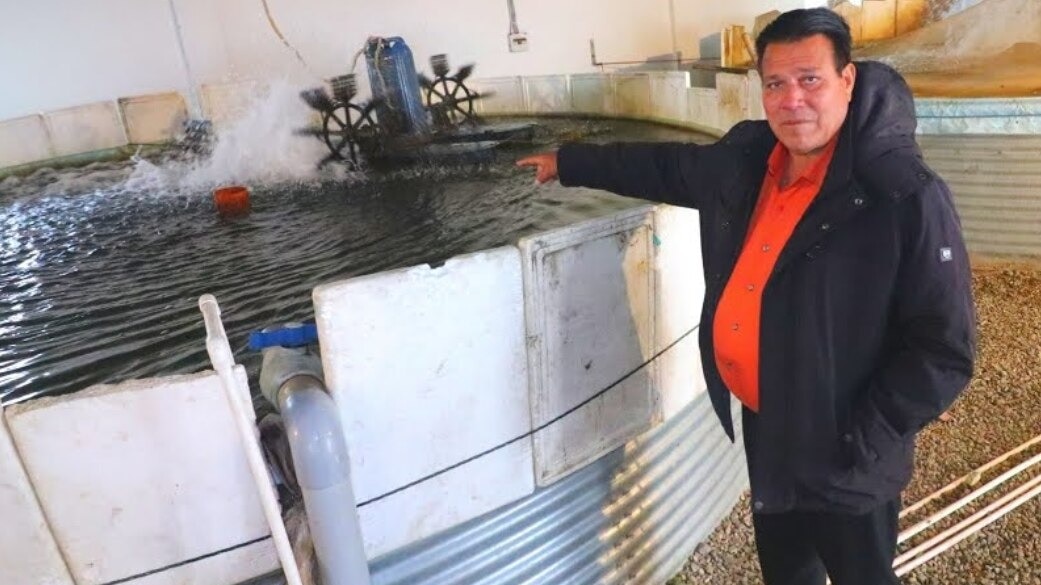
Fish farming is usually associated with coastal communities, fishing nets and the seafood-rich cuisines of Goa, Bengal, Kerala and Tamil Nadu. Haryana, on the other hand, evokes images of wheat fields, mustard crops, cattle and traditional dairy farming.
But Padma Shri awardee Sultan Singh has spent more than four decades challenging this perception, turning village ponds and agricultural land in Karnal into a thriving fish farming enterprise.Sharing his journey at India Today Group's Kisan Tak Bharat Agriculture Conference, Sultan Singh, one of the Krishi Veers, recalled how he ventured into inland fisheries in 1982, when the business was still largely unexplored in north India."I was studying in college in 1982, and nobody in north India was doing the fish business, particularly inland fisheries on privately owned land," he said at the Kisan Tak conference.He noticed that several village ponds, which were earlier used by cattle for drinking water, were lying unused. He decided to take some of them on lease and experiment with fish farming. "I initially took four or five ponds in my village.
Some were leased for Rs 500, while others cost Rs 2,000. That was the value of these ponds at the time," he said.
The decision was not an easy one. When Singh approached his father for land to expand the venture, he faced resistance."When I asked my father for five acres of land, he refused.
He said, 'You will dig pits in the land. What will the children eat in the future?'" Singh recalled.
He eventually persuaded his father to give him five acres to start fish breeding. Today, of the family's 105 acres, around 30 acres are now used for fish breeding.Singh said the ponds he initially leased have also become valuable assets for the villages.
Some of them, which he had taken on rent for a few hundred or a couple of thousand rupees, are now worth around Rs 50-60 lakh."That money has become useful for villages where there was hardly any source of income. It is helping bring about a lot of development there," he said.HOW FRESHWATER FISH FARMING WORKSSingh specialises in composite fish culture, a method in which different compatible fish species are reared together in the same freshwater pond.Unlike marine fishing, which involves catching fish from seas and oceans, freshwater aquaculture involves breeding and raising fish in ponds, tanks and reservoirs.
The principle behind composite fish culture is to select species that feed at different levels of the pond, allowing farmers to make better use of available food and space while reducing competition.For instance, catla feeds near the water's surface, rohu in the middle layers and mrigal at the bottom. Silver carp, grass carp and common carp can also be raised in this system.The process begins with preparing the pond and ensuring suitable water quality.
Farmers then stock it with healthy fingerlings, provide supplementary feed where required and monitor the fish's growth, health and water conditions. Once the fish reach marketable size, they are harvested.
Fish hatcheries play an important role in this process by producing fish seed, including fry and fingerlings, that farmers can stock in their ponds.Freshwater aquaculture is not restricted to carp. According to the Indian Council of Agricultural Research's Central Institute of Freshwater Aquaculture (ICAR-CIFA), species such as catfish, murrel, tilapia, pangas and freshwater prawns are also cultivated in freshwater systems.
These offer farmers different options depending on local water conditions, consumer demand and market prices.The taste of freshwater fish can differ from that of marine fish, but there is no single flavour profile common to all freshwater species. It depends on the species, its diet and the conditions in which it is raised.Some pond-reared fish can develop an earthy or muddy flavour because of compounds called geosmin and 2-methylisoborneol, produced by certain algae and bacteria.
These compounds can accumulate in the fish's flesh. This is not an unavoidable feature of freshwater fish.
Farmers can manage the problem through better water-quality control and, in some cases, by keeping harvested fish in clean water before sale to reduce the unwanted flavour. Research published in the journal Aquaculture has examined this phenomenon and methods to address it.FROM FISH FARMING TO PRODUCING FISH SEEDOne of the biggest turning points in Singh's journey was his decision to establish a fish hatchery.In the early years, he had to procure fish seed from Kolkata, which was transported by train.
Delays in transportation often affected his business and led to losses. He then decided to produce the seed himself rather than depend on supplies from elsewhere.At the Bharat Agriculture Conference, he recalled setting up a hatchery in 1984 and becoming the first person in north India to do so.He said he now produces seed of 14 fish varieties and supplies it to farmers in Haryana, Uttar Pradesh, Rajasthan, Gujarat and Maharashtra, among other regions."I started producing fish seed, and this helped me expand the business.
Today, I supply fish seed to north India, as well as Maharashtra, Gujarat, Rajasthan and Uttar Pradesh," he said.Fish seed refers to the early stages of fish development, including fry and fingerlings, which are stocked in ponds and reared until they reach marketable size. By producing seed locally, Singh helped reduce the dependence of farmers in the region on distant suppliers.His work has also extended beyond his own farm.
Singh said he had trained around 25,000 people in fish farming and helped create livelihoods for 300-400 people directly in the business.- Ends