


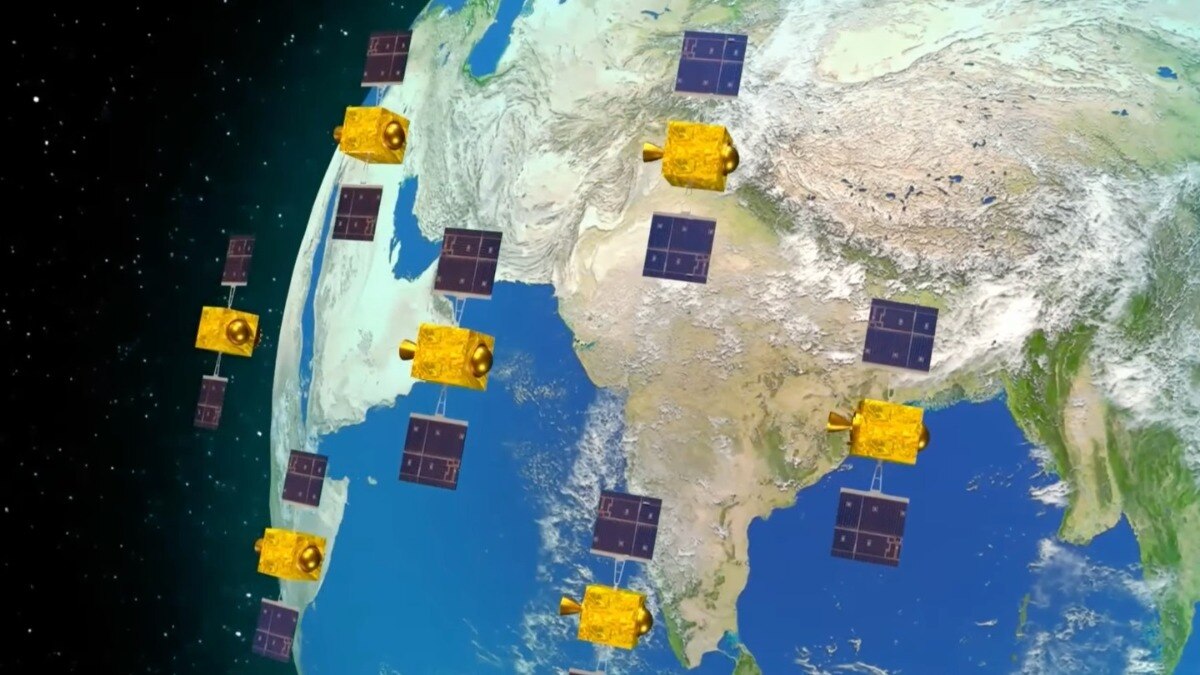
India's push for independent satellite navigation has gained momentum, with the latest mission bringing new possibilities for technology and infrastructure.An artist's concept of a satellite constellation over the Indian subcontinent. India's home-grown navigation system, NavIC, has received a major boost after ISRO successfully completed the third and final orbit-raising manoeuvre of its latest satellite, NVS-03, placing it in its designated geosynchronous orbit.The Indian Space Research Organisation, or Isro, launched the satellite aboard its GSLV-F18 rocket from the Satish Dhawan Space Centre in Sriharikota on October 30, 2026.
Following its successful launch, NVS-03 was placed in an initial transfer orbit before undergoing a series of manoeuvres to climb higher. Isro has now successfully completed the third and final orbit-raising manoeuvre, placing the satellite in a geosynchronous orbit of 35,842.6 34,594.9 km.
The successful deployment marks an important step towards restoring the full positioning capabilities of India's independent navigation network.HOW WILL NVS-03 IMPROVE EVERYDAY LIFE?NavIC, short for Navigation with Indian Constellation, is India's own satellite-based navigation system, similar to the US Global Positioning System (GPS). It provides location and accurate timing information across the Indian landmass and an area extending approximately 1,500 km beyond the country's borders.
Its signals can be used by smartphones, vehicles, ships, trains and other devices for navigation and tracking.However, problems with the atomic clocks aboard some earlier satellites had weakened the constellation. A previous replacement satellite, NVS-02, also failed to reach its intended orbit because of a propulsion-system issue.
This left NavIC with fewer than the four operational satellites required to independently provide full positioning services.NVS-03 is expected to restore this minimum requirement.The satellite carries an indigenously developed atomic clock, which helps maintain precise time, along with additional clock systems. It also supports the L1 frequency band, making NavIC signals more accessible to commonly used smartphone chips and navigation receivers.WHY IS INDIA'S NAVIC IMPORTANT?An operational NavIC gives India greater control over critical navigation and timing services instead of relying entirely on foreign satellite networks.Such capabilities are important for everyday navigation as well as emergency response, transportation, maritime operations, infrastructure and strategic applications.NVS-03 has been designed for an operational life of around 12 years.
However, reaching its designated orbit does not automatically mean that all services are immediately available. Isro will need to complete further checks, test the satellite's systems and commission it before it becomes fully operational.With NVS-03 successfully in position, India has moved closer to restoring the independent navigation services that its satellite network was designed to provide.- Ends