


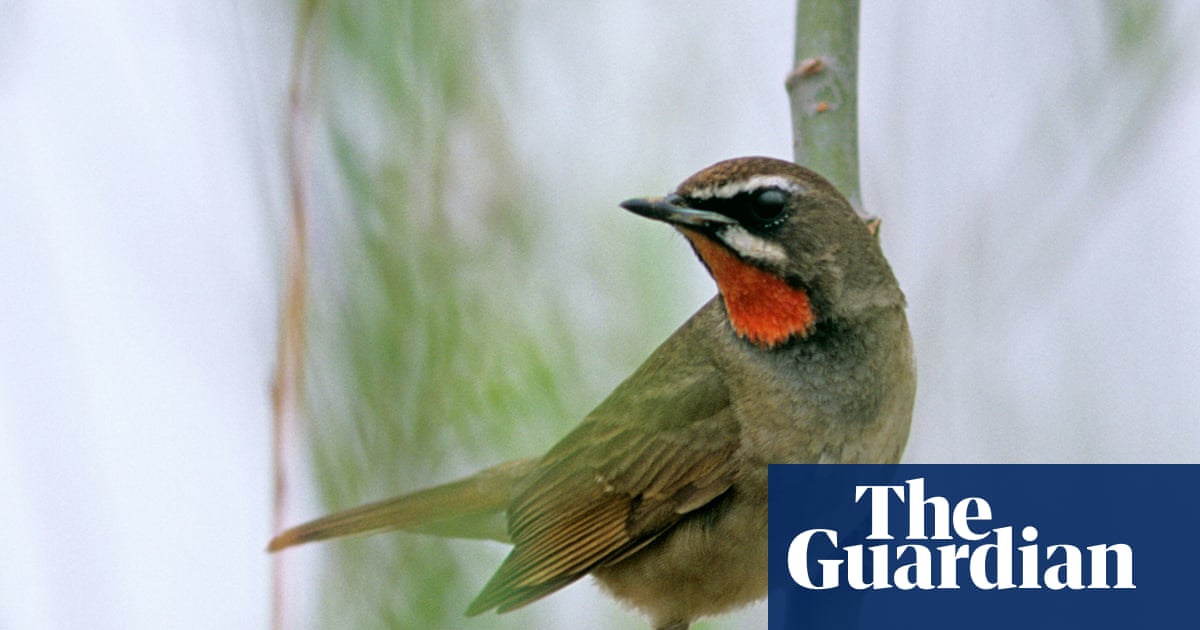
A bird that flies south from its breeding grounds in Siberia to winter in south and south-east Asia has been found thousands of miles off course in Cumbria. Regrettably, it was found by a cat.Chris Hind, Cumbria’s county recorder for birds, said it was “extraordinary” that a Siberian rubythroat was found on his patch, albeit dead.
There have been only 17 recorded instances of the bird in the UK, 15 of those in the northern Scottish isles.Hind was contacted by the RSPB at the weekend after a womanwho lives in a remote north Cumbrian valley reported the bird. She had recognised it was out of the ordinary and put the dead bird in her freezer.“She realised that it was something unusual,” Hind said. “She probably didn’t realise how incredibly unusual it is.
There are only two accepted records of it from mainland Britain.”The woman, who wants to remain anonymous, told the BBC she had “heard the cat flap go” and her heart sank when her cat “brought her a bird and trotted off”.“I saw the bird’s distinctive, beautiful orange-red feather patch under its beak but I couldn’t recognise the species,” she said.Quite why the bird appears to have headed west, rather than south, is a mystery although Hind pointed to the puzzle of yellow-browed warblers that have been spotted in the UK in increasing numbers in recent decades.“It used to be thought that these are birds which had just got lost but there are academics now thinking that it may be something rather more purposeful,” he said.Hind said the bird brought in by the cat was very underweight, weighing 28 grams (just under 1oz). Textbooks say it should be about 73 grams.Siberian rubythroats were also extremely secretive, he said. “They tend to creep around in the vegetation and the place where it was found was a place hugely vegetated, lots of trees, lots of bushes, lots of hedges in a remote little valley.”skip past newsletter promotionafter newsletter promotionIt was likely, he said, that no one would ever have seen it had the cat not come across it. “I have very mixed emotions.
I’m very sad for the bird, quite angry with the cat, but you know cats are predators, this is what they do, it’s not the cat’s fault.”The plan is now for academics to take samples and then the bird – currently in Hind’s freezer – will go to Tullie House museum in Carlisle. Hind hopes it can be prepared in such a way that it might go on display.
As well as having a remarkable story, “it is a very dramatic looking bird”.