


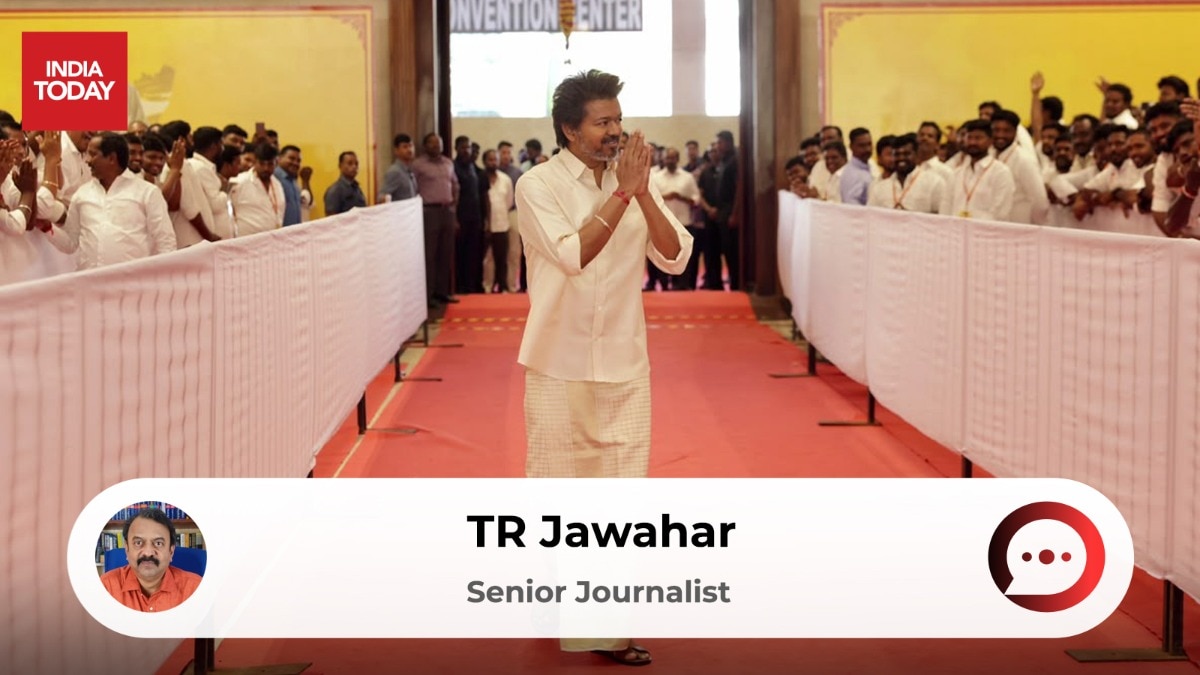
Six months is enough time for a government to discover that winning an election and running a State are two different occupations. Tamil Nadu Chief Minister C Joseph Vijay came to Fort St George promising change, clean administration and a break from the familiar habits of Dravidian politics.He inherited an experienced bureaucracy, a demanding electorate, a formidable Opposition and an overflowing calendar of public expectations.Six months later, the promises remain, but they have acquired companions: law-and-order controversies, administrative embarrassments, anxious legislators, restless allies and some awkward questions about political consistency.
None of this proves that the experiment has failed. It does establish that the honeymoon has encountered the working week.The election supplied the mandate.
The Secretariat supplied the fine print. And the fine print is beginning to make its presence felt.
Vijay has closed liquor outlets, ordered corruption investigations, announced reforms and celebrated two Assembly by-election victories. His meetings with Rahul Gandhi and Narendra Modi also displayed an ability to negotiate political relationships across national divides.
But the first six months have brought a sterner examination. Tamil Nadu voted for a change of government.
It is now entitled to ask how much governance itself has changed.WHEN CHANGE MEETS CRIMEDeepavali brought its customary procession of crackers, cinema crowds and overflowing liquor counters. It also brought a disturbing succession of murders.
Media reports counted 13 killings on the festival day and 17 over two days, while the police disputed those figures and cited eight under their own classification. The difference in counting methods deserves clarification, but the controversy soon acquired a distinctly political flavour.
Minister A. Rajmohan responded by citing murders during previous Deepavalis, including six the preceding year and eleven the year before.
He subsequently clarified that he was providing historical context rather than defending the latest killings. Yet the initial response was revealing.
Vijay had promised change, while his Minister appeared to offer continuity, even in the murder statistics. That the previous government did it too is a curious defence from a party that came to power promising to do things differently.Vijay convened an emergency police review.
That was necessary, but the State's law-and-order performance will be judged in its streets and neighbourhoods, not conference rooms. Citizens want crimes prevented, offenders caught and investigations completed.
They are unlikely to find comfort in comparisons with the criminal calendar of an earlier regime.There is another side to the police story. The government has pursued arrests and criminal cases involving DMK leaders and other political adversaries, some over alleged threats and others over offensive remarks.The police must act against genuine offences, but the enthusiasm shown in pursuing political controversies invites comparison with the harder business of everyday crime.
A government that promises to protect the public must ensure that its police are neither distracted by political sensitivities nor deployed as custodians of political pride.OPENING CEREMONIES, CLOSING EXPLANATIONSCoimbatore's Periyar Arivulagam has supplied an embarrassing illustration of the difference between opening an institution and ensuring that it is ready for public use. The 301-crore library was conceived and developed under the DMK government, but Vijay inaugurated it on October 16.
There was little public acknowledgement of the previous administration's contribution, although public institutions belong to the people rather than the politicians who initiate or inaugurate them.The ceremony was barely over when questions arose about books, authorship and procurement. Writer Perumal Murugan raised concerns that brought the purchasing process under scrutiny.
The government ordered an inquiry and removed IAS officer Jayanthi from her additional charge as Director of Public Libraries. She was not suspended from service, but the administrative embarrassment was considerable.Why the apparent haste in opening an institution whose procurement arrangements soon required investigation?
The government has pointed towards decisions inherited from its predecessor.That may explain part of the controversy, but an administration that takes credit for inaugurating a project must also examine what it is inaugurating. The ribbon belongs to the present government; the responsibility for the files must be established through the inquiry.
Governments inherit assets, liabilities and unfinished work. They cannot choose only the ritzy ceremonies.A public library should be a repository of knowledge, not a fresh chapter in the politics of blame.
The Periyar name makes the irony sharper. An institution dedicated to inquiry and rational thought has itself become the subject of questions that should have been answered before the celebrations.Elsewhere, the Times of India reported trucks and excavators removing sand and earth from the bed of Cholavaram reservoir, one of Chennai's important watersources.
The report raises serious questions about enforcement, especially in a State where illegal sand mining has repeatedly figured in political and criminal investigations. Former DMK ministers have faced separate allegations involving sand extraction.
The present government must now show whether it can prevent the same old practices from flourishing under a new political flag. Chennai cannot afford to watch its water sources disappear by the truckload while officials debate responsibility.HORSES AND THE HOUSEThe political arithmetic has meanwhile become another source of anxiety.
TVK won 108 Assembly seats, and the number fell to 107 after Vijay vacated Tiruchy East. Subsequently it gained two seats in October's by-elections.
The party still depends upon allies for its majority, making every legislator, every alliance arrangement and every rumour of defection politically consequential.Vijay's November 11 meeting with party legislators near Mamallapuram reflected these concerns. Reports spoke of warnings against attempts to destabilise the government, while TVK legislators alleged inducement offers running into 60–70 crore.
The allegations require evidence, but the very need for such a meeting suggests that the Chief Minister is taking the threat of political instability seriously.There is an paradox here that Tamil Nadu's seasoned political observers will scarcely miss. TVK itself welcomed former AIADMK legislators and leaders into its ranks.Politicians who changed allegiance helped strengthen Vijay's government, while possible attempts to persuade others to change sides now cause understandable anxiety.
Horse-trading allegations are flying in both directions, though the horses have yet to give evidence. In Tamil Nadu politics, loyalty can be loudly proclaimed in the morning and subjected to fresh negotiations before sunset.Four constituencies associated with former AIADMK legislators remain caught in political and legal complications, while Tiruchy East is separately vacant following Vijay's resignation.
The prospect of further by-elections keeps the arithmetic alive. The ruling alliance also contains partners with their own ambitions and constituencies, and support in the Assembly does not mean the disappearance of political differences.Two controversies involving ruling-party legislators have added to the discomfort, with allegations concerning an assault on a constituent and inappropriate conduct towards an official.
These matters require fair investigation, but they also underline the difficulty of imposing discipline upon a rapidly assembled political organisation. Vijay must now manage politicians who bring not only votes and experience but also their own histories, rivalries and expectations.The party that promised a new political culture has discovered the old demands of coalition management.
A political alliance is not a marriage certificate, but repeated arguments over loyalty can certainly disturb the household.DELHI, DRAVIDAM AND THE DISCONTINUED COMMITTEEVijay's decision to discontinue the Justice Kurian Joseph committee on Centre–State relations has opened another argument, this time about Tamil Nadu's long-standing pursuit of greater autonomy. The committee had been examining the Governor's powers, language, federal relations and other constitutional questions.
The government has transferred its work to the State Law Commission, citing overlapping responsibilities.Administrative efficiency is a reasonable explanation, but the decision deserves closer scrutiny because the committee had already undertaken substantial work. Tamil Nadu's federal argument has a history far longer than the life of any government.
From Anna's abandonment of separatism to successive demands for State autonomy, the State has repeatedly insisted upon a stronger voice within the Union.The question is whether the Law Commission will carry forward the specialised inquiry with equal seriousness or whether an important constitutional exercise will lose momentum in an administrative reshuffle. State autonomy cannot become another government scheme that changes its name with every administration.
Delhi remains the same distance from Chennai, whoever occupies Fort St George, and the constitutional issues remain just as persistent.FROM GOVERNMENT OFFICE TO GOOD GOVERNANCEVijay's first six months have exposed the difficulty of translating a promise of political change into a different style of administration. He has inherited a large bureaucracy and problems that accumulated over decades.
Crime, corruption, illegal mining, institutional weaknesses and disputes with Delhi were familiar features of Tamil Nadu politics long before TVK arrived. But the new government sought office precisely because it promised to deal with these problems differently.That promise now confronts the habits of power.
When crime figures become embarrassing, Ministers reach for comparisons with earlier governments. When a public project attracts criticism, responsibility travels backwards to the previous regime.When political defections threaten the ruling party, the familiar language of loyalty and inducement returns.
When institutional decisions provoke questions, administrative explanations replace the larger political argument.The government has also recruited politicians from the very Dravidian establishment it campaigned against. Their experience may be useful, and their electoral support may be valuable.
But accommodating familiar political faces makes it harder to convince voters that a fundamentally different culture has arrived. Changing the party flag is easier than changing the practices that have flourished beneath successive flags.The administration has undertaken visible initiatives, from liquor-shop closures to anti-corruption investigations.
Their value will depend upon implementation. A closed TASMAC outlet must contribute to reduced social harm rather than merely shift customers to another tavern on a different street.
An investigation must produce credible evidence and withstand judicial scrutiny.A library must serve readers, a reservoir must retain its sand and water, and a government must be able to manage its legislators without allowing political survival to consume administrative attention.Vijay has spent six months discovering what every Chief Minister eventually learns. The Opposition can demand change without specifying every administrative detail.
A government must answer for the details, including those inherited from its predecessor.Tamil Nadu has not run out of problems, nor has the new administration run out of time. But the first six months have exposed the distance between a political promise and its execution.
Vijay can still argue that his government represents a break from the past. The evidence will have to come from better policing, cleaner administration, stronger institutions, steadier alliances and results that citizens can recognise without a government advertisement.The box office records the opening.
Government office must account for the performance.- Ends