


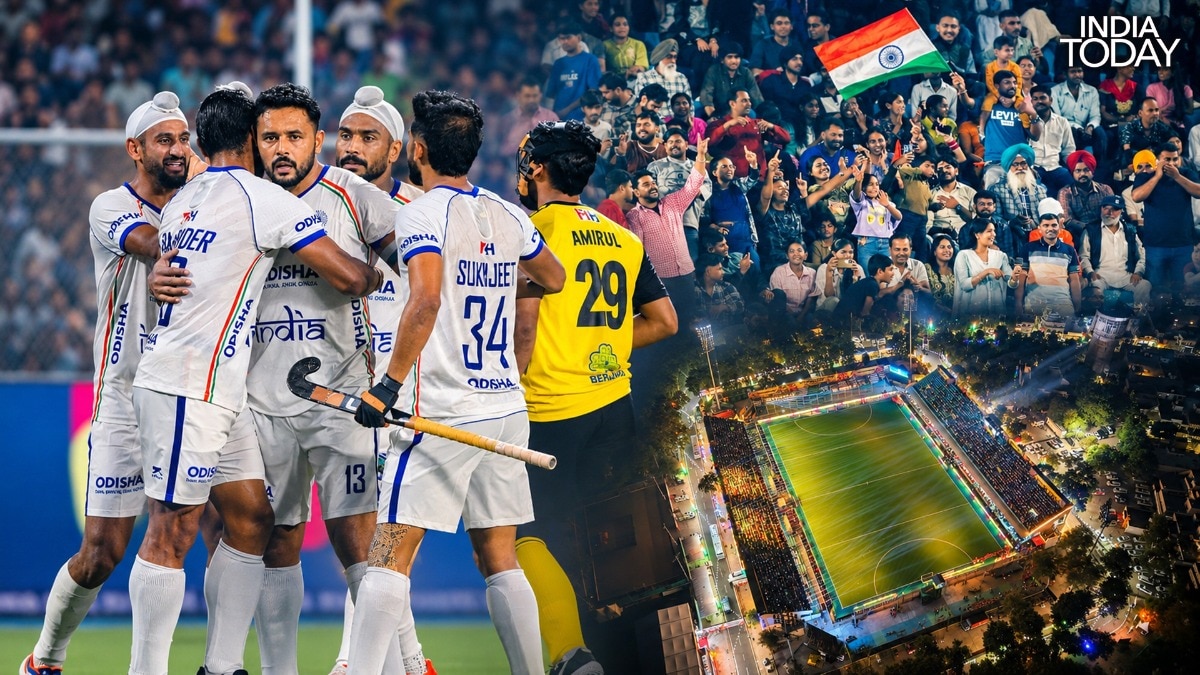
There is something special about Jalandhar. You can sense it the moment you arrive.
Calmness and chaos seem to coexist in this sleepy city, around 150 km from Punjab’s capital, Chandigarh. But what truly sets Jalandhar apart is its deep rooted connection with sport, especially hockey.If you don't believe us, try navigating its traffic.
The experience offers a glimpse of the situations a player might encounter on a hockey field. Squeezing through narrow roads feels like being a defender trying to break through an opponent's high press.ASIAN CHAMPIONS TROPHY: FULL COVERAGEThen come the traffic lights.
You need the reflexes of a first rusher at a penalty corner, ready to charge out the moment the signal turns green. Hesitate, and you risk being left behind, watching the rest of the traffic fly past you like a drag flick sailing into the back of the net.
Even waiting for a rickshaw to take you back to your hotel or home teaches you a lesson in patience. The wait can be long, and there is little to do but hold your nerve, much like a hockey team probing for an opening before finally finding a breakthrough.But beyond these parallels, hockey is woven into the very fabric of Jalandhar.
The city is home to several sports manufacturing companies and has produced some of India's finest hockey players. Look no further than the Indian squad competing in the Asian Champions Trophy, which is being held in the city.
Captain Harmanpreet Singh, Mandeep Singh, Manpreet Singh, Jarmanpreet Singh, Dilpreet Singh and Krishan Pathak all came through the famous Surjit Hockey Academy in Jalandhar.The villages of Sansarpur, Mithapur and Khusropur have long served as fertile grounds for hockey talent. On the outskirts of the city, Sansarpur is renowned for producing Olympians who represented India, Canada and Kenya.
Nearby Mithapur has also left a significant mark on Indian hockey, producing legends like Pargat Singh and current internationals Manpreet Singh and Mandeep Singh."Hockey is in our blood," the ever-smiling Mandeep Singh told India Today, expressing his happiness at playing in Jalandhar.For all its rich heritage, however, the city has spent years away from the international hockey spotlight. Punjab is hosting an international hockey event for the first time in 17 years.
In the intervening period, Jalandhar's celebrated hockey nursery took a hit before beginning to find its feet again.To understand how the city became one of Indian hockey's most important breeding grounds, and how it is attempting to reclaim that status, we traded auto rides for a walk through its lanes.GENESIS OF JALANDHAR'S HOCKEY CULTUREWhere did Jalandhar's hockey story begin? To trace its origins, we turned to Balbir Singh Kular, a member of India's team that won Asian Games gold in 1966 and Olympic bronze in 1968.A resident of Sansarpur, Balbir traces the game's roots in the region to the British era.
The acquisition of village land by the British may have come at a cost to local residents, but the grounds they left behind eventually helped hockey take root."The connection for Jalandhar goes back to the time when the British came to Punjab. I am talking specifically about Jalandhar.
Near the southern end of the cantonment, there is Sansarpur, where I come from. Khusropur and Mithapur are also nearby, but Sansarpur is very close to the cantonment.""The British acquired land in our area.
There was a parade ground where they used to do exercises and morning PT. There were grounds for hockey and football as well.
They acquired our land, and we lost some of it. We probably did not get much money for it either.""But we also gained something from it.
They left some portion of that land for playing purposes, and our village boys used those grounds," said Mr. Balbir. (Credit: Balbir Singh Kullar The British regiments stationed in the city played hockey matches, exposing local youngsters to the game.
What began with village boys watching soldiers play gradually turned into a sporting tradition."The boys started learning by watching the British play. In the evening, they would play games, and the local boys would watch them.""People had to find a way to earn a living.
Many people joined the Army, and hockey became a way for them to get opportunities.""Hockey spread from one village to another. Sansarpur, Khusropur and Mithapur were very close to each other, so the players also had a close connection," said Mr.
Balbir.The next major boost came from the Jalandhar Sports School and Sports College, which helped nurture another generation of players through the 1970s and 1980s.Olympian Rajinder Singh Sr. remembers an environment in which passion for hockey often mattered more than the prospect of financial reward."I started studying at the school around 1970 or 1974 to 75. I was part of the school at that time.
There were a lot of hockey players coming in. They were playing from the heart.
There was not much money at that time, but there was a lot of passion for hockey," said Olympian Rajinder Singh Sr."Hockey was played in our villages. Most of the children who came to study there belonged to the Amritsar and Gurdaspur areas, the Majha belt."For Rajinder Sr., those years represented a golden period for the sport, when hockey was a major draw for young athletes and admission to the city's sports institutions was highly sought after."If I talk about the 1970s, hockey was considered one of the best games.
It was even ahead of cricket.""Jalandhar was a city where every child wanted to get admission to the Sports School or Sports College. They wanted good coaching so that they could become good players.
That was the preference," said Rajinder Sr.Decades later, that same sporting culture shaped Mandeep Singh's journey. His father was determined to see him play hockey, even when the youngster's attention drifted towards cricket."In our village, there was a board under which children used to play cricket.
I started going there a little more because I wanted to play cricket and hit fours and sixes.""I went there for two or three days. My father used to go to the hockey ground regularly, but for two or three days, he did not see me there.
When he went and asked about me, they told him I had not come for two or three days.""He then found me playing near our house. He spoke to me firmly and told me that I should play hockey because my brother was also playing it," said Mandeep.In Mithapur, hockey was more than a game played on the village ground.
It was a family tradition, strengthened by the achievements of those who had come before."We have had legends of hockey from our village. Pargat Singh, for example, has been an Olympian and has also been a captain.
Hockey had a lot of prestige in the village from the beginning.""Then Manpreet came in 2011. After that, our generation came through.
Hockey had been very popular in Mithapur from the beginning because of the legends who came before us. Hockey was present in almost every household.
There were hockey families everywhere.""After that, our generation started coming through this nursery, and the tradition continued," said Mandeep.SURJIT ACADEMY: WHERE TALENT IS TURNED INTO STARSJalandhar had no shortage of raw talent. What it needed was a system capable of turning promising youngsters into elite players.
The Surjit Hockey Academy, tucked inside Burlton Park in a residential neighbourhood, became one of the institutions at the heart of that process. Manpreet is an alumni of the Surjit Hockey Academy (Courtesy: Surjit Hockey Academy) Named after legendary hockey player Surjit Singh, the academy was established with the ambition of producing more players capable of reaching the highest level.
Its contribution has been evident across generations. When India ended its long Olympic medal drought with bronze at Tokyo 2020, nine members of the squad were products of the Surjit Hockey Academy.Iqbal Singh Sandhu, COO of the Surjit Hockey Society, believes the academy's emphasis on specialised coaching and player development has been central to its success."When children take admission in the lower classes, they are beginners.
They are okay, but when they come to the Surjit Academy, they get all kinds of coaches. The academy gives them proper training.
Their fitness, diet and everything is taken care of," said Iqbal Singh Sandhu."There are different coaches for different things. There is a separate coach for goalkeepers and a separate coach for the forward line.
Training is given accordingly.""Secondly, the children who come to the Surjit Hockey Academy play daily practice matches against big teams. These teams include Punjab Police, Punjab, ASC, EME, CRPF, BSF and other teams based in Jalandhar.""Jalandhar is a place where children come from all the surrounding districts and other places.
A lot of children come here. They get polished here, and quality comes out of that quantity.""This is the reason that eight or nine players from this academy have played for the Indian team.
This is the reason for Jalandhar's success."Behind several of those success stories were coaches who could recognise potential early and build on it. Avtar Singh Pinka played an important role in the development of players like Mandeep and India captain Harmanpreet Singh.
Aim of the Surjit Hockey Academy is to find the next big talent (Courtesy: Surjit Hockey Academy) He still remembers Mandeep as a lean, cheerful youngster who was rarely seen without a smile. Harmanpreet, meanwhile, was a different kind of project: a player whose drag flicking ability needed to be sharpened into a weapon capable of troubling the world's best defences."We had made a separate pit for Harmanpreet to practice drag flicking.
We had installed turf in that pit for him to practice. There was a goalpost in front, and we had closed it off on all four sides with netting.""Initially, I told him only one thing: generate maximum speed.
Hit the ball anywhere. Do not look at where you are hitting it.""Once he started getting the drag flick right and developed speed, we worked on angles.
We put two cones on the right and left and told him to hit the ball at those angles.""He is a very mature and very aggressive player now. Most of the goals India scores through drag flicking come from him.
India is scoring more because of him.""I do not think anyone will be able to reach this level in the coming time," said Mr. Pinka.For Mandeep, the academy offered far more than technical training.
His five years there helped shape him as both a hockey player and a person, while hostel life taught him the importance of discipline and teamwork."I came to Jalandhar city and spent five years at Surjit Hockey Academy, which is one of the most well known academies in Punjab.Hostel life is very important for a player. You learn about structure and how you have to live.
You learn how to stay connected with other players and what kind of combination you need to develop with them," said Mandeep.The academy's success reflects a wider ecosystem in Jalandhar: village level talent, access to coaching, competitive matches and a sporting culture that has repeatedly supplied players to the national team. But even a strong tradition can falter when the support around it begins to disappear.WHEN JALANDHAR'S HOCKEY NURSERY FALTEREDFor all its history, Jalandhar's hockey culture has not been immune to decline.
The pipeline that once supplied talent across Indian hockey began to weaken, with the effects particularly visible in the women's game.Iqbal Singh Sandhu believes a lack of sustained attention from hockey associations and successive governments contributed to the problem. The closure of established centres deprived young players of pathways into the sport."The basic reason is that our associations in the past, and those who have been working until now, did not pay much attention to women's hockey.""Earlier, we had a centre in Jalandhar at Nehru Garden School.
It produced the maximum number of Indian players and gave them to the Indian team.""But what did the previous governments do? They broke up that centre.
The Nehru Garden centre was shut down, and after that, admissions stopped there. The other centres also gradually closed down.""Because of this, earlier, at least eight or nine players in the Indian team used to be from Punjab.
The Punjab team would always finish first, second or third in the national competitions. Now, we hardly hear Punjab's name.
We don't hear that the Punjab women's team has won," said Mr. Iqbal.The changing priorities of families also played a part.
As private schooling and overseas opportunities became increasingly attractive, sport began to lose its place in the ambitions many parents had for their children."If you talk about Jalandhar and its villages, a new trend started. Earlier, children used to study in government schools.
The target was different. You would work at home, study and play sports as well.""Then the situation changed when private schools came in.
What happened was that people who were good players sent their children to these schools, but there was no sport in those schools. After that, their target became that the child should complete Class 12 and then be sent abroad.""This was one reason why children stopped playing hockey in some of the very good hockey belts," said Mr.
Pinka.Drug abuse was another concern in the region, with the crisis threatening the prospects of young people who might otherwise have pursued sport. A 2017 study estimated that more than 860,000 men aged 15 to 35 in Punjab used some form of drugs.
In 2018, the state reportedly recorded 60 drug related deaths in a single month, highlighting the scale of the problem.Pinka believes sport can offer young people a constructive alternative, but warns that exposure to drugs can put that pathway at risk."As far as drugs abuse is concerned, wherever there are drugs, if a young person is moving around in a village and comes into contact with them, that person can get involved.""Sports was one thing that kept many people away from drugs. Those who came into sports did not take drugs.
Those who were separate from sports lived separately in the villages. Their situation was different," said Mr.
Pinka.The changing economics of sport added another challenge. As cricket offered greater financial rewards and visibility, hockey struggled to compete for the attention of young athletes and their families."Earlier, when our players got good jobs, they also got a good status in society.
There was not so much focus on money at that time. Now, the thinking is different.
Now, people are running after money, like they do in cricket," said Rajinder Sr."If there is no money in hockey, fewer players will come to play it. This is the problem we are facing today."THE ROAD TO REVIVALJalandhar's hockey story, however, is far from over.
There are signs of a revival, with renewed government support and the return of international hockey to Punjab offering fresh hope to its players and academies.A packed Olympian Surjit Singh Hockey Stadium, passionate fans and an atmosphere like no other! The crowd is out in full force, cheering every moment as India take on Malaysia at the Hero Asian Champions Trophy Punjab 2026! #HockeyIsBack #HACT2026 #SatSriAkalAsia #IndiaKaGame— Hockey India (@TheHockeyIndia) November 1, 2026For Iqbal Singh Sandhu, one of the most significant changes has been the direct financial assistance provided to budding players.
The support, he says, gives youngsters greater freedom to choose their own equipment and meet their training needs."Until today, no government has given so much money for the game.""For a budding player who plays hockey, they have put Rs. 23,000 into the player's account to buy equipment.
The player can buy whatever he likes and whatever he feels is good.""Then, for all the players staying in hostels, they have put Rs. 35,000 per player into their accounts.
Whatever quality of hockey stick they want, whatever tracksuit or shoes they want, they can buy them according to their own choice.""There is no interference from a coach or anyone else. Players have never received this kind of money directly before," said Mr.
Iqbal.For current India players, the return of international hockey to Punjab is about more than the opportunity to play in front of a home crowd. It is also a chance for young players to see the sport up close and imagine themselves following the same path.Mandeep credited Punjab Chief Minister Bhagwant Mann for helping bring international hockey back to the state, saying the tournament could inspire the next generation."I would like to thank the Chief Minister because he came forward and made this happen.
This was something that had not been happening, and now it has started because of his efforts.""Punjab has a very big hockey nursery. You can see that eight or nine players from Punjab are always playing in the Indian team.""Something that had stopped has started again.
I think our future and our youth will benefit from this in the coming years," said Mandeep.For Jalandhar, the return of international hockey is a reminder of what the city has given the sport, and what it could offer again. Its villages continue to produce players, its academies continue to nurture talent, and its sporting legacy remains a source of pride.
The challenge now is to ensure that the next generation has the support and opportunities to carry that legacy forward.As the city begins to find its hockey rhythm again, Mandeep returns to the sentiment that has defined its relationship with the sport for generations."As I said earlier, hockey is in our blood.""When you come to Punjab and play, you enjoy it even more," Mandeep signed off with his signature smile.In Jalandhar, that connection has never entirely disappeared. Now, the hope is that the game once again becomes part of everyday life, on village grounds, inside academies and, most importantly, in the dreams of the children who will one day wear India's colours.- Ends