


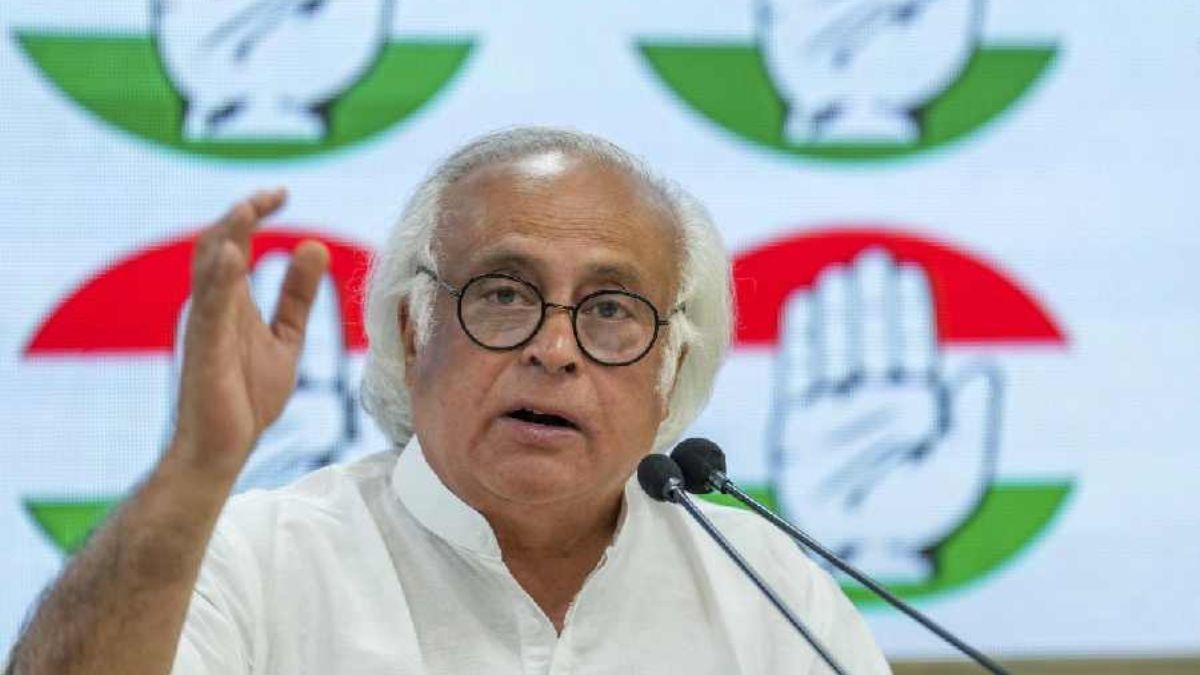
Congress leader Jairam Ramesh has said that while India is a multi-religious society, religion cannot be the sole basis of a nation, news agency Press Trust of India reported. He cited Maulana Abul Kalam Azad's prediction that Pakistan could not remain united on religious lines alone, which was proved right in 1971.Ramesh said Azad and Jawaharlal Nehru represented India's composite heritage.
Though neither was deeply ritualistic, both were spiritual and recognised that the country's diversity of religions, languages, castes and regions had to be respected and celebrated to keep the nation united.“Maulana consistently maintained that a nation cannot be built on the basis of religion. In 1952 or 1953, he predicted that Pakistan, split between West and East Pakistan, could not remain united on religious lines alone — a statement proven right in 1971 when headlines declared ‘Maulana Azad Proved Right’,” Ramesh said, according to PTI.In 1971, an independent Bangladesh emerged from what was then East Pakistan after India won the war against Pakistan.
Referring to the birth anniversaries of Azad on November 11 and Nehru on November 14, Ramesh said the two dates held immense significance in India's history. “The builders of modern India — first Maulana Azad and later Jawaharlal Nehru — were born on these dates,” he said.Ramesh urged Imran Pratapgarhi to ensure that Azad's birth anniversary was observed seriously every year. “While we celebrate November 14 with great fanfare, every year, on November 11, we should also observe Maulana Azad's birth anniversary in a deeply serious manner, educating the new generation about his writings, thoughts and contributions to our history,” he said. Azad and Nehru, born in 1888 and 1889 respectively, met for the first time in 1920. “Pandit Ji's first meeting with Maulana Azad took place in 1920.
And in 1923, at the age of 35, Maulana Azad became the Congress president. At 35 years of age, if anyone could be considered a young leader in those days, it was Maulana Azad,” Ramesh wrote.Azad became Congress president in Delhi in September 1923.
Ramesh said the event marked the beginning of his friendship with Nehru, though Azad already knew Motilal Nehru. Their friendship grew stronger as both continued to be imprisoned during the freedom struggle.“Between 1920 and 1947 — a period of 27 years — Pandit Nehru spent nine years in jail, meaning he spent one out of every three years behind bars.
But very few people know that Maulana Azad spent 10 years in prison. Although two and a half of those 10 years were spent under house arrest in Ranchi, house arrest under the British was still imprisonment,” Ramesh said.Azad was elected Congress president for the second time at the party's historic Ramgarh session on March 19 and 20, 1940, and remained in the post for six years.
Ramesh said that, in his view, Azad's presidential address at the session was the most influential such speech in the Congress's 140-year history and remained worth reading.“I get emotional when I read that speech, which was delivered in Urdu. Most people do not read or speak Urdu fluently, so our historical knowledge of what Maulana said in Ramgarh comes from its English translation.
And you might be surprised to learn who translated that famous speech — it was translated by Jawaharlal Nehru himself,” Ramesh said, adding that Nehru's command of Urdu was strong.Citing a letter written by Azad from Kolkata on March 27, 1940, Ramesh quoted him as telling Nehru: “You have done something wonderful in how you translated it. I knew your English was very good, but I was amazed by how you captured the full understanding of what I expressed in Urdu and presented it in English; what you wrote in English was precisely my thought.”Ramesh said the speech was so powerful that Sonia Gandhi quoted several parts of it in an address at Oxford University's Centre for Islamic Studies on November 29, 2002, after being invited by its director, Farhan Nizami.During the Quit India movement, Nehru and Azad were imprisoned together at Ahmednagar Fort with nine other Congress leaders, including Sardar Patel, Narendra Deva, Govind Ballabh Pant and Pattabhi Sitaramayya.
It was the first time Azad and Nehru shared a prison.At Ahmednagar, Nehru wrote The Discovery of India, while Azad wrote Ghubar-e-Khatir. “In the preface of The Discovery of India, Pandit Ji expressed gratitude to all 11 companions, specifically singling out Maulana Abul Kalam Azad and noting how delightful and, at times, astonishing it was to witness Maulana's extraordinary intellect,” Ramesh said.When independent India's first Cabinet was formed in 1947, Azad became Education Minister and remained in the post for 11 years. Ramesh said that while ministries such as Home, Finance and Railways saw several ministers between 1947 and 1958, the Education Ministry was the only one whose incumbent did not change.“The reason was the deep personal, non-political bond between Pandit Ji and Maulana Sahib.
Maulana was one of the rare individuals who could candidly tell Nehru, ‘Jawaharlal, I do not agree with this,’ and if he said so, Pandit Ji would defer the decision,” Ramesh said.After Azad died in February 1958, Nehru delivered a long speech in the Lok Sabha in which he described him as a rationalist rather than an emotional man and said he viewed matters scientifically. “He noted that despite his title ‘Maulana’, Azad was not a traditionalist but a modernist. Nehru concluded by saying that while Maulana was a scholar and a good Muslim, he was spiritual rather than religious,” Ramesh wrote.Ramesh's account recalled Azad and Nehru's decades-long friendship, their role in the freedom struggle and independent India, and their shared belief that the country's religious, linguistic, caste and regional diversity must be respected to preserve national unity.- Ends(With PTI inputs)