


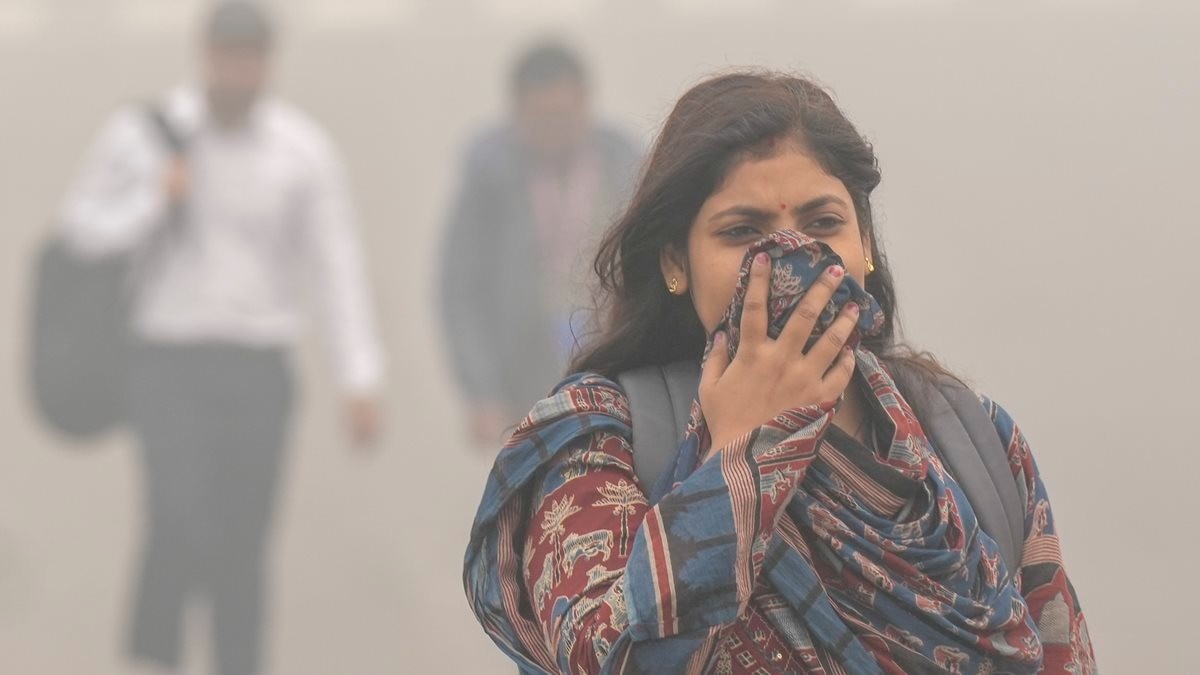
Delhi has entered the fortnight that typically records some of the highest air pollution levels of the year, with farm fires, festival-related activity, firecrackers and unfavourable weather conditions threatening to push the national capital into another spell of toxic air.The warning signs are already visible. Real-time readings from AQI.in on November 2 showed Delhi's AQI at 386 at 11:01 am, placing it in the 'Severe' category on the platform.The reading had peaked at 512 shortly after midnight, while the minimum over the preceding 24 hours was 334.
Neighbouring Noida recorded an even higher AQI of 409 at 11:01 am, classified as 'Hazardous' by the platform.The readings also showed dangerously elevated particulate pollution. Delhi's PM2.5 concentration stood at 233 micrograms per cubic metre, while PM10 was recorded at 291 micrograms per cubic metre.
In Noida, PM2.5 was 262 micrograms per cubic metre and PM10 stood at 297 micrograms per cubic metre. Graphic: AQI.in These are real-time readings from AQI.in and should not be confused with the Central Pollution Control Board's 24-hour citywide average.
CPCB's average AQI for Delhi on November 1 was 261, in the 'Poor' category. However, several monitoring stations had already reported 'Very Poor' air quality.WHY THE NOVEMBER FORTNIGHT MATTERSThe first half of November is particularly challenging for Delhi-NCR because multiple pollution sources converge.
Paddy harvesting in Punjab and Haryana leads to a seasonal rise in stubble-burning incidents, sending smoke and particulate matter towards the national capital depending on wind direction.According to the government's Decision Support System, farm fires contributed around 18.57 per cent of Delhi's pollution on November 1, up sharply from 5.33 per cent a day earlier.Historically, the contribution from agricultural fires tends to peak around the first week of November. Transport emissions also remain a significant source of pollution.
Graphic: AQI.in Festival-related activity adds another layer of emissions. Increased traffic, celebrations and firecrackers can worsen pollution, particularly when atmospheric conditions are unfavourable.Weather plays a critical role in determining how long pollutants remain trapped over the region.
Low wind speeds, falling temperatures and a shallow atmospheric mixing layer restrict the vertical and horizontal dispersion of pollutants. This allows emissions from vehicles, industries, construction, waste burning and farm fires to accumulate close to the surface.The Air Quality Early Warning System for Delhi has forecast that air quality could deteriorate into the 'Very Poor' category on November 4, with conditions likely to remain between 'Poor' and 'Very Poor' over the subsequent six days.AUTHORITIES ANNOUNCE PRECAUTIONARY CURBSThe Commission for Air Quality Management has already moved to tighten pollution-control measures.Under a fresh order, government and private offices in Delhi and six NCR districts will operate with only 50 per cent of staff attending physically between November 5 and 20, with the remaining employees working from home.
Graphic: AQI.in The commission has also ordered restrictions on dust-generating construction and demolition activities during this period. These measures come in addition to Stage-I restrictions under the Graded Response Action Plan, which were invoked on October 21.Vehicle restrictions have also been tightened, including curbs on the entry of non-BS-VI compliant vehicles registered outside Delhi from November 1.With the most polluted part of the season now underway, the coming days will test whether these preventive measures can limit the deterioration.
For residents, the concern is not merely a few hours of poor visibility, but prolonged exposure to high concentrations of fine particulate matter that can penetrate deep into the lungs.Delhi's winter pollution season has begun in earnest, and the next fortnight could determine how severe the capital's air crisis becomes this year.- Ends