


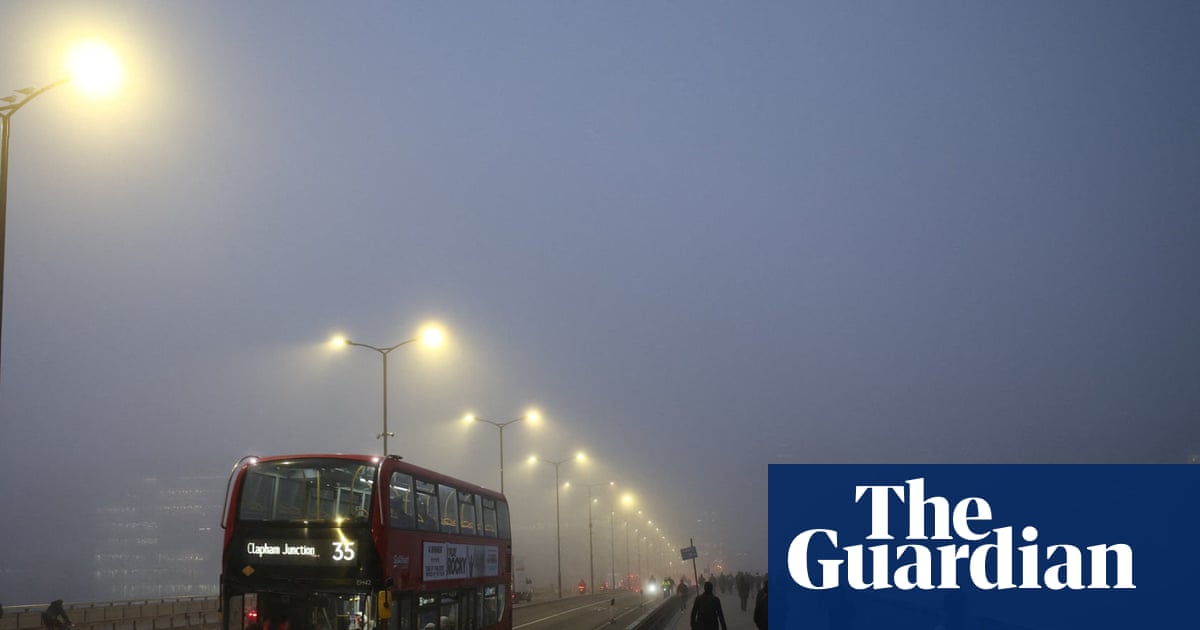
Air pollution soared to “very high” levels across urban parts of England on Monday as still, foggy weather kept emissions trapped after a weekend of fireworks and bonfires.Government monitoring showed 11 sites, mainly in London and Greater Manchester, reached the highest band on its 10-point index for particulate matter in the 24 hours to 10am. A further 27 sites recorded “high” levels across the capital, the north-west, the Midlands, Yorkshire and the east of England.The worst reading was in Hillingdon, west London, where fine particles (PM2.5) peaked at a 24-hour average of 129 micrograms per cubic metre, more than eight times the World Health Organization’s daily guideline.
In the north west, Manchester Piccadilly, Wigan, Blackburn, Preston and Rochdale all reached the “very high” band.Particulate matter consists of tiny solid particles and liquid droplets suspended in the air. Exposure is linked to heart and lung disease and cancer.Jane Burston, the CEO of the Clean Air Fund, said although monitoring networks could not determine where pollution came from, it was highly likely the pollution was from autumn celebrations.“It’s a combination of the weather, which has been foggy and not windy at all, and then the fireworks and bonfires and Diwali,” she said. “What it means is the wind doesn’t blow the pollution away and the fog keeps it trapped down in the same place.“If you’ve got asthma or a lung condition, you absolutely will not have wanted to go outside this morning or yesterday – it can bring on asthma attacks, coughing and wheezing.“But for everybody, it’s dangerous.
People in some of the worst affected areas are breathing particulate matter concentrations five to 10 times above normal annual levels,” she added.Burston called for better pollution forecasts, more widely accessible health alerts and stronger action to reduce emissions from wood burning and transport. “If we had air quality at a much safer lower level all year round, then on nights like Bonfire Night, the extra pollution is less likely to push us to extreme levels,” she said.Larissa Lockwood, the director of campaigns at Global Action Plan, said the high pollution levels were “not surprising at a time of year when people are lighting log burners, having bonfires and lighting fireworks. On top of the normal levels from transport and industry, we see higher levels of air pollution and they’re then unable to disperse because they’re trapped by the fog.”Domestic burning and transport are the biggest sources of particulate pollution, she said.
Lockwood called for a public health campaign on air pollution and “burn alerts”, asking people in towns and cities not to use wood burners when levels are high.skip past newsletter promotionafter newsletter promotion“We need to phase out non-essential burning in our towns and cities so that we don’t experience these unhealthy air pollution levels,” she added.A spokesperson for the mayor of London said: “On the advice of forecasters at Imperial College London, we’ve issued a high air pollution alert for Tuesday 10 November. Monitoring data show that pollution levels rose sharply across London from Friday to Sunday and remained elevated into Monday morning.”A Clean Air Greater Manchester spokesperson said: “Higher particulate pollution levels occur each year around Bonfire Night, when fireworks and bonfires add particulate matter to the air.
This year, weather conditions are also an important factor, with light winds and fog creating conditions in which pollution from a range of sources can accumulate near ground level. The latest information and health advice provided by Defra is available online.”The government has been contacted for comment.