


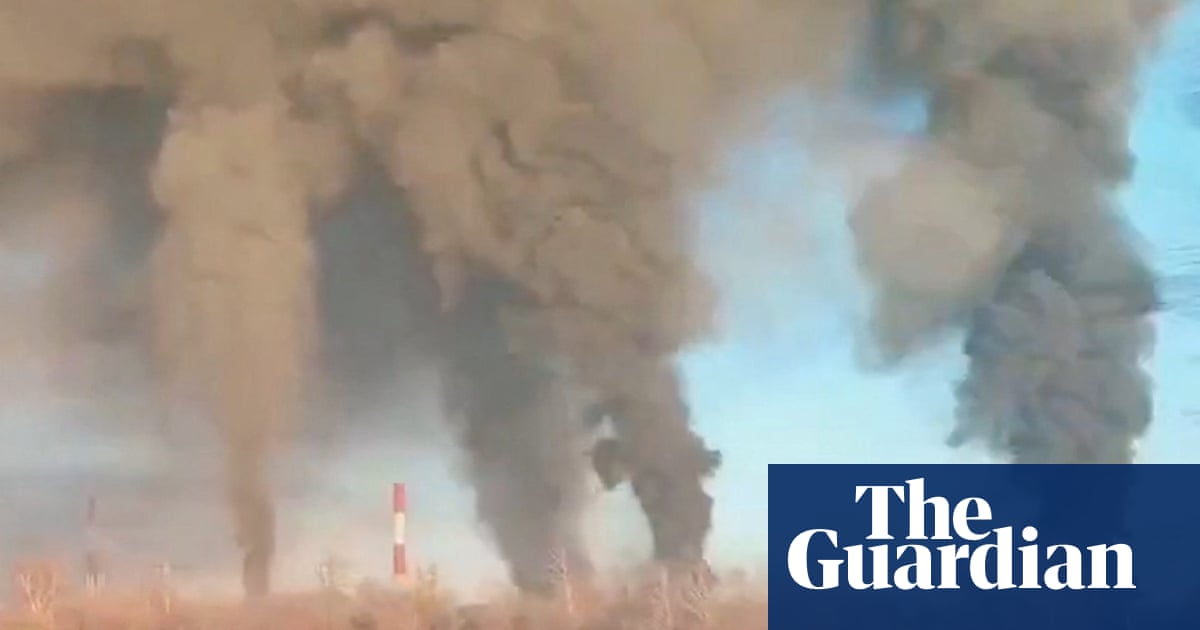
Ukraine has resumed its attacks on Russian oil refineries in defiance of pressure from Donald Trump ahead of the US midterm elections, with a ceasefire in the occupied town of Oleshky due to end late on Sunday.Russian state media said on Sunday Ukrainian long-range drones had set fire to the Kstovo refinery in Nizhny Novgorod oblast overnight, following soon after a major strike against another big refinery in Samara oblast, owned by the Russian state energy giant Rosneft.The Wall Street Journal had reported that Ukraine had given in to pressure from the White House to stop bombing Russian energy infrastructure.Ukrainian officials, however, told the Kyiv Independent newspaper that they never agreed to a demand from Jared Kushner, the US president’s son-in-law, to pause refinery strikes for 30 days. The raids on restarted on Friday, Kremlin officials said, complaining that Kyiv is now “simply ignoring” US wishes.Trump has blamed the Ukrainian president, Volodymyr Zelenskyy, for the rise in global fuel prices, and last month lifted US sanctions on Russian diesel.Zelenskyy has not acknowledged the latest refinery attacks, in an apparent attempt to avoid angry US reprisals.
Instead, he said his armed forces had hit a defence industry enterprise in Russia’s Rostov region that made missiles. A Pantsir missile system was destroyed, he added, as part of Ukraine’s ongoing “long-range sanctions”.Zelenskyy said that his country was obliged to retaliate because of a remorseless campaign by Moscow, using drones and ballistic missiles, against vulnerable city-based energy facilities.
Four regions were hit by Russia overnight, with electricity cut as a result in hundreds of thousands of households.“The intensity of the strikes is very high, and the Russians are seeking to maximally exploit the deficit of ballistic missile interceptors,” the Ukrainian president said on Telegram. Kyiv experienced power cuts lasting eight to ten hours on Sunday, after a critical thermal power plant was damaged.Zelenskyy said Russia was suffering record losses, with 54,400 military personnel killed and wounded in October – the highest monthly figure since the full-scale war began.
He said Ukraine recaptured 96.2 sqkm (37 sq miles) of its territory last month, 10.4 sqkm (4 sq miles) more than Moscow managed to seize, and emphasised: “Russia is losing.”The latest attacks came as a six-day local ceasefire brokered by the US first lady, Melania Trump, was due to come to an end in the Russian-occupied town of Oleshky. Hundreds of residents were reunited with their loved ones over the weekend in northern Ukraine, with both sides hailing the evacuation mission as a success.Ukrainian observers say the Russian military used the truce to reinforce its positions and to swap hungry and exhausted troops garrisoned in Oleskhy.
The town sits on the left bank of the Dnipro River, to the east, and is opposite the larger city of Kherson, which Ukraine recaptured in autumn 2022. A renewed Russian onslaught is inevitable, the observers believe.skip past newsletter promotionafter newsletter promotionThe pope said on Sunday he hoped cooperation between Russia and Ukraine in implementing the Oleshky ceasefire – the most significant since 2022 – would pave the way for broader peace efforts.“I hope that the cooperation between the parties, which made this necessary humanitarian gesture possible, will strengthen their willingness to engage in dialogue,” he said during his Sunday prayer.Trilateral talks involving Russia, Ukraine and the US are likely to take place later this month, with Kremlin officials saying on Sunday that Putin was willing to talk directly with Zelenskyy by phone.
They added that European leaders who support Ukraine should not be involved in any such call.There is little prospect of a wider breakthrough, however, as the Russian president’s maximalist demands remain unchanged. He is insisting that Ukraine give up all of the eastern Donetsk oblast – which Russia has been unable to seize since 2014 – as well as further territory in Kherson and Zaporizhzhia provinces, which the Kremlin does not control but says it has “annexed”.