


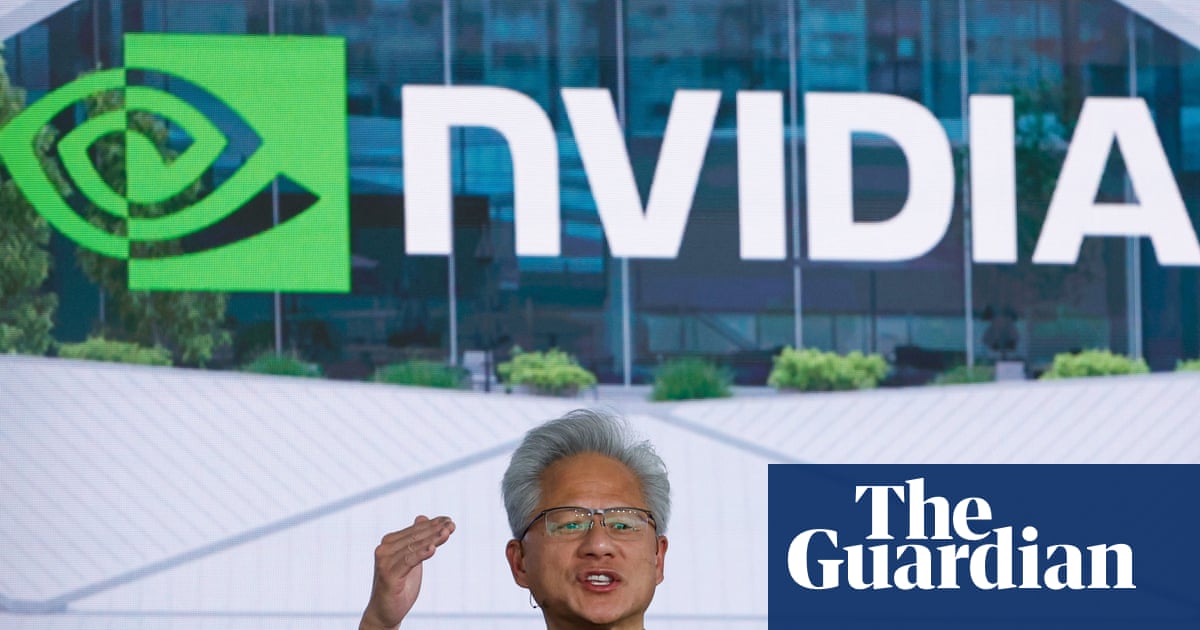
Good morning. Espionage is supposed to be a secretive business, and spies are supposed to be virtually invisible.
That hasn’t been the case for Alice Huang, the mysterious Shanghai executive who formed a romantic relationship with Jensen Huang, the founder of Nvidia, one of America’s most powerful tech companies.Many questions have arisen since it emerged that US intelligence believes that Huang (no relation of Jensen’s) is an asset recruited by the Chinese intelligence services to spy on behalf of Beijing. This morning’s newsletter explains what we know about the story, and what it tells us about the effectiveness of Chinese espionage.
That’s after the headlines.Five big stories UK | Ministers are considering changing the law to force the entertainment industry to better protect women and children in the wake of the revelations over David Walliams and the conviction of Russell Brand. Climate | The UK government has appointed the world’s first special representative for climate security, in the strongest sign yet of fears that climate breakdown will bring chaos to the country.
US midterms | Democrat Scott Colom has become the first Black senator in Mississippi to be elected since Reconstruction, in a stunning upset after more than a week of vote counting in one of the country’s most reliably red states. Europe | Millions of people across Spain have joined the country’s first general strike in 14 years, setting up picket lines to protest against soaring housing prices before an election in which the far right could be catapulted into power.
Technology | Police officers risk arresting innocent people, especially from ethnic minorities, if they treat inaccurate facial recognition data as evidence, an official report has found. In depth: Everything we know (or don’t) about the Nvidia affairUS intelligence officials had been conducting surveillance on Alice Huang.
Photograph: CTI/AFPTV/AFP/Getty ImagesLast month, the New York Times reported that Jensen Huang had formed a “close relationship” with Alice Huang, the former executive of a Singapore-based computing company, Megaspeed. Megaspeed is a customer of Nvidia; it buys the extremely valuable chips they produce, which are essential for powering AI, and rents computing space to Chinese companies.
The US government had already been investigating whether Megaspeed could be flouting US restrictions and smuggling chips into China – allegations that both Nvidia and Megaspeed deny.US intelligence officials, who had been conducting surveillance on Alice Huang, eventually concluded she was a Chinese intelligence asset who had been passing on information to Beijing. The intelligence behind this assessment is classified, so we don’t know exactly what they found – or which intelligence body was conducting the surveillance.
Nvidia said Jensen Huang’s interactions with Alice Huang were “not unusual or unexpected”, but on Sunday, Huang admitted in a letter to his employees that he had been having an affair. “I was unfaithful to my wife. My actions hurt her and our children,” he said, adding that he was “deeply sorry”.Nvidia’s valuation is inextricably linked to Huang.
By yesterday, $430bn (5.5%) had been wiped off its share price, and in the early hours of this morning, that figure ballooned to about $600bn following reports that Nvidia’s board was deciding whether to oust Huang (you can follow the latest on that here). The company has appointed outside counsel to review the pair’s relationship and says it has no reason to believe that secrets or national security were compromised.The most interesting aspects of this story are the questions we can’t (yet) answer.
Did Nvidia’s board know that US intelligence suspected Alice Huang was a spy? What evidence led US intelligence to conclude she was spying for China?
What information could she have passed to Beijing? And …Who is Alice Huang?Reporters and sleuths on Chinese social media have been trying to get to the bottom of who the Megaspeed chief really is.
On Tuesday, the Financial Times published an interesting report (£) about Alice Huang’s backstory. She was born in the rural area of Hunan, worked as a journalist at China’s state broadcaster, then at HSBC and the investment bank Citic Securities.
In 2015, she joined an investment management company Hexi.There, she met financier Kang Wei. The two became romantically involved, and together they reinvented themselves as AI entrepreneurs.
In 2023, Huang and her business partners acquired Megaspeed, a Singaporean subsidiary of a Chinese gaming company, which she and Wei aimed to turn into a datacentre business. According to the FT’s report, the two pitched investors on their ability to secure access to Nvidia chips.Nobody knows exactly when Jensen Huang met Alice Huang, when their relationship became romantic, or what information she might have passed to Beijing while it was going on.
The earliest picture of them together is at an after-party following a tech trade show in Taipei, taken in 2024. As Aisha Down and Dan Milmo pointed out earlier this week, Jensen Huang is close to Donald Trump, so it’s possible that Alice Huang could have gained glimpses into US AI policy as it was being formed, into Trump’s thinking on AI, or into Nvidia’s company strategy.
But without seeing the evidence, all this is speculation.What does this reveal about Chinese espionage?The US has been historically cautious about allowing AI chips to end up in Chinese hands. In 2022, Joe Biden’s administration introduced the Chips and Science Act, which restricted the sale of US chips in China, banning the export of most Nvidia chips. “The Chinese have a very strong pedigree for industrial espionage and copying other nations’ technologies,” Steve Tsang, the director of the SOAS China Institute, tells me. “They’ve been doing this for decades.
And now it’s no longer engines they’re interested in, but AI.”Both the US and China have an interest in gathering intelligence about each other’s AI firms. What’s more remarkable is the possibility that the Chinese spy agency, the MSS, could have recruited Alice Huang as a “honeytrap” to ensnare Jensen Huang – a method fraught with risk, which seems more reminiscent of 1970s spy fiction than contemporary counterintelligence (China, for its part, has rejected claims that Alice Huang was a spy).“The facts clearly aren’t established, but it seems more likely that if Alice Huang was working for Beijing, the MSS would have recruited her after they became aware of her relationship with Huang, not before,” Nigel Inkster, the former director of operations and intelligence for the British Secret Intelligence Service, tells me.China has built a large intelligence gathering operation: the MSS is now bigger than the CIA, and various national security laws mean that Chinese nationals can be required to provide assistance to the Chinese state. “You have a lot of people who can be co-opted into intelligence gathering, all of whom can be tasked with different requirements,” Inkster says. “Business delegations travelling abroad can be tasked with gathering information.
So can visiting academics.”“The big question, to my mind, is whether the Chinese intelligence agencies have actually been willing to deliver unwelcome information to the party leadership,” Inkster adds.What approach has the US taken?Jensen Huang is the most influential figure in the US AI industry outside major labs such as Anthropic, and has cultivated a close relationship with Donald Trump. He’s successfully lobbied the Trump administration to loosen regulations on AI and roll back restrictions on the sales of Nvidia’s chips to China (last year, Trump controversially approved the sale of Nvidia’s H200 chips directly to China in exchange for the federal government taking a 25% cut).
Huang was present at the White House twice last month: once for a state dinner with Xi Jinping, and again for a meeting of tech and AI executives.Huang’s close relationship with Trump could help explain why the president has so far played down concerns about Chinese espionage, appearing remarkably ambivalent about the recent allegations. The president was reportedly briefed last year about US intelligence conducting surveillance on Alice Huang, and in spring this year, his secretary of state, Marco Rubio, supervised the drafting of a classified memo warning that Jensen Huang was in a relationship with a Chinese spy.
In May, Trump issued a last-minute invitation to Jensen Huang to board Air Force One in Alaska and join a delegation of executives bound to China. A US government official told reporters at the New York Times that when Rubio learned that Huang would be joining the trip in Alaska, he briefed Trump on the memo.But on Monday, Trump, who is due to meet Xi Jinping later this month, said he had not known at the time of the trip about Huang’s relationship.
He said the FBI had been investigating a matter relating to Huang, and defended the Nvidia CEO, describing him as an “honourable guy” who “built a great American company”.What else we’ve been readingBeetle mania! … theatregoers on Halloween dressed up for Beetlejuice the musical in the West End. Photograph: Christian Sinibaldi/The Guardian I loved Arifa Akbar’s story on theatregoers donning costumes to watch their favourite shows, though I’m not entirely convinced that wearing feline ears to watch Cats absolves her from “veering into fandom” … Michael Joanna Moorhead uncovers the growing disquiet surrounding a little known collection of Indigenous artefacts handed over to powerful Catholic missionaries and now held at the Vatican Museums in Rome.
Libby Martin Lewis writes about his Small Ideas Initiative – quick fixes to make Britain work better, suggested by the public – with infectious enthusiasm. I just hope the government reads to the bit where he reminds us small fixes have to work alongside bigger structural change.
Libby Providence, Rhode Island, has become the second US city to divest Israel (Somerville, Massachusetts was first) in a landslide vote. Claire Wang has the details.
Michael Wire in, as they say in Scotland: our Comfort Eating podcast is back with a new host, the magnificent Siobhán McSweeney. Libby skip past newsletter promotionafter newsletter promotionSportHarry Kane is England’s record goalscorer with 91, ahead of Wayne Rooney’s 53.
Photograph: Adam Davy/PAFootball | Harry Kane says he still feels a pressure to prove his worth, even as he prepares to become England’s most capped men’s player, as he outlined his determination to set records that will stand for years.Cricket | White-ball tour begins in Perth on Friday, but there is only one story in Australian cricket and the tourists are not it.Fifa | A complaint has been filed to the United States Internal Revenue Service calling for an investigation into claims an individual on the Fifa payroll was working privately as a housekeeper for Gianni Infantino.The front pages Photograph: The Guardian“TV industry must tackle abuse or face crackdown, ministers warn”, is the Guardian’s splash today. Metro writes “Another mystery star bids to block claims”.The Times writes “Milburn: Cut sick benefits to force young into work”, and the i Paper has “Under-25s with ADHD won’t get £217-a-month benefits in new welfare reforms”.The FT leads with “Democrats pledge to expose ‘absolute avalanche of corruption’ under Trump”, the Mail has “Even Cameron tells PM: Don’t rejoin the EU”, and the Telegraph writes “SAS issues warning over troop witch hunts”.
The Mirror says “Not even a bed for an OAP with cancer”, and the Express has “‘Sanctuary in nature helped me to recover’”.The Latest Photograph: The GuardianTrump’s $10bn BBC battle: judge rules lawsuit can go aheadDonald Trump’s $10bn defamation lawsuit against the BBC has been granted permission to proceed, after the corporation’s attempt to get it dismissed was thrown out by a Trump-appointed Florida judge. The case focuses on an edit in a 2024 Panorama documentary that spliced two comments together that were made by the president during a rally before the January 6 Capitol riots, for which the BBC has apologised.
With the lawsuit now set to continue, what’s at stake for press freedom? Lucy Hough speaks to global editor, Devika Bhat.Cartoon of the day | Nicola Jennings Illustration: Nicola Jennings/The GuardianThe UpsideA bit of good news to remind you that the world’s not all badResearchers discover a potential diagnostic breakthrough for ovarian cancer, a disease often discovered after it has already spread.
Photograph: Simon Dawson/PAResearchers from the Hoag Family Cancer Institute have made a potential breakthrough in the early diagnosis of ovarian cancer – a disease often detected after it has spread.For decades, efforts to detect the cancer earlier have focused on finding smaller tumours. “We asked … what if we could identify the earliest molecular warning signs before invasive cancer even develops?” said study leader Rajan Gogna.Ovarian cancer often begins with microscopic changes in the lining of the fallopian tubes. The study found that women experiencing these changes have elevated levels of a molecule called Tu-Stroma in their blood.The study’s co-author Dr Esha Madan says the discovery “could transform how we approach prevention”.Sign up here for a weekly roundup of The Upside, sent to you every SundayBored at work?And finally, the Guardian’s puzzles are here to keep you entertained throughout the day.
Until tomorrow. Quick crossword Cryptic crossword Wordiply