


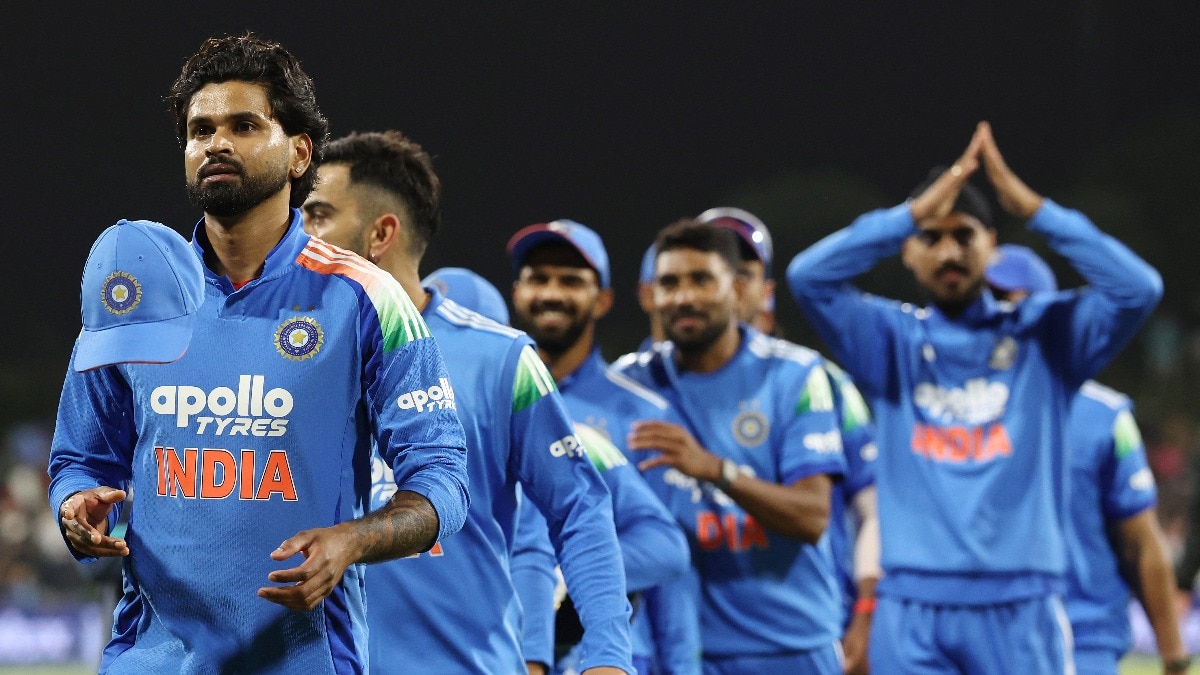
Shreyas Iyer offers a different take from Gautam Gambhir on India's batting struggles in New Zealand, saying the conditions cannot be compared with South Africa ahead of the 2027 ODI World Cup. Iyer also discusses overseas challenges and player fatigue.Shreyas Iyer does not want to compare India's batting performance in New Zealand with what lies ahead in the 2027 ODI World Cup in South Africa.
Mount Maunganui,Nov 15, 2026 18:51 ISTBrief Scores: India (209 all-out) beat New Zealand (187 all-out in 48.1 ovs) by 22 runs. Arshdeep (3/30); HIGHLIGHTS | SCORECARDShreyas Iyer believes India should be careful about drawing comparisons between their performances in New Zealand and what awaits them at the 2027 ODI World Cup in South Africa.
The stand-in captain offered a different perspective from head coach Gautam Gambhir on India's batting struggles, arguing that the conditions in the two countries cannot be viewed through the same lens.The difference in assessment comes after India wrapped up the five-match ODI series 3-1 on Sunday, bouncing back from a crushing defeat in the fourth game to win the series finale.India's batting came under considerable scrutiny after they were bundled out for just 89 in the fourth ODI, suffering a 244-run defeat. The collapse raised concerns about the team's preparedness for the World Cup, particularly with South Africa expected to offer conditions that could test India's batters.
Gambhir had made his concerns clear after that defeat, suggesting that New Zealand offered conditions closest to what India could encounter at next year's global tournament."You're always concerned when you get bundled out for 90-odd. Why won't I be concerned?
These are conditions which are going to be closest to what we might get during the World Cup," Gambhir had said. However, Iyer was reluctant to draw similar conclusions from the series, pointing out that conditions in New Zealand could not be directly compared with those in South Africa, particularly with almost a year remaining before the World Cup."We are in New Zealand, so we can't really compare with South Africa.
Weather will be different. Especially from the batting point of view, both teams, it did not happen, our bowling was consistently good and theirs too, and the wicket was predominantly bowler support," Iyer said at the post-match press conference."But the most important thing for us was to win the series, and we won.
So after that, we don't think much about the rest."WORLD CUP PERSPECTIVEIyer, who led India in the absence of Shubman Gill, acknowledged that the tour would provide individual lessons for the players. However, he also highlighted the mental demands of playing extended international series, with changing conditions and constant travel adding to the challenge.The batting returns were hardly encouraging for either side, with bowlers enjoying greater assistance throughout the series.
Iyer felt that adaptability would remain important as India continue their preparations for the global event."Definitely, there will be takeaways. Every individual will reflect within themselves, and we have been playing for a long time, so mentally you get exhausted the longer series you play.
So adaptability also, on every wicket it's different, there is a challenge, but keep learning and definitely you accept the challenge and move on," he added.OVERSEAS BATTING CHALLENGEIyer also explained one of the practical difficulties Indian batters encounter on overseas tours, pointing out that the lack of access to centre wickets for practice makes it harder to judge how the ball behaves on a particular surface.Unlike in India, where players often get opportunities to practise on the main playing surface, overseas preparations are largely restricted to open nets. That, according to Iyer, can make the transition into match conditions more challenging."We don't get to practise in the centre wicket here, so we don't gauge where the ball is going to go.
Whenever we come overseas, we get to practise in the open net. Everything is monotonous," he said."Once we get an idea, because in India we get an open net, so when we hit, we know where the ball is going, where it's travelling.
So that is one challenge that we face overseas."The India captain also highlighted the physical and mental toll of travelling between countries while continuing to play international cricket. He felt that the demands of regular matches and practice sessions could eventually reflect in performances."But if you're playing consistently overall, and when there is travel, practice in between, it kind of gets exhausting.
And it definitely reflects in the performance as well. We are all humans at the end of the day and not machines," he said.MOVING ON FROM 89Iyer insisted that India did not spend much time dwelling on their fourth ODI collapse.
Instead, the team chose to acknowledge New Zealand's performance and shift its focus to the series finale."Honestly speaking, the next day, we forgot about the loss. We didn't even discuss about what happened.
It was one odd game. We just had to brush it under the carpet and move on," he said.He also credited Matt Henry for his devastating spell in the fourth ODI, acknowledging the New Zealand pacer's ability to exploit the conditions."That day, Matt Henry was bowling gas.
He was lethal, and he was bowling with venom. So I think credit where it's due," he added.SIRAJ EARNS PRAISEThere was also praise for Mohammed Siraj, who returned to the playing XI for the series finale after missing the previous two matches.
Iyer likened the fast bowler to a soldier heading into battle, underlining the fearlessness and intensity he brings to the Indian attack."I feel Mohammed Siraj is like that guy who is, when you see a horse in a war, who is fearless, who wants to go and battle in every field. He's that kind of a player," Iyer said."Obviously, he wasn't part of a couple of games previously.
But today, he got that opportunity. He lived up to the expectation."India leave New Zealand with a series victory, but the batting concerns that surfaced during the tour will remain part of their preparations for the 2027 World Cup.
Gambhir has already made it clear that the team cannot afford such collapses in conditions similar to those expected in South Africa. Iyer, meanwhile, believes the focus should be on learning, adapting and recognising that the two tours will present different challenges.- Ends