


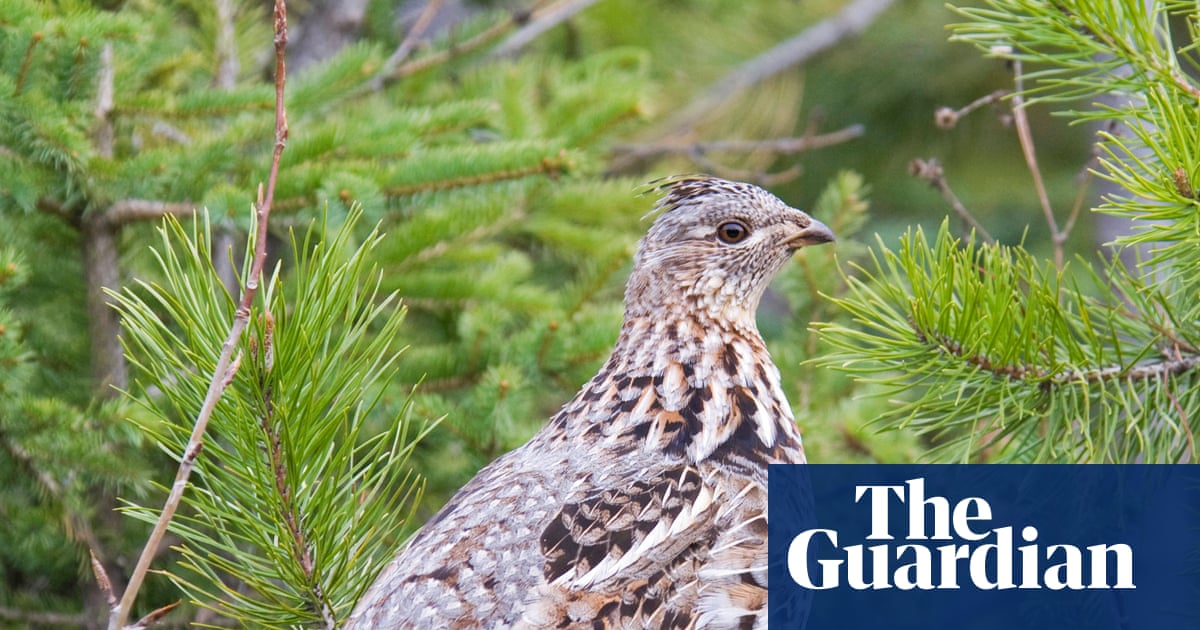
Every November, hundreds of hunters descend on four designated wilderness areas in southern Ohio in pursuit of the elusive ruffed grouse.But not this year.Dispersed across an enormous range from the southern Appalachian mountains to Alaska, the ruffed grouse is one of the most popular game birds in North America. But for the first time since 1937, no open permits have been issued to the public to hunt ruffed grouse in Ohio due to falling numbers.“Roadside drumming surveys suggest grouse numbers remain quite low across the species’ range in eastern and southern Ohio,” says Mark Wiley, forest gamebird biologist for the Ohio department of natural resources.Actual ruffed grouse numbers are not recorded in Ohio, but hunters conducting drumming counts, which can provide a broad estimate, have fallen to less than 1% of the rate recorded in the early 1980s.Six years ago, ruffed grouse was added to Indiana’s state endangered list, where it is thought to survive in just 12 counties.
That state’s hunting season closed in 2015. Four years later, ruffed grouse hunting ended in New Jersey for similar reasons.While the bird is famously tough and able to withstand winter storms that many other bird species struggle with, habitat shortages and the growing distribution of West Nile virus, a disease that’s carried by mosquitoes that feed on blood, are taking a toll.Detected in more than 320 species of birds, raptors and corvids are especially susceptible to West Nile virus.
In 2023, dozens of hawks fell sick from the virus in northern Colorado after heavy early summer rain. Birds in general are thought to be favorite targets of the white-dotted mosquito.While prolonged freezing winter conditions typically prevent mosquitoes from migrating north, warming temperatures and milder winters caused by human-activated climate change mean that may no longer be the case.“We’re seeing a shift in both altitude, with the mosquito moving farther north, and also topography-wise, that it’s moving into upland, mountainous areas where the higher elevations of New York and Pennsylvania have been strongholds for grouse,” says Karl Malcolm of the Ruffed Grouse Society, a conservation and advocacy organization.“I wasn’t surprised by the decision [in Ohio to close open hunting this year].
The long-term storyline here is one of decline of the species.”An analysis of data by Climate Central, a nonprofit news organization, found that the Ohio valley and north-east regions of the US have experienced a greater increase in “mosquito days” – days with an average relative humidity of 42% or more and daily minimum and maximum temperatures ranging between 50F (10C) and 95F (35C) – than any other region in the country since 1979.What’s more, infected birds can also serve as a virus amplifier, passing the virus on to other mosquitoes not previously infected by it.For rural communities that depend on income from hunters, the struggles facing the ruffed grouse could be particularly damaging. Hunting is worth almost $2bn to Ohio’s economy, the overwhelming majority of which stays in rural communities.
The majority of ruffed grouse hunting was centered in the state’s Appalachian counties, a region with some of the lowest income levels in Ohio.Biologists at the Ohio division of wildlife say that while they don’t have specific figures for the economic impact of ruffed grouse hunting on rural communities, between 1993 and 2014, the number of licensed hunters pursuing the bird fell from 13% to two per cent.Wisconsin, Michigan and Minnesota are home to the largest populations of ruffed grouse in the country, but they are also states that have experienced some of the highest levels of warming between 1970 and 2025, according to reports.Northern Wisconsin is known as the ruffed grouse capital of America, and a 2022 study by the Wisconsin department of natural resources found that hunting the bird alone generated about $7.5m in economic output.In Park Falls, Wisconsin, Terry and JoAnn Ides have been offering guided grouse and woodcock hunts on local rolling swamp forests since the 1970s. Each fall, the family works with around 100 clients and right now, the couple says they are not concerned about West Nile virus affecting the birds their business runs on.“We sent in a lot of samples to be tested for West Nile, and we really weren’t a hotspot here,” says Terry. “I don’t consider that to be a problem.”However, the first recorded case of the virus in Wisconsin this year was in a wild bird found in a county an hour’s drive from Park Falls.What’s more, there have been signs that changeable weather has influenced local birds’ behavior.
JoAnn says that warm temperatures this fall have kept birds high in the trees, where they use the passing wind to keep cool, making it harder for hunters to track them on the ground.About the same size as a bantam chicken, on spring mornings, the male ruffed grouse can be heard in woods “drumming” their wings against their chests while perched on a log. The dozen grouse species of birds known to live in North America are notoriously wild and difficult to breed in captivity.With habitats across 38 US states and all Canadian provinces, ruffed grouse numbers are also struggling in the eastern US due to ageing woodland topography: the bird thrives in open spaces of young tree growth, which is in increasingly short supply as forests across Appalachia and the midwest mature.The amount of birdlife in the country’s eastern forests has fallen by 27%, according to a report by the Cornell Land Trust Bird Conservation Initiative.Part of the problem, says Malcolm, who has a doctorate degree in forest and wildlife ecology, is that the wider population no longer has a strong relationship with the outdoors, or understands that conservation and hunting in fact work hand in hand.“We’re getting to a point in human history where people don’t have that same direct connection to the landscape and a lot of folks have a sense that the only thing you can do with nature is either leave it alone or mess it up,” he says.“The reality is there are a lot of things we can do that make the land healthier.”