


If Sigmund Freud were to arrive in Delhi in 2026, there is one phenomenon that will immediately catch his fancy — the number of Thars on our roads. Mostly driven recklessly, Thar is a car that is comical and menacing at the same time.
Comical because its silhouette is similar to an overgrown toy created by someone with no aesthetic sense and taste. And menacing, because like a car in Mad Max movies, it is brutish, complete with a macho grille and artificially padded exterior, the kind that puny kings used to wear to look more imposing than they actually were.But Freud would not look at the aesthetics of Thar.
He would probably try to figure out why someone, who works in an office cubicle 9-5, would want a car like this to drive on congested city roads. And Freud might reach a conclusion, like he so often did, that it is all due to repressed sexual desires.
That probably the Thar owner is trying to compensate for something, that maybe the Thar drivers don't get laid enough, and the car is a manifestation of it all.Freud could be wrong. Or he could be right.
Who really knows the mind of a Thar owner!This piece is not about Thar, though. Neither is it about the repressed sexual urgency, voluntary or involuntary, and how it can wreck someone psychologically.
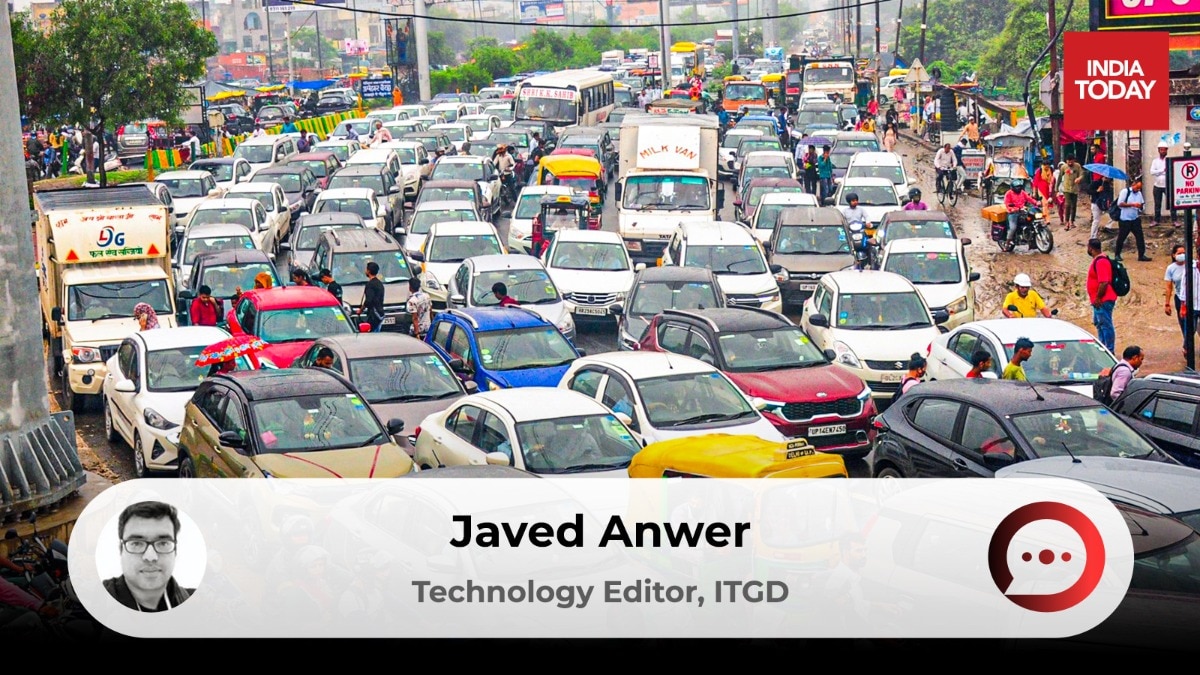
Instead, this piece is about the love affair that Indians have with large cars — SUVs and wannabes. And how this SUV mania is choking our roads and cities.
Indians love large cars! There are some reasons, genuine ones, for that.
Our roads are often bad, and an SUV with higher ground clearance is better suited to navigate through potholes and speed breakers. Such a car is also better for driving through waterlogged roads.But these reasons do not entirely explain India’s love affair with large cars.
In fact, even if roads get fixed tomorrow, our affair with big cars will not end. It is the Indian psyche that seems to be fuelling the phenomenon.
A Thar doesn’t just run on petrol. It also runs on the ego, unfulfilled desires and inferiority complex of its driver.
Alfred Adler once called the phenomenon overcompensation. A large car on the road adds several dimensions to a person’s psyche.
It probably gives the owner a feeling that they exist a few inches higher than the rest of India. It gives them a feeling of power and control when they sit on the high seat of an SUV and look down upon the smaller cars, bicycles, and pedestrians.
It probably makes them feel chuffed that they are manoeuvring and controlling a huge box of steel and iron. It gives them, even if it is false, an impression that in their big car they are big people.
In their mind, their car makes them big.The problem, however, is that Indian roads and cities are not the suitable arenas where the Thar gladiators should be racing their metal chariots in search of glory. Our cities are congested places, teeming with masses and vehicles.
There are turns in our cities that narrow arbitrarily. There are roads that get swallowed by parked vehicles from 8 in the morning to 10 at night.
And some roads get swallowed by parked vehicles from 8 in the evening to 10 in the morning.The large cars — SUVs and wannabes — only add to the problem. They add to it in two ways: one by their physical presence and two by their psychological play.This piece is now about a particular car brand or a particular car.
But I fail to understand the design of the Mahindra XEV 9, a car that seems unnecessarily large. It is not the only comically and meaninglessly large car one sees on the road.
From Creta to Thar, from Alcazar to Sierra, cars in India have been deliberately made big. They come with, compared to global standards, puny engines.
But size? They have been stretched to the maximum possible, because otherwise the Indian car buyer will steer clear of them.From parking to taking road space in traffic, the SUVs create nightmares on the roads.
They slow down our already slow traffic because their wheel base and the enlarged rears can’t be squeezed through tight spaces. Across the world, no other population in congested cities love big cars as much as we Indians do.
The most popular cars in most European cities, which are often as congested as Indian cities, are small cars. The likes of Renault Clio and Dacia Sandero.
Same with Japan, where Toyota Yaris hatchback with its size of less than 4 meters is often the car that leads the charts.Indian cities are exceptions for being places that are congested and yet have a love affair with large cars. Otherwise, large cars are only popular in places like the US, Australia, Canada, and the Middle East that are sparsely populated.Along with their physical presence, large cars also bring to our roads a psychological dimension.
They are, by their nature, driven in a particular way. They tend to accentuate the worst driving aspects of their drivers.
As soon as a driver is behind the wheel in an SUV, it seems to give him a shot of adrenaline, a toxic rush to the head that makes him inclined to shove and push their vehicle in whichever direction they feel like. The rest of the road is treated like private property.
Bicycles, autos, pedestrians, any “loser” still stuck in an Alto – they are viewed with contempt. An open stretch of a road is seen as an invitation to hit 120 km/h.
The lane changing is done at the flick of the wheel because the big car hurrr durr! You may find someone a sensible driver with a small car.
But put them in a Thar, and they transform. It’s the big car ego that takes over them.The end result is again the same: a city choking with poor traffic and total mayhem on roads.Given the love Indians have for big cars, there is no way we are going to make a sensible choice by choosing a smaller car.
Instead, the only way to solve this problem is if the government enters the scene.Instead of forcing ethanol down our throats, the government needs to nudge — or even push — people to choose smaller cars. It needs to make buying big cars more expensive, and needs to offer bigger incentives and larger tax breaks on smaller cars.
Maybe parking rates for big cars need to be made higher. Maybe their entry in parts of our cities needs to be banned.
But something needs to be done because, unlike Europeans or Japanese, or, for that matter, any other sensible people living in congested cities, we Indians put our ego and psychological need for overcompensation over our own comfort and convenience. All those big cars parked in a congested South Delhi colony are an example of that. (Views expressed in this opinion piece are those of the author)- Ends