

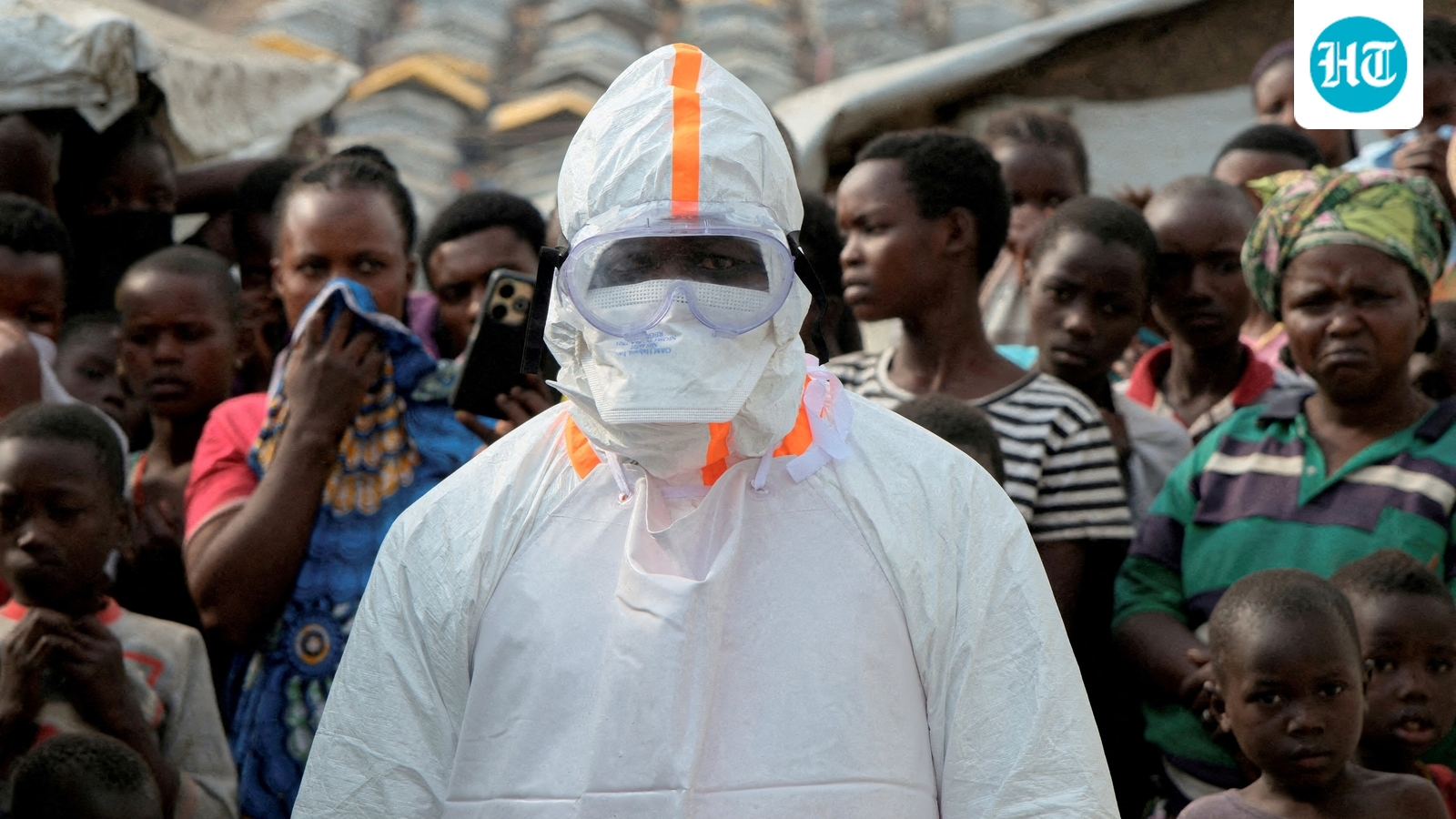
Six months into the biggest Ebola outbreak in the Democratic Republic of Congo’s history, containing the virus increasingly depends on solving problems far beyond Ebola — hunger, armed conflict, mistrust and a health system already buckling under the strain.A health worker in protective gear attends to a patient in the Democratic Republic of Congo, where containing the Ebola outbreak depends on tackling hunger, conflict and fear. (Reuters/Representative Image)More than 11,000 people have been infected and 5,500 have died since the outbreak was declared May 15. For months, Ebola has been killing roughly 240 people a week, the equivalent of about one and a half Boeing Co.
737 passenger jets crashing every week.“It’s a systems problem compounded by basically geography, insecurity, conflict, poor roads, mistrust,” said William Clemmer, a physician who has worked in Congo for three decades and is senior regional health adviser for Corus International based in Goma.Clemmer, 69, who has worked on four Ebola outbreaks, said many health facilities entered the current crisis without reliable water, electricity, sterilization, waste disposal or supply systems. Delivering protective equipment can only accomplish so much if clinics lack the basic infrastructure needed to use it safely, he said.Congo’s own data illustrate the problem.
As of Nov. 14, the country had recorded 11,376 confirmed infections and 5,568 deaths, for a fatality rate of almost 49%.
The outbreak had reached 68 health zones across eight provinces.In North Kivu province, 153 Ebola patients and suspected cases were being cared for in ordinary health facilities outside designated treatment and isolation centers on Nov. 14.
People who aren’t identified and isolated can continue spreading Ebola at home, in clinics and during funerals.About two-thirds of Ebola deaths have recently occurred in communities rather than treatment centers, according to Médecins Sans Frontières.“When two-thirds of our deaths occur in local communities, that basically tells us that either people are being detected too late or they’re not reaching care at all,” Clemmer said. “That is an indication not just of failure of surveillance, but also of access, trust and security.”Also Read: Ebola outbreak in Congo set to become 2nd largest on record, 3,200 confirmed casesFear FactorThe International Rescue Committee said its teams recently documented 84 rumors, including a recurring belief that people taken to Ebola treatment centers “do not return home alive.” The group said fear is discouraging some women from seeking routine medical care, including postnatal services.The outbreak’s roughly 50% fatality rate makes that reluctance understandable, Clemmer said. Unlike the 2018-2020 Ebola epidemic in eastern Congo, responders don’t yet have a vaccine or treatment proven to work against the Bundibugyo strain driving the current outbreak.Telling families that a relative needs to enter a treatment center where many patients are dying can fuel resistance, he said.The consequences extend far beyond Ebola.
Almost 29 million people in Congo already face acute food insecurity, a number projected to exceed 30 million in the first half of next year, according to United Nations agencies. More than 11 million of them are in Ituri, North Kivu and South Kivu, the eastern provinces at the center of the country’s humanitarian crisis.Conflict displaces families from their farms and livelihoods, while Ebola restrictions and fear can further disrupt farming and trade.
For health officials, that creates another obstacle: asking someone exposed to Ebola to isolate is harder when leaving home may be necessary to earn money or find food.“These people have the responsibility of working, of getting food for their family,” Clemmer said.Violence poses a more direct threat, with armed groups killing more people than Ebola itself in some affected areas, Julien Harneis, the UN’s senior Ebola response coordinator, said last week.Over one recent weekend, more people were murdered by the Allied Democratic Forces, or ADF, than died from the virus, he said in a post marking six months since the outbreak was declared.The violence is also making the epidemic harder to stop. Harneis said one of the response’s most pressing challenges is finding ways to improve contact tracing in conflict areas where attacks by the ADF and other armed groups are impeding the work.
He also called for greater engagement with private health providers, where he said most people initially seek care.Also Read: Nigeria confirms Ebola case in patient who arrived from UgandaScientific HopeThere are reasons for optimism. Transmission has declined in some former hotspots, neighboring countries have so far avoided sustained spread, and clinical trials underway in Congo could eventually provide vaccines and treatments specifically suited to Bundibugyo Ebola.Thousands of people are already receiving Merck & Co.’s Ervebo vaccine while scientists investigate whether the shot, approved against Zaire ebolavirus, can also protect against Bundibugyo.
Africa CDC said emerging evidence suggests it may provide some cross-protection and supports its use in high-risk children while the evaluation continues.Meanwhile, two vaccines designed specifically against Bundibugyo — one developed by the University of Oxford with the Serum Institute of India and another from Moderna Inc. — are set to enter a late-stage trial in Congo. Researchers will test whether they can protect people exposed to the virus from developing severe disease or dying, with results expected in early 2027.The latest government report underscores both the urgency and the scale of the effort.
More than 3,300 people have been vaccinated in North Kivu, leaving just 247 doses there and prompting an urgent request for 10,000 more. Researchers are also testing experimental treatments and post-exposure therapies as part of several trials.Those scientific advances may create another challenge.
Wellcome, a London-based health research foundation, warned that financing and procurement arrangements need to be established before trial results arrive so that successful vaccines or medicines can quickly be manufactured and delivered at scale.“The measure of success of this outbreak response will not be whether new tools are developed, but whether those at risk can benefit from them,” said Charlotte Watts, Wellcome’s director of solutions.For now, however, the epidemic is still being fought largely with the basic tools of outbreak control: finding infected people, tracing their contacts, isolating patients, protecting health workers and persuading frightened communities to cooperate.Those measures can work. The difficulty is making them work simultaneously across a vast area affected by armed conflict and a health system that was struggling long before Ebola arrived.“This is an outbreak that with good public health measures can be controlled,” Clemmer said. “It’s just we need those measures” to overcome the systems problems standing in their way.