


There are moments when history seems to hold its breath. Then one-man acts — and the fate of a people changes.One such moment came 367 years ago, on 10 November 1659.
Maharashtra remembers it as Afzal Vadh.Afzal Khan was no ordinary adversary. Born, according to tradition, to a cook, he had risen to become one of the most formidable commanders of the Adil Shahi Sultanate of Bijapur, in present-day Karnataka.
His remarkable ascent spoke for itself. He was regarded with exceptional favour by the Adil Shah, and had even once captured Aurangzeb.
Of immense physical stature, he was described in sources such as the Shivabharat as a man of almost mountain-like build. His name inspired fear across the Deccan.His own seal revealed the scale of his ambition, noting, "If exalted heaven were to display the excellence of the most excellent and the excellence of Afzal, then, instead of reciting the tasbih, every angel would proclaim: 'Afzal is excellent!' The quintessence of well-wishers, the conqueror of kingdoms, the destroyer of rebels and Kafirs, the breaker of idols, the foremost conqueror of the lands of Malabar and Karnataka, the paragon of the age, possessor of the seat of dignity and valour: Afzal Khan-i-Muhammad Shahi!
May he remain under Divine protection." But the events of November 10, 1659, were preceded by devastation, diplomacy, threats, and finally the road to Pratapgad.For weeks, Shivaji had watched the storm approach. Afzal Khan came with an army behind him and destruction in his wake.
Temples were desecrated, settlements devastated, and negotiations exchanged. But Shivaji understood what lay beneath the courteous language.
This would be no ordinary meeting. It was a trap — or an opportunity.
Perhaps both. And Shivaji was ready.HOW DID SHIVAJI PREPARE TO TURN AFZAL KHAN'S TRAP AGAINST HIM?Before walking towards Afzal Khan, he had quietly prepared the battlefield.
Infantry and cavalry had received their orders. Men waited silently in the surrounding hills, each contingent knowing its place and purpose.
The Bandals and Silimkars were among those entrusted with crucial responsibilities.The Jedhe Chronology (Shivacharitra Pradipa, pp. 19–20) records how Shivaji Maharaj anticipated treachery by Afzal Khan and carefully positioned his forces before their meeting at Pratapgad."At a confidential council held by Shivaji with his ministers and Kanhoji Jedhe, it was agreed that the Mleccha [Afzal Khan] was a perfidious man.
The Bandal deshmukh, together with his forces, would remain stationed in Jawali and the forest of Par," according to the Jedhe Chronology."Should the Khan resort to treachery during the meeting, the Bandal deshmukh was to prevent the Khan’s army, encamped at Par, from ascending the mountain (to the fort) and was to come to my [Shivaji's] assistance with a select body of men.... If, by the blessings of the goddess Shri Amba, Afzal Khan were slain, the Bandals, upon receiving a signal from the fort, would fall upon the enemy army at Par and destroy it utterly.
Haibatrao and Balaji Naik Silimbkar, with their troops, were stationed at the Bochegholi Pass and were instructed not to allow the enemy to ascend through it," it noted further.The instructions show that Shivaji had prepared not just for the encounter with Afzal Khan, but also for the battle that could follow, with troops positioned to block the enemy's routes towards Pratapgad.The final pieces were in place. Shivaji had entrusted the Bandals with a task upon which everything might depend: to watch the road between the place of meeting and Afzal Khan's camp at Par, and, at the appointed signal, fall upon the enemy.
The Silimbkars guarded the Bochegholi Pass.Beyond this, certainty fades. No contemporary source tells us exactly where every deshmukh stood or how Shivaji deployed the rest of his forces.
Later chronicles offer a fuller picture, but not always a reliable one.Yet the design is unmistakable. Shivaji had not walked towards Afzal Khan alone, nor unprepared.
Every approach to Pratapgad had been considered. Men waited in the forests, along the passes and beside the narrow mountain roads, each knowing what was expected when the signal came.Then came 10 November 1659.Beneath the towering heights of Pratapgad, Shivaji and Afzal Khan came face to face.Only one of them would walk away.WHO STRUCK FIRST WHEN SHIVAJI AND AFZAL KHAN CAME FACE TO FACE?What happened in those fateful moments has been argued over for centuries.
The surviving accounts differ over the weapons, the sequence and the instant when violence erupted.Most say that Shivaji struck him with a dagger; a few add the wagh nakh, or tiger claws, a weapon fitted around the hand and capable of remaining concealed within a clenched fist. Nor do all the sources agree on who made the first move.History, at this point, offers competing versions rather than perfect certainty.
The account followed here is that of the Shivabharat, the most reliable source for the events surrounding the meeting.Yet beneath these differences lies one fact that no version can erase. Whatever weapon was used, whoever struck first, and however the desperate struggle unfolded, Shivaji had entered that meeting resolved that Afzal Khan must not leave it alive.HOW DID A PEACEFUL EMBRACE TURN INTO AFZAL KHAN'S DEATH?The Shivabharat captures the moment in these words: "Shivaji began his preparations for the meeting when he learnt that Afzal Khan had set out for the appointed place at the foot of Pratapgad Fort.
Following the counsel of the priests, he worshipped Lord Shiva in the prescribed manner and, as was his daily custom, distributed alms. After a light meal, he occasionally sipped pure water and spent a few moments in silent prayer to the goddess Tulaja.
He then dressed for the occasion and glanced at his reflection in a mirror."Rising at once, he paid his respects to the priest and the other Brahmins and received their blessings. He gazed upon the sun before giving a cow and her calf, along with gold, in daan to a virtuous Brahmin.
Meanwhile, he secretly stationed his bravest followers, eager to accompany him, for the defence of Pratapgad Fort.He then set out to receive the Muslim (Afzal Khan), who had come with treachery in his heart, with the outward cordiality due to a guest. Beneath his robes, Shivaji wore fine armour.
A white turban adorned with a hackle crowned his head, while his robe was sprinkled with saffron. With a sword in one hand and a patta in the other, he resembled Lord Vishnu incarnate, bearing a sword in one hand and a mace in the other.Shivaji descended the fort on foot with a brisk step.
Afzal saw him approaching, and Shivaji, too, met the gaze of his adversary with a smile.The Khan, anxious to dispel any suspicion from Shivaji's mind, handed his sword to an attendant standing nearby. Then, feigning warmth and friendship, he called out in a loud voice, "Oh, you who feign an eagerness for war and behave with such wilfulness!
You have strayed onto the wrong path and, in your arrogance, show no regard for the Adilshah, the Qutbshah, or the mighty Timurid Emperor. I have come to chastise you for your insolence.
Abandon these mountain forts and cast aside your avarice. Submit to me, and I shall personally take you to Bijapur, make you bow before my victorious master, Ali Adilshah, plead your cause before him, and secure for your great wealth.""O son of Shahji, child!
Cast away your pride in your own wisdom. Let me take your hand in mine.
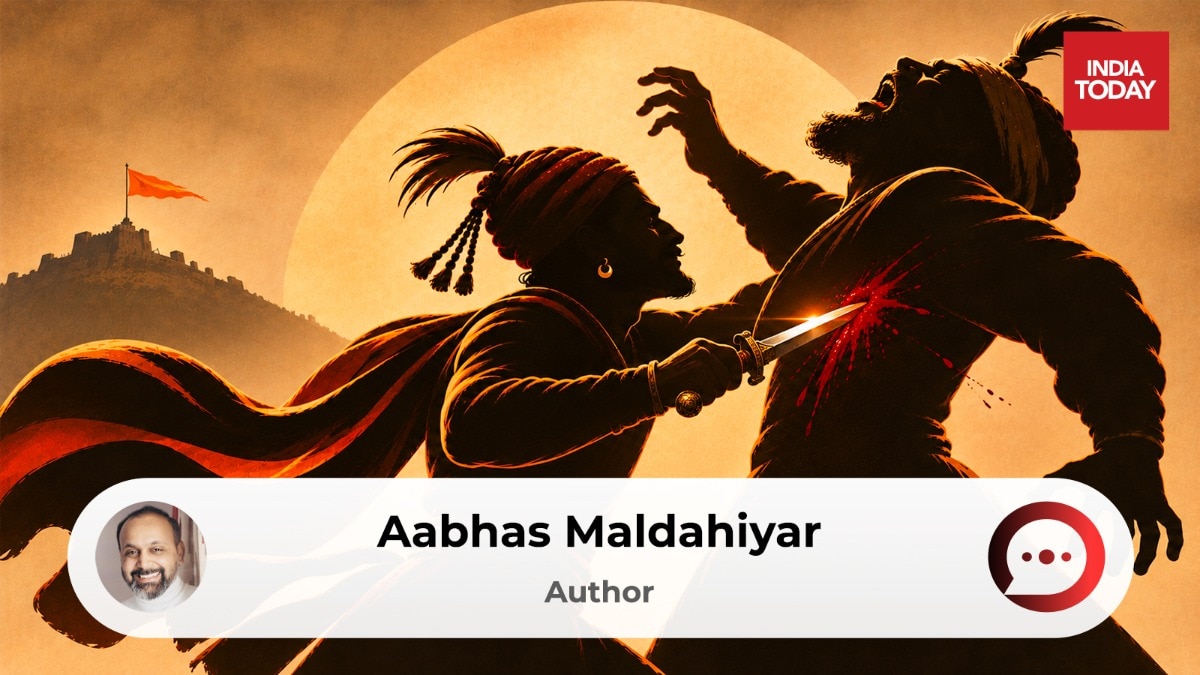
Come, embrace me," Khan added.With these words, Khan drew Shivaji's neck beneath his left arm and struck his side with a dagger. Quick and agile, Shivaji broke free from his grasp, parried the blow, and drove his own sword into the Khan's stomach.Stunned by the wound, the Khan tried to hold back his spilling entrails and cried out that he had been slain.
At once, his servant rushed towards Shivaji, Khan's sword raised to strike. Khan had brought this man into his entourage knowing that Shivaji would never kill a Brahmin.
Shivaji parried the blow and, wielding his patta, cleft Khan's head in two.Thus, at noon on Thursday, 10 November 1659, Shivaji slew Afzal Khan, the enemy of the Devas.WHAT HAPPENED TO AFZAL KHAN'S MEN AFTER SHIVAJI KILLED HIM?In the confusion that followed, another figure briefly enters the record: a Brahmin in Afzal Khan's service. The Shivabharat says that one of the Khan's Brahmin servants attacked Shivaji, but gives neither his name nor his fate.
Later sources identify him as Krishnaji Bhaskar, though their accounts conflict.Some manuscripts of the AK Chronicle state that Krishnaji struck at Shivaji and missed, whereupon Shivaji spared him because he was a Brahmin. Another version says that Krishnaji did attack, but Shivaji refused to kill him on account of his Brahmin status; Jiva Mahala, it claims, dealt the fatal blow.The truth is difficult to recover.
The killing of a Brahmin was regarded as a grave sin, and Shivaji was not untouched by the religious beliefs of his age (for the broader belief, see Shivacharitra-Sahitya, vol. I, nos.
15, 48; Cosme da Guarda, in Surendranath Sen, ed., Foreign Biographies of Shivaji, 102; Marhycy Itihsc Sdhane, vol. VIII, no.
24). Yet beneath that tent, there was little room for such calculations.
Afzal Khan had already attacked Shivaji, and violence had erupted around them. It is therefore difficult to imagine Shivaji consciously sparing an armed assailant merely because he was a Brahmin.Perhaps Krishnaji Bhaskar was killed by another hand, and the latter writers turned the circumstance into a story of deliberate restraint.
Only one version explicitly says that he survived. Against it stands the silence of the Shivabharat, the earliest and most important narrative of the encounter.
On balance, Krishnaji Bhaskar probably did not survive.But there was scarcely time to consider the dead.The moment Afzal Khan fell, 10 of his men rushed towards Shivaji: Abdul Sayyid, Bada Sayyid, Rahim Khan — Afzal Khan's nephew —Pahlawan Khan, four other Muslim guards, and Pilaji and Shankaraji Mohite.Shivaji met them with a sword and a patta. His own 10 guards rushed forward: Sambhaji Kawji, Kataji Ingale, Kondaji Kank, Yesaji Kank, Krishnaji Gayakwad, Suryaji Kakade, Jiva Mahala, Visaji Murumbak, Sambhaji Karwar and Siddi Ibrahim, an Abyssinian Muslim.For a few violent moments, Shivaji's life depended upon the men around him.
Bada Sayyid moved to strike, but Jiva Mahala cut him down before the blow could fall. Shivaji's guards then descended upon Afzal Khan's remaining bodyguards in the furious melee that followed, according to Shivabhrata.The meeting had begun with ceremony and professions of courtesy.
Within minutes, Afzal Khan was dead.The private encounter was over, and the battle had begun.HOW DID THE KILLING OF AFZAL KHAN ELEVATE SHIVAJI INTO A LEGEND?Sabhasad records as below on what followed. "The Raja [Shivaji] himself slew the Khan in single combat — a man who was a veritable Duryodhana, as formidable in bodily strength as he was wicked at heart. Just as Bhima had slain his adversary single-handed, so too did the Raja.
Shivaji Raja was Bhima himself; it was he who slew Afzal. Such a deed could not have been accomplished by an ordinary mortal.
Surely, he was an incarnation, and only thus could he have performed such a feat. Victory was won."Adnyandas carried the vision further (Aitihsik Powe, pt.
I, 22). Shivaji, to him, was no ordinary mortal raised by courage or fortune, but a divine force sent for a purpose.
In his struggle echoed an older sacred war: as Rama had stood against mighty Ravana, Shivaji rose alone against overwhelming odds.Three hundred and sixty-seven years later, the arguments over every weapon, every blow and every moment beneath that tent continue. History may never recover every detail.
But it cannot erase what followed. At Pratapgad, a young ruler confronted a vastly more powerful adversary who had come to crush him, and Afzal Khan did not return.For Shivaji's contemporaries and those who came after them, Afzal Vadh became more than the death of a general.
It became the moment when defiance ceased to be a gamble and became a force. Perhaps that is why Maharashtra has never forgotten the day.
Empires possessed armies, wealth and power. Shivaji possessed a mountain, a handful of loyal men, the will to refuse surrender, and last but not the least — the blessings of Maa Bhawani.On 10 November 1659, history did not just record a death, it witnessed the prologue of a legend.- Ends(Aabhas Maldahiyar is the author of Babur: The Quest for Hindustan.
Views expressed in the piece are those of the author)