


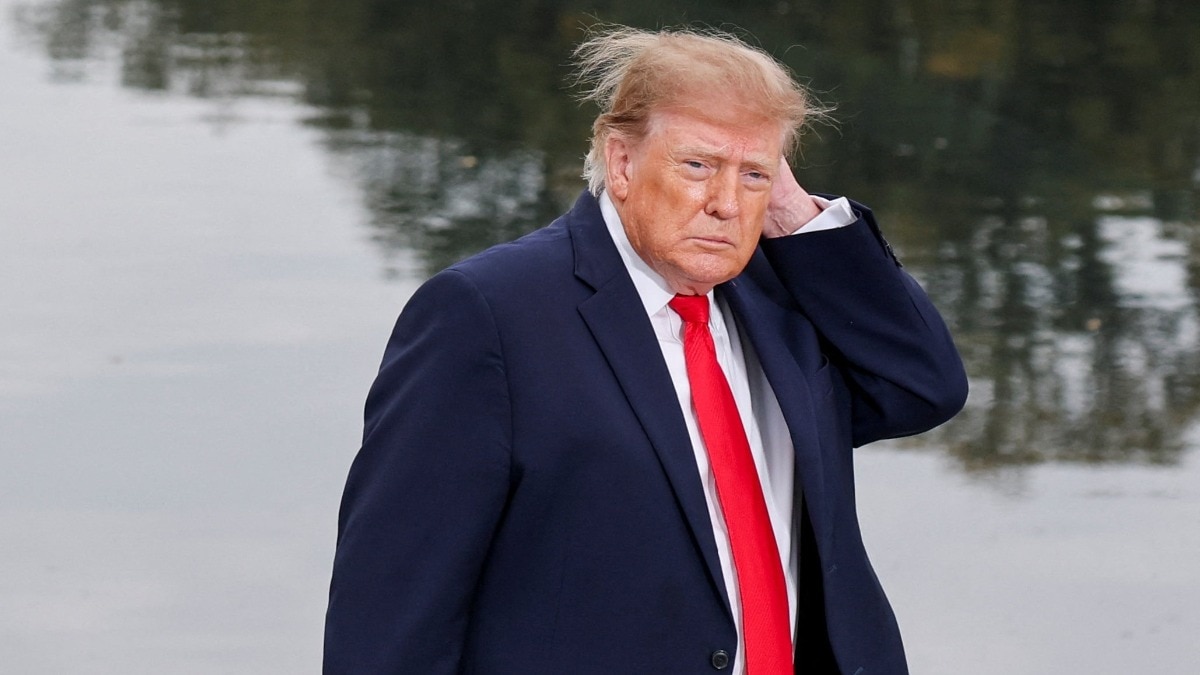
The decisions followed an earlier intervention by the US Supreme Court, which swiftly rejected the administration's request to step into a Justice Department lawsuit seeking to prevent California from counting mail-in ballots from more than 20,000 people whom the government suspects may not be US citizens.US President Donald Trump (Reuters)Federal judges have dealt a series of legal setbacks to US President Donald Trump's administration over its efforts to tighten scrutiny of voter eligibility, blocking several attempts to pressure state election officials over alleged noncitizen voting just hours before polling began in the US midterm elections on Tuesday.The court rulings came after months of efforts by the administration to crack down on what Trump and his allies describe as widespread voting by non-US citizens. However, evidence suggests that such instances are extremely rare, while judges have repeatedly questioned the administration's authority to intervene in state-run election processes.With Republicans seeking to retain their majorities in both chambers of Congress, the administration had stepped up its efforts to identify suspected noncitizens on voter registration lists.
But its campaign has faced mounting resistance in federal courts, which have ruled that election administration falls primarily under the authority of individual states, as stipulated by the US Constitution.Courts have also raised concerns about inaccuracies in the administration's lists of suspected noncitizen voters, warning that they could result in eligible voters, including naturalised American citizens, being wrongly prevented from casting their ballots. COURTS BLOCK TRUMP ADMINISTRATION'S DEMANDS TO STATESThe latest setbacks came on Monday, when two federal judges in Washington issued separate orders restricting the administration's actions in California and other states.One judge barred the administration from directing California election officials not to count ballots received from individuals named on a list of suspected noncitizens.
Another prohibited the federal government from distributing such lists to election officials in any state. The decisions followed an earlier intervention by the US Supreme Court, which swiftly rejected the administration's request to step into a Justice Department lawsuit seeking to prevent California from counting mail-in ballots from more than 20,000 people whom the government suspects may not be US citizens.Reacting to the developments, David Becker, executive director of the nonpartisan Center for Election Innovation and Research, which advises election officials, said the judiciary had reinforced the constitutional authority of states over elections."The Supreme Court joined federal courts across the country in reaffirming state sovereignty," Becker said."Every time the administration's claims regarding noncitizen voters have been subjected to any sort of scrutiny, they have immediately fallen apart."JUSTICE DEPARTMENT VOWS TO CONTINUE EFFORTSThe Justice Department expressed disappointment over the Supreme Court's decision but maintained that it would continue pursuing measures to enforce federal voting laws.Department spokesperson Kiersten Pels said, "But this is not the end of our efforts.""We are deploying election monitors in California and across the country to observe compliance with federal law, charging election fraudsters daily, and will pursue other legal avenues to ensure that only eligible American citizens vote," she added.However, not all the court decisions have gone against the administration.On Tuesday, the 9th US Circuit Court of Appeals, in a 6-5 decision that split along ideological lines, overturned a lower court order that had barred the administration from threatening election officials with prosecution if they failed to comply with its demands concerning suspected noncitizen voters.Pels welcomed the ruling, saying it "recognised our important and lawful efforts to protect the integrity of our elections."In another development, a federal judge in Washington late on Monday rejected a request by the National Association for the Advancement of Colored People (NAACP) to prevent the Justice Department from deploying federal law enforcement personnel as election monitors.The judge based his decision on assurances from the department that any monitors drawn from federal law enforcement agencies would be unarmed and dressed in business-casual clothing.Pels dismissed concerns over the deployment, describing suggestions that federal law enforcement personnel would be present at polling stations as "fearmongering".ALASKA SENATE RACE FACES SEPARATE LEGAL CHALLENGEMeanwhile, another legal battle involving the administration remains unresolved in Alaska, where the Justice Department has asked an appeals court to revive its lawsuit seeking to block certification of the Senate election result if Republican incumbent Dan Sullivan loses by a narrow margin.The department has argued that voters could be confused because another candidate contesting the same election has a name identical to that of the senator.The legal challenges are part of Trump's broader campaign against what he claims are widespread irregularities in US elections.
The president has repeatedly, and falsely, maintained that fraud cost him victory in the 2020 presidential election.His allies subsequently filed more than 60 lawsuits challenging the outcome of that election, but none succeeded.- EndsWith inputs from