


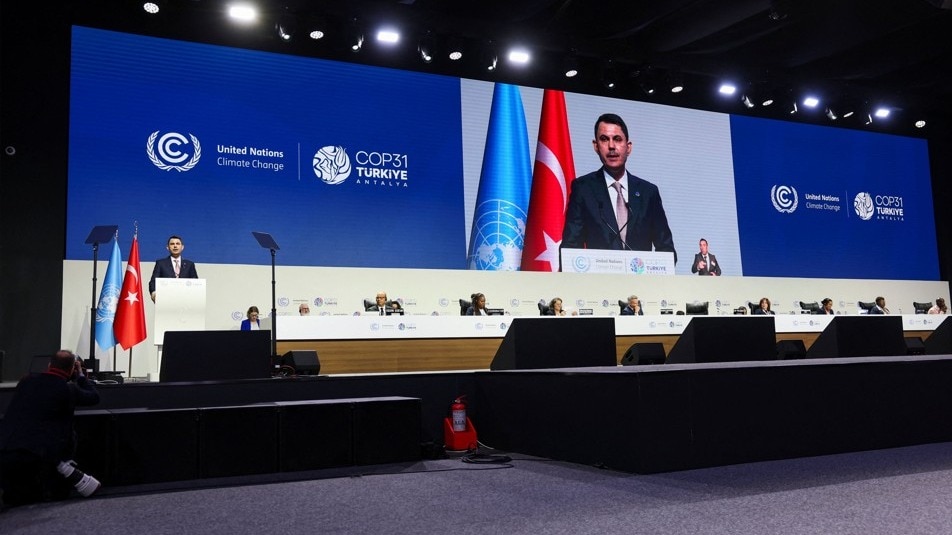
Australia and Turkey assumed the COP31 presidency as vulnerable nations pressed their climate demands. The opening exposed unresolved divisions over adaptation finance, emissions cuts and the 1.5°C limit.President of COP31 Murat Kurum of Turkey delivers a speech during the opening ceremony of the UN Climate Change Conference (COP31) in Antalya, Turkey, November 9, 2026. (Photo- Reuters)The first day of COP31 in Antalya ended with renewed calls for urgent climate action, increased adaptation finance and stronger measures to protect vulnerable communities, as Australia and Turkey formally took over the summit's presidency.Negotiators worked late into the night to finalise the conference agenda, with the inclusion of the Climate Finance Work Programme emerging as a key development.
However, disagreements over adaptation finance and the threat of global warming exceeding the 1.5°C threshold remained unresolved.The opening day saw Nepal call for mountain-related climate risks to be prioritised, African nations push for greater financial support, and Pacific representatives insist that the world must maintain its commitment to the 1.5°C temperature limit.AUSTRALIA AND TURKEY TAKE OVER COP31 PRESIDENCYCOP31 opened with a formal handover from the outgoing Brazilian leadership to the incoming joint presidency of Turkey's Murat Kurum and Australia's Chris Bowen. The ceremony brought together outgoing COP President Andr Aranha Corra and the incoming leadership duo.
It was marked by handshakes, embraces and expressions of diplomatic goodwill, signalling cooperation as the two countries prepare to steer negotiations.However, several delegates, observers and media personnel were reportedly left waiting outside the venue for accreditation badges as the opening ceremony got underway. The delay meant many participants missed the initial moments of the proceedings.
The joint leadership faces the challenge of building consensus among countries with competing priorities on emissions reductions, climate finance and adaptation.NEPAL CALLS FOR MOUNTAIN COMMUNITIES TO BE PRIORITISEDOne of the key interventions on the opening day came from Nepal, which urged COP31 to place mountain-related climate risks at the centre of global climate negotiations.Speaking to journalists, Nepalese Member of Parliament Sagar Dhakal warned that the summit could not conclude without meaningful attention to the growing threats facing mountain communities.Dhakal highlighted the devastating consequences of glacier-related disasters, describing a catastrophe in which, according to his account, around 10,000 people were lost within 10 minutes following a glacier collapse. He also claimed the disaster wiped out approximately 10 per cent of Nepal's GDP.His remarks highlighted the risks posed by glacier instability, glacial lake outburst floods and other climate-related hazards.Nepal called for greater attention to early warning systems, adaptation measures and financial support to protect mountain ecosystems and vulnerable communities.AFRICA GROUP SECURES CLIMATE FINANCE WORK PROGRAMME ON AGENDAThe Africa Group's negotiating team held overnight discussions to resolve disagreements surrounding the summit's agenda, eventually securing the inclusion of the Climate Finance Work Programme.The development marks a procedural breakthrough for African countries, many of which face escalating climate impacts while having limited resources to invest in adaptation and resilience.However, discussions on tripling adaptation finance remained a major sticking point.African nations have consistently called for predictable and accessible financial support to address the impacts of droughts, floods, extreme heat and food insecurity.HIGH AMBITION COALITION WARNS AGAINST CLIMATE OVERSHOOTThe High Ambition Coalition warned that COP31's success would depend on how effectively countries address the threat of global temperatures exceeding the 1.5°C threshold.The coalition called for stronger emissions reductions and measures to limit the scale and duration of any temperature overshoot.At a press conference, German Climate Minister Heike Henn stressed the need for science-led decisions and greater support for vulnerable countries."We need to listen to the science," Henn said, while warning that support for vulnerable countries was "not good enough".Her remarks highlighted concerns that current global emissions trajectories remain insufficient to meet the Paris Agreement's temperature goals.PACIFIC ENVOYS DEMAND UNCOMPROMISING COMMITMENT TO 1.5°CPacific representatives issued a strong warning against weakening the global commitment to limit warming to 1.5°C.The envoys highlighted the threats posed by rising sea levels, ocean warming and coastal erosion to island nations and their communities.They argued that temporarily exceeding the temperature threshold could have devastating consequences for vulnerable ecosystems and populations.The representatives also called for faster emissions reductions, an accelerated transition to renewable energy and increased climate finance through regional mechanisms, particularly the Pacific Resilience Facility.They further urged negotiators to place the ocean at the centre of global climate discussions, citing its importance to food security, livelihoods, biodiversity and cultural identity.THE BIG PICTURECOP31's opening day reflected the growing divide between the urgency of the climate crisis and the pace of international negotiations.While the inclusion of the Climate Finance Work Programme marked progress, unresolved disagreements over adaptation finance highlighted the challenges facing the summit.Nepal's appeal for mountain communities, Africa's demand for financial support and the Pacific's insistence on defending the 1.5°C target underscored the priorities of climate-vulnerable nations.The coming days will test whether the joint presidency of Australia and Turkey can translate diplomatic goodwill into concrete commitments on emissions reductions, climate finance and adaptation.- Ends