


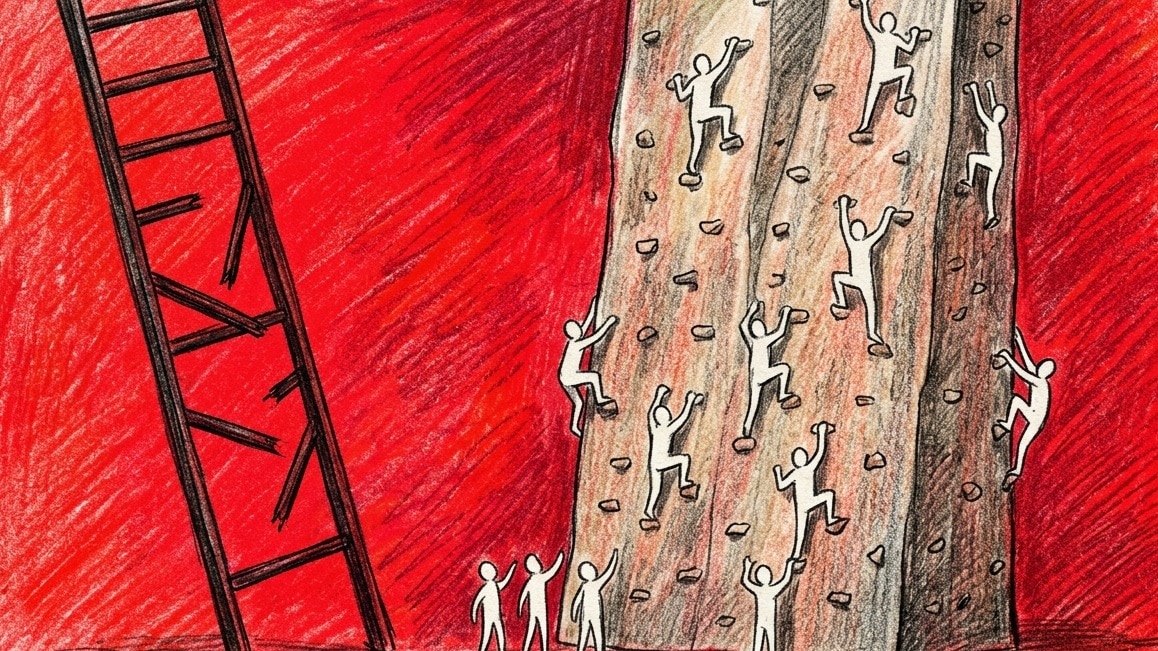
AI is changing how employees build careers, earn promotions and gain experience. As traditional corporate ladders give way to more flexible career paths, the big question is whether everyone gets an equal chance to climb.
Your next promotion may not be upwards. How AI is changing career growth (AI-generated image) For decades, professional success followed a relatively familiar route.
Employees joined organisations in junior positions, gained experience, moved into senior roles, and eventually climbed into management. The next promotion, salary hike, or leadership position was often seen as the natural reward for years of experience.Artificial intelligence (AI) could be changing that equation.As companies automate routine tasks, restructure teams and place greater emphasis on specialised skills, the traditional corporate career ladder is becoming less predictable.
Employees may increasingly have to move sideways, take on unfamiliar responsibilities, switch departments or acquire entirely new skills to progress.On November 2, Microsoft's chief economic opportunity officer Aneesh Raman described the emerging workplace model as a "climbing wall", where employees chart their own career paths based on their skills, interests and opportunities, as reported by Fortune. But while this could offer greater flexibility, it also raises an important question: are employees being given more ways to grow, or are they increasingly being left to figure out their careers on their own?THE TRADITIONAL CAREER LADDER IS LOSING ITS RUNGThe idea that employees must spend several years in one position before moving up is gradually being challenged.
As AI changes job responsibilities, companies are increasingly looking at what employees can do rather than simply how long they have occupied a particular designation. This also means that career progression may not always involve a promotion.
Moving into another department, managing a new project, acquiring expertise in AI or taking up a specialised role could become alternative ways of advancing professionally.The shift is reflected in India's changing employment landscape. A recent report on India's AI skills gap highlighted how employers are increasingly seeking specialised AI capabilities even as hiring demand weakens in some AI-exposed occupations.The implication is significant: professional experience alone may no longer guarantee the same opportunities for advancement.WHEN AI TAKES AWAY THE FIRST FEW STEPSHowever, there is another side to this transformation.
The traditional career ladder did more than offer promotions. It also gave employees time to learn.Entry-level professionals traditionally gained experience through routine assignments, research, documentation, basic coding and administrative work.
These responsibilities helped them understand workplace processes before taking on more complex tasks.AI is changing that learning curve.India's entry-level job market is already showing signs of pressure. A recent analysis of India's fresher job market found that postings for junior and entry-level positions fell 11% in the second quarter of 2026, compared with a 5% decline in overall job postings.The problem is not simply that fewer entry-level opportunities may be available.
It is also about how young professionals will acquire the experience needed to move into senior positions if routine learning assignments increasingly become automated.THE NEW CAREER ADVANTAGE: SKILLS, NOT JUST TENUREAs the workplace changes, employees may have to become more comfortable with continuous learning. Being good at one particular job could no longer be enough if the responsibilities attached to it keep evolving.This is particularly important in India, where access to specialised training and workplace experience remains uneven.The IMF findings on India's AI skills gap point to an emerging divide between workers who can access specialised AI opportunities and those whose skills are becoming less aligned with employer demand.For employees, this could mean building expertise across functions, learning to work with AI tools and demonstrating the ability to solve problems beyond their immediate job descriptions.BUT WHO GETS TO CLIMB?A climbing wall sounds exciting because it offers multiple routes to the top.
But not every employee starts from the same position.Workers with access to training, supportive managers, mentorship, and challenging assignments may find it easier to navigate different career paths. Others could struggle to identify opportunities, particularly in organisations where promotion criteria and internal mobility remain unclear.This is also where employers have a responsibility.
Greater flexibility cannot become an excuse for making career progression entirely the employee's problem.Companies will need transparent promotion policies, structured learning opportunities and clear internal mobility programmes. They must also ensure that AI adoption does not remove the entry-level experiences that help develop future leaders.The corporate career ladder may not disappear overnight.
But its familiar steps could become less relevant as AI reshapes how work is organised.The real challenge will be turning this new climbing wall into an opportunity for more employees, rather than a workplace where only those with the right skills, networks and resources can find their way up.- Ends